Reported by
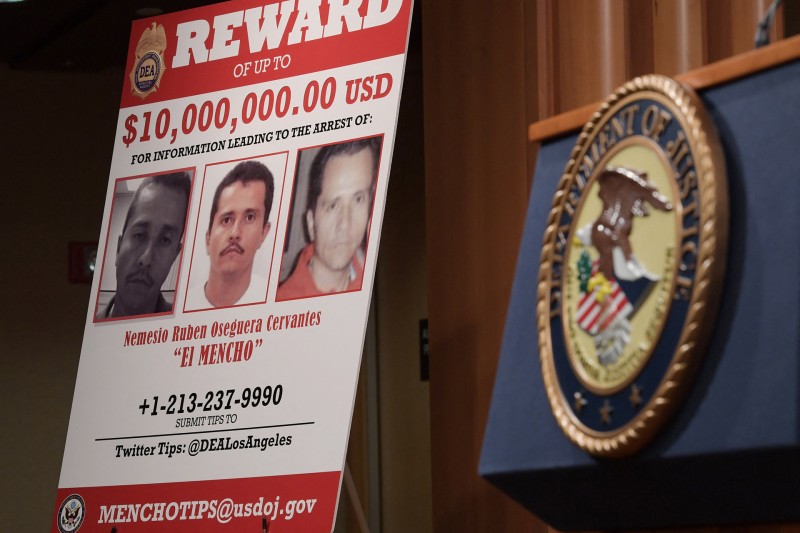
A day after the Mexican military killed Nemesio “El Mencho” Oseguera Cervantes, the leader of one of the country’s most powerful drug cartels, U.S. President Donald Trump claimed credit for his administration.
“We’ve also taken down one of the most sinister cartel kingpins of all — you saw that yesterday,” Trump told Congress on February 23, 2026.
Months of intense pressure including tariff threats had borne fruit: a Mexican special forces operation supported by U.S. intelligence resulted in a high-profile political win for both Trump and his Mexican counterpart, President Claudia Sheinbaum.
But if the study of the U.S. drug war in Latin America reveals anything, it’s that killing or capturing cartel bosses — known as the kingpin strategy — fails to break drug supply chains. That’s because backers of the strategy fundamentally misunderstand the character of modern organized crime groups.
The removal of a cartel boss like El Mencho often results in what researchers describe as the “hydra effect,” a reference to the Greek mythological hero Heracles’ difficulty in slaying the hydra, a venomous serpent.
For every head Heracles cut off, two new ones sprouted from the wound.
“It’s very much the American narrative that organized crime groups are pyramidal organizations led by a supreme leader who controls everything,” said Adrián López Ortiz, director general of the Sinaloa newspaper Noreste.
Modern organized crime behaves more like a network, or grand spiderweb, he said.
Despite Mexican authorities taking out dozens of cartel leaders since the drug war began in 2006 — often at the behest of, under pressure from, or in coordination with their U.S. counterparts — the street price and purity of drugs like cocaine and methamphetamine in the U.S. has remained relatively stable or fallen.
Drug overdose deaths — a crude but important metric of drug use in the U.S. — saw a decade-long rise from 2014, according to the U.S. Drug Enforcement Agency (DEA).
Most recently, several different interventions, including a supply-side disruption of precursor chemicals, appear to have reversed the trend, pointing to a more effective set of policies.
“As far as the impact on trafficking goes, the kingpin strategy is largely symbolic,” said Genevieve Kotarska, an associate fellow at the Royal United Services Institute, a U.K.-based security think tank.
Meanwhile, the relative stability provided by powerful cartels, known as “pax mafiosa,” is often replaced by the violent chaos of organizations breaking up into smaller groups. They become more violent as they compete over strategic trafficking routes and local rackets, security analysts say.
“Pax mafiosa is the sort of relative appearance of peace that can exist under an organized criminal group, but it requires a level of stability and strong leadership that the kingpin strategy inherently undermines,” Kotarska told OCCRP.
Absent a smooth handover of power, groups splinter and violence is unleashed.
“The strategy of extracting and capturing leaders has only served to justify government strategies and reduce geopolitical tension,” said Darwin Franco Migues, the general coordinator of Jalisco-based investigative journalism platform ZonaDocs.
Removing a leader doesn't work, because the structure remains untouched, Franco said.
“It is clear that it is a useless tool for dismantling criminal groups or reducing their control over communities,” said Catalina Niño, a Latin America security expert at the Friedrich-Ebert-Stiftung, a German think tank.
“It has been pushed because it is easy to sell to a public that generally demands a heavy-handed response, and in that sense, it yields political gains.”
To better understand what happens when a cartel leader is taken out, OCCRP examined the data, and asked Mexican journalists, regional analysts, and a Colombian former presidential advisor to explain how this scenario unfolds.
Rise in Homicides
In the hours after El Mencho’s killing, hundreds of burning roadblocks were erected across the country, creating a sense of national panic.
But in the days and weeks since, relative calm has returned to Jalisco.
“There’s this tense calm, in which the government is trying to maintain the impression that everything is normal,” said Franco.
“But what people are actually experiencing is that they’re waiting for something to happen.”
Research suggests the sense of foreboding is justified.
A 2015 research paper by the Institute for the Study of Labor Economics, a German non profit, examined the effects of the kingpin strategy and included an analysis of homicide rates in Mexico. Researchers found that the capture of a leader of a drug trafficking organisation in a municipality increases its homicide rate by 80 percent, and that this effect persists for at least twelve months.
Examples abound.
When Mexican President Felipe Calderón launched his so-called war on drugs in December 2006, the Sinaloa Cartel was in an alliance with another drug trafficking group, the Beltrán-Leyva Cartel.
Calderon’s first “kingpin” arrest came in January 2008, with the detention of Alfredo Beltrán Leyva, a senior figure in the Beltrán-Leyva cartel.
His detention led to the rupture of the alliance, a bloody conflict between the two groups, and an immediate spike in the national homicide rate, according to the NBER study.
From that month on, murder rates continued to climb, and by the end of 2010 were 150 percent higher than they had been before the government launched the drug war, the study shows.
The same trend was observed after Eduardo Arellano-Felix, leader of the Tijuana Cartel, was arrested in Tijuana, Baja California state, in October 2008. His cartel split into two rival factions, leading to a rise in local homicides, according to data in the study.
Rubin Martin, a seasoned independent journalist from the Jalisco state recalls how the death of Ignacio “Nacho” Coronel Villareal, a founder of the Sinaloa Cartel in July 2010, also led to a period of intense unrest.
“The death of Ignacio Coronel involved a restructuring of the companies and of the criminal economy here in Jalisco, and what we saw was truly a period of intensification of violence,” Martín said.
“We began to see bodies in bags, people murdered with a message written on a piece of cardboard pinned to their chest, or with their testicles or penis stuck into their mouth to send a message of violence. This [was] performative violence.”
In total, the Institute for the Study of Labor Economics paper estimated that kingpin captures led to an additional 11,626 homicides in Mexico between 2007 and 2015.
“The effects of these kingpin captures can explain 36 percent of the 130 percent increase in the homicide rate (or approximately a quarter) between 2006 and 2010,” the study found.
Splintering Organizations
As the Mexican government captured or killed more leaders, other alliances and major cartels like Los Zetas, La Familia Michoacana, and the Gulf Cartel continued to fracture into smaller groups.
In other words, instead of defeating criminal groups, the kingpin strategy multiplied them.
In the decade after 2010, the number of criminal groups in Mexico exploded from 76 to 205, according to an analysis by the International Crisis Group, which developed a dataset of criminal groups by drawing on the country’s narcoblogs.
“Crisis Group’s data show a clear correlation between the number of groups present in a municipality and the average per capita murder rate,” the ICG wrote in a report.
“Violence continues to increase broadly in step with the number of additional groups.”
Jane Esberg, assistant professor of political science at the University of Pennsylvania, put together the ICG analysis.
“One of the major causes of violence in criminal conflict is turf wars and contestation between criminal groups,” Esberg told OCCRP.
“When a single group is in charge, it deters weaker challengers, who might consider their odds pretty bad. That's not to say strong criminal groups don't cause their own problems, but as a general rule there is often less violence when control over a territory isn't contested.”
It’s a phenomenon that’s repeated itself in the three decades since the DEA first developed the kingpin strategy to confront Colombian drug trafficking networks in the early 1990s.
In December 1993, police killed Pablo Escobar, the leader of Colombia’s Medellín Cartel. Two years later, they arrested the two brothers leading the Cali Cartel, who had become the dominant trafficking organization in Colombia following Escobar’s death.
“The organizations immediately began to fight over whatever they wanted and ended up splitting,” said Hugo Acero Velásquez, a former presidential advisor during the peace accords in that era, and the former secretary of security for Bogotá.
“We went from personal organizations led by one person, a family or a specific clan, to highly organized corporations with many heads,” Acero said.
This approach has failed to dent long term cocaine production, which increased around 2,800 percent to 2,664 metric tons in 2023, the latest year data is available, up from an estimated 92 metric tons in 1990, according to the United Nations Office on Drugs and Crime (UNODC).
Similarly in Mexico, the approach has yet to break the supply chains funneling narcotics north to the U.S..
The Monitoring and Support Project for the Global Illicit Flows Programme, a project run by RUSI Europe in partnership with the European Union, reported last year that the “removal of high-level criminal actors, while important, appears to have limited impact on the market overall or supply trends, beyond displacement of commodity flow routes.”
Makeshift Crematoriums
As criminal groups have fragmented, the type of violence has also evolved alongside the way the government reports it.
When Franco, the ZonaDocs coordinator, moved to Jalisco’s state capital Guadalajara in 2008, he didn’t feel the level of crime. That changed in 2010, he said.
That year, the death of Sinaloa cartel leader Coronel, and the resulting crumbling of that group’s alliance with the Milenio Cartel triggered a bout of executions, but also the rise in a less visible kind of violence: kidnappings and forced disappearances.
“It was in that period that the disappearances of people in Jalisco began to grow, until we arrived to where we are today, which is the capital of disappearances in all Mexico,” said Martín, the other journalist in Jalisco.
“Even though the areas, neighborhoods, times, and the modus operandi are known, there hasn't been any real action by the authorities to reduce them.”
Last year a collective of citizens looking for missing relatives found human remains, piles of clothes, hundreds of shoes, ashes and alleged makeshift crematoriums at a ranch turned forced labour camp in Jalisco, which the attorney general said was controlled by people linked to El Mencho’s CJNG.
Local authorities had previously secured the ranch without cataloging or successfully investigating the remains.
To complicate things further, in recent years the government has begun to reclassify many intentional murders under other categories.
Security analysts and human rights organizations say this has created a statistical mirage of success, with the numbers “massaged” to artificially lower the homicide rate for political gain.
Although official murder rates in Jalisco between 2024 and 2025 actually fell by around one third, manslaughter and femicides each saw increases of 7.6 and 3.2 percent, respectively, according to a report by Mexico’s Ibero-American University.
Meanwhile, disappearances exploded by 231%.
Following the rupture within the Sinaloa Cartel, a similar pattern is now repeating in that state.
“[In 2011], we had barely any disappeared people, and now we have more disappearances than homicides,” said López from newspaper Noreste.
In Sinaloa, for the year 2025, reports of missing persons overtook homicides, reaching approximately 2,400, according to an analysis by México Evalúa, a think tank.
López also points to a sharp rise in other crimes, such as car theft, robberies, rape and arson, as well as the displacement of citizens by the ensuing territorial violence.
“We have many rural zones, [...] where they have completely abandoned villages because the people were displaced,” López said. “They’ve become ghost towns. They’re in complete dispute between the factions.”
Ultimately, the drug war’s focus on kingpins rests on a mischaracterization of these groups, he said.
“Every time that you take a node out, those relations reconfigure themselves.”
Paradoxically, until his killing, El Mencho had actually benefited from the kingpin strategy as various rivals were removed by security forces and he was able to consolidate power, said Kotarska from the RUSI think tank.
“One of the things that we've seen historically and contemporarily in Mexico and elsewhere is the links between cartels and political and economic elites. The kingpin strategy does very little to undermine those.”
The enduring question for Mexico is not just who will take over El Mencho’s business, but why the state fails to tackle the network of elites supporting it.