Reported by
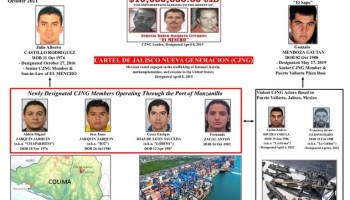
On Sunday, February 22, the streets of the Mexican city of Puebla were bustling with costumed carnival dancers when word spread that one of the country’s most powerful organized crime leaders, “El Mencho,” had been killed in a shootout with the military around 800 kilometers away.
Within minutes, social media was flooded with shocking reports and images: El Mencho’s Jalisco New Generation Cartel (known by the Spanish acronym CJNG) erecting hundreds of roadblocks and setting fire to vehicles; a passenger plane, banks, businesses, supermarkets, fuel stations and a church torched; gunmen taking over Guadalajara airport.
In Puebla, a rumor of a shooting and a burning vehicle sparked panic. People hid behind shuttered market stalls and the carnival was abandoned.
“We all ran to our homes to hide,” said Mariana Ávila, who had come down to the neighborhood to watch the dancers.

A view of the location where Mexican Army troops killed Nemesio Oseguera Cervantes, known as “El Mencho,” head of the Cartel Jalisco Nueva Generacion, during a federal operation in Guadalajara on February 22, 2026.
But while it was true that highways were blocked and cars were burning in 20 of Mexico’s 31 states, not all the chaos was real.
Whereas two decades ago the CJNG may have hung a banner on an overpass to spread their message, online trolls connected to organized crime syndicates now use a mixture of spectacle and disinformation to pump fear straight into people’s phones.
The cartel’s online response to the killing of their boss, whose real name was Nemesio Oseguera Cervantes, was the most powerful example yet of how propaganda — and disinformation — can be spread by social media accounts that experts believe to be linked to Mexican criminal syndicates.
According to Alberto Escorcia, a Mexican journalist specializing in disinformation and artificial intelligence, it is common for these accounts to share fake, misleading, or AI-generated images of violence alongside real ones.
“It was amplified to appear as though the whole country was on fire, and the truth is that it wasn’t,” Escorcia said.
The gunfire in Puebla turned out to be a false alarm, as was the claim that armed men had taken over Guadalajara airport.
A widely shared photo of a burned-out passenger plane on a runway was debunked as fake, as was another of the main church ablaze in the beach resort of Puerto Vallarta.

A screenshot of a widely-circulated image of a burning plane that fact-checkers debunked as fake.
In the southern city of Mérida, an alert from the public transport authority announcing that services had been suspended also turned out to be bogus.
Escorcia immediately traced a significant number of these false images back to three X accounts that, through his years of research, he believes are connected to the cartel.
“What the Jalisco Cartel trolls do is generate a critical mass. They know how to game the Twitter [X] algorithm,” Escorcia told OCCRP.
Mexico’s security minister Omar Garcia Harfuch said authorities were investigating whether organized crime was behind “numerous” online accounts they had identified as “spreading lies” during the crisis.
More opportunistic accounts not linked to crime groups, including right-wing handles in Mexico and the United States, also fanned the flames, circulating the images and messages further afield.

Social media posts sharing photographs and news about violence in Mexico that was later debunked as AI-generated and photoshopped misinformation.
The Evolution of Narco Propaganda
When President Felipe Calderón launched the so-called “war on drugs” in 2006, the primary way that organized crime groups communicated with the broader public was by hanging large banners known as “narcomantas” from overpasses or in other highly visible public spaces. Journalists would then flock to the sites to photograph and report on the banners, spreading the messages of the crime groups far and wide.
“Narcomantas worked really effectively [in the age of] print and TV,” said Philip Luke Johnson, a political scientist and professor at Flinders University in Australia who studies how organized groups communicate with the public.
By the end of the decade, Mexican criminal groups had moved online to broadcast announcements such as the imposition of curfews on towns they controlled, or gory videos of beheadings and torture.
Meanwhile, dedicated narco blogs and webpages maintained by anonymous citizen journalists flourished, helping fill the information void in areas that were simply too dangerous for local reporters to cover.
The 2023 emergence of a video showing five kidnapped teenagers — one forced to murder his friend — marked a horrific watershed in the weaponization of digital content. It wasn’t clear who was responsible for the brutality or uploading it, but it sent shockwaves across the country.
“That was when journalists were saying that [their job shouldn’t be] just going around finding narcomantas on fences anymore,” Johnson says. “[Propaganda] gets into people’s inboxes, it gets on WhatsApp, where it spreads more rapidly and organically.”
One early incident of disinformation about narco violence translating into real-world terror was in September 2012, when videos circulated on social media showing scenes of mass hysteria in different parts of greater Mexico City.
“These incidents were fueled by rumors that armed members of the Familia Michoacana cartel, traveling in pickup trucks, were attacking businesses and firing shots into the air,” said Paloma Mendoza-Cortes, a senior analyst at PHLX Consulting.
The rumors led to the suspension of classes in some schools, and residents even claimed that a curfew had been imposed, which never actually happened, she said.
Cartel messaging is most effective when there are few other sources to rely on.
As the events unfolded on Sunday, the government provided little clear information, allowing disinformation, misinformation and AI imagery to pour into the vacuum.
Mexico's security ministry posted on X that Jalisco State’s commercial centers were unaffected by the outbreak of violence, just as malls were announcing that they had closed over security concerns.
In Puebla, where roadblocks had appeared on highways, the state government claimed that schools would be closed only because of “strong winds.”
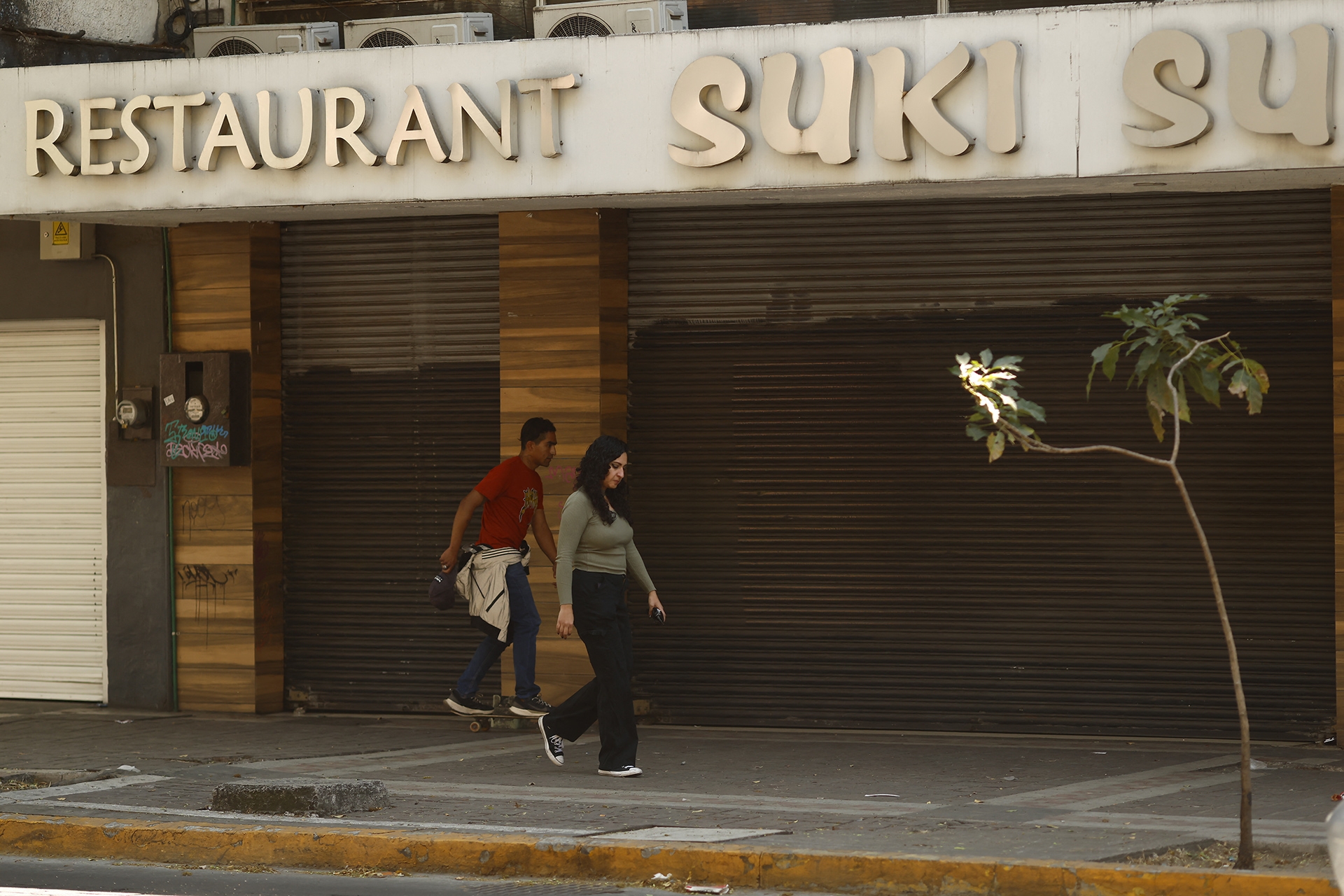
Businesses in Guadalajara temporarily shut down in the wake of violence by the Jalisco New Generation Cartel.
Burning Roadblocks
While the photo of Puerto Vallarta’s burning church had been created by Google Gemini, an AI platform, other images of the city engulfed by columns of black smoke from the vehicles that CJNG members set ablaze were real.
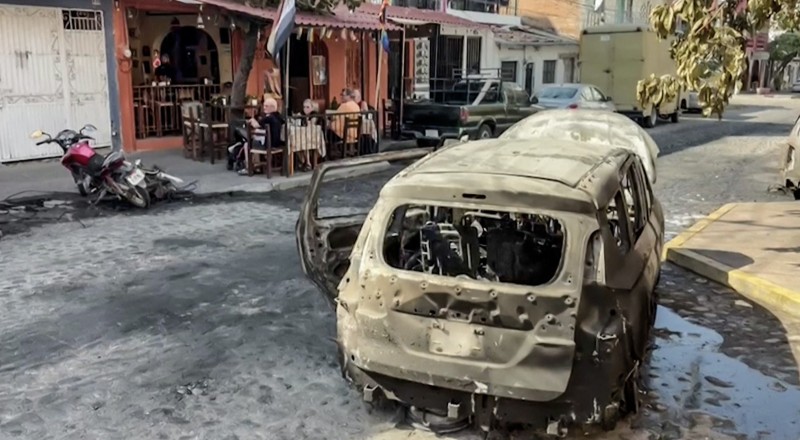
Setting up fiery roadblocks is by now a well-trodden tactic used by Mexican criminal groups to get public attention and make a scene .
These “narcobloqueos” were pioneered by the now-fractured Zeta Cartel around the same time as the criminal groups moved online, in the early 2010s. Other groups quickly adopted the tactic.
The CJNG, for example, brought Guadalajara traffic to a standstill in 2012 by blocking roads with burning vehicles after Mexican authorities arrested another of its leaders.
(The cartel later hung up a narcomanta apologizing to the population for the inconvenience, claiming that the blockade was simply pushback against the government for interfering in cartel business.)
They’re designed to “impact the biggest arteries to get the maximum effect”, said Johnson. “Everyone in the city feels it because it’s peak hour, and nothing is moving. [But] you’re not immediately in danger a lot of the time.”
Cheap and easy to pull off, they require no more than a small team with firearms and a gas canister to ambush a car or truck, force the driver out, and set it alight. But their impact can be significant.

View of a burned vehicle in Guadalajara, Mexico on February 22, 2026.
“The central objective of the narco roadblocks is to hinder the security deployment in a city, so that forces can’t arrive to help whoever’s in charge of an operation, such as capturing a criminal leader,” says Víctor Manuel Sánchez Valdés, a security researcher and professor at the University of Coahuila.
“At the end of the day, it’s impactful to see an avenue in your city that you transit every day blocked, and that they set fire to a vehicle on it. It creates fear, right? A collective fear,” said Sánchez Valdés.
This is exactly the tactic used by the CJNG’s rivals, the Sinaloa Cartel, on October 17, 2019, when Mexican armed forces captured the son of its former leader, Joaquín “El Chapo” Guzmán Loera, in the city of Culiacán.
The cartel’s fierce response, which involved not just roadblocks but also arson, shootouts, and the dissemination of both real and fake videos, forced the president to order the immediate release of El Chapo’s son.

The Culiacanazo roadblock was widely covered in Mexican media
The battle became known as the ‘Culiacanazo,’ and made news around the world. “It’s using the people to make the government squirm,” said Johnson.
Mendoza-Cortes said the event “was interpreted as a major victory for organized crime against the federal government, and other cartels imitated this behavior.”
For many in Mexico, the Culiacanazo loomed large when the CJNG responded to El Mencho’s killing.
“It was like a Culiacanazo at the national level,” said Escorcia.
Force Multiplier
Even though Mexicans are by now accustomed to narcobloqueos, the scale and coordination of last week’s roadblocks was unprecedented.
In the 2019 Culiacanazo, the Sinaloa Cartel erected around 20 roadblocks, Sánchez Valdés said. On Sunday, the CJNG set up 252 across 20 different states, according to the government’s security agency.
“I think that was the objective,” said Sánchez Valdés. “Get attention at the same time as creating fear, and try to do it in the largest number of cities and places possible.”
When the message is fear, taking violence viral acts like a force multiplier.
Sunday’s havoc left 42 alleged cartel members and 25 national guardsmen dead, according to the government.
For now, however, only one civilian appears to have been killed across the country, a pregnant woman caught in the path of a shoot-out in the city of Zapopan.
Given the cartel’s proven capacity for indiscriminate murder, the Instagram-ready unrest was a quick and effective show of strength.
Unlike the Culiacanazo, in which the criminal group had a clear tactical goal — to free their leader’s son — CJNG created turmoil after their leader had been killed, making it appear more like a retaliatory public relations campaign.
In Puebla and other cities across the country, the group’s hybrid warfare — blending real-world violence with digital tactics — triggered a wave of national panic.
“They said they’d set fire to one of the dance troupe’s trucks,” said Ávila, the woman in Puebla who had come to watch the carnival. “All the troupes stopped dancing…. We went into a sort of psychosis.”
As with many previous instances of law enforcement using the “kingpin strategy” to take down the leader of an organized crime group, a far more deadly reaction to El Mencho’s killing could yet unfold.
“Even though it looks like what was happening on Sunday was 'You kill a leader and there's immediately all this violence,' the weekend was not the intense version of it,” said Johnson.
“The intense version of it will be if, over months in different areas that Jalisco control, there are these turf wars where things get really violent."