Reported by
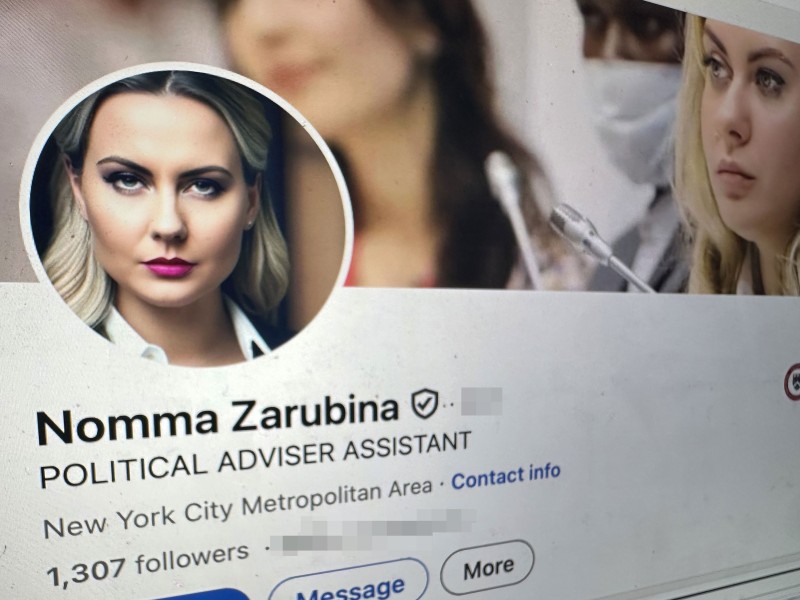
When Nomma Zarubina stood before a federal judge in New York to plead guilty to federal charges, the proceeding generated little public buzz. She admitted to lying to the FBI in 2021 about her connections to Russia’s top domestic security and counterintelligence agency, FSB, and to deceiving immigration authorities about her role in a New York-area prostitution ring.
But a transcript of that hearing, made public on the court docket this week, has peeled back the curtain on a far more bizarre geopolitical drama, revealing that Zarubina made a stunning claim to the judge: She was secretly passing information to the Central Intelligence Agency.
The revelation occurred when District Judge Laura Taylor Swain asked Zarubina if she had been confused when she lied to federal agents about her Russian intelligence connections. Zarubina replied that she was not confused, but rather terrified of the FBI agent handling her case, Neil Summers.
“He just scared me because, actually, I was responsible that moment before my initiative to pass information not to the FBI but to the CIA,” Zarubina told the court. After briefly conferring with her lawyer, she restated that she lied out of fear.
The CIA did not respond to requests for comment regarding Zarubina’s claims, and her court-appointed defense attorney, Kristoff Williams, declined to discuss the matter while the case remains active.
The sprawling federal case against Zarubina, who operated under the intelligence code name “Alyssa,” reads like a pulp espionage thriller. In April 2025, a grand jury added charges accusing her of transporting women across state lines for prostitution and lying on her United States citizenship application.
During the plea hearing, prosecutors outlined the extensive evidence they had prepared to present had the secretive operation gone to trial. Assistant U.S. Attorney Henry Ross detailed a two-pronged case. Prosecutors pointed to photographs from Zarubina's social media accounts proving she attended an event at the specific direction of an FSB officer to secretly photograph the contact information of a journalist.
The government extracted evidence from her cell phone showing contact information for her FSB handler, as well as a photograph of an FSB epaulet sent to her by a second Russian intelligence officer.
To prove her involvement in the prostitution ring, prosecutors cited surveillance logs of Zarubina picking up women in Brooklyn and transporting them to a New Jersey massage parlor. The government also cited license plate reader data and testimony from law enforcement officers who conducted a raid on the parlor following an undercover sting operation.
Zarubina first drew the attention of federal investigators due to her self-reported work for Elena Branson, a dual U.S.-Russian citizen indicted in 2022 for acting as an unregistered foreign agent. Branson, who fled the United States before the charges were announced, operated the Russian Center New York and oversaw an “I Love Russia” campaign—an initiative that federal prosecutors described as a Kremlin-backed propaganda machine.
Despite the FSB ties, intelligence experts suggest Zarubina was likely a minor player. Paul Joyal, a former security chief for the Senate Intelligence Committee, described her as a likely “low-tier compatriot-network influence-recruit.” Given soft tasks like identifying journalists and mingling with policy wonks, Joyal noted that after her arrest, she was “abandoned without any visible extraction effort” by Moscow.
Her treatment stands in stark contrast to Maria Butina, another young Russian woman charged in 2018 with acting as an unregistered foreign agent. The Russian government elevated Butina to a national symbol; after her deportation, she became a television personality and was eventually elected to the Duma, Russia’s legislative body.
While she awaits sentencing on June 11—where she faces up to 10 years in prison—Zarubina has been sitting in a jail cell. Judge Swain revoked her bail last December after she engaged in an alcohol-fueled texting spree with an FBI agent, believed to be Summers. In additional texts introduced by prosecutors, Zarubina threatened to retaliate by revealing the names of prominent, VIP clients who frequented her New York-area prostitution ring.
She also faces likely deportation proceedings, a situation complicated by the fact that she has a young daughter born in the United States.
Despite the threats and her admissions of guilt, the February transcript reveals a defendant who felt deeply underappreciated by the American government she claims she was trying to assist—in part, she noted, because she opposed Russia's invasion of Ukraine.
“Everything they have from my phone, and from me, actually, I volunteered,” Zarubina told the judge. “I was very persistent in communications with them, and I initiated five out of eight our meetings. So it was my initiative to share information with them, and they never appreciated that.”