Reported by
The urgent email came from Senegal. The son of the former president desperately needed help. He’d been sentenced for corruption and needed lobbying in the U.S. to get the matter in front of key lawmakers and diplomats.
“Sorry but who are you,” was the initial response from a puzzled Jeffrey Epstein.
A woman named Elisabeth Feliho replied, explaining that she worked for Karim Wade, a former Senegalese government minister whose portfolio included air transport and energy. He was also the son of Abdoulaye Wade, who served as Senegal’s president from 2000 to 2012.
By the time the email from Feliho landed, Wade and Epstein had shared years of correspondence, according to files released by the U.S. Justice Department. Before, during and after his corruption case — which ended in a conviction in 2015 — Epstein assisted Wade.
After he was sentenced, Wade leaned on Epstein to help win back his freedom, and clean his reputation. In her email, Feliho asked Epstein to send a payment to a firm that could lobby influential figures in the U.S. and at the United Nations.
“Total cost for 3 months would be 100,000 USD and they are ready to start today,” she wrote in September 2015, a few months after her boss had been sentenced.
The newly released files pull back the curtain on the global business and political network of contacts curated by Epstein, who died in a New York jail cell in August 2019. The chain of emails shows that Wade befriended Epstein, who then introduced him to his network of global finance powerbrokers.
Wade was a man of some influence himself. During his father’s administration, he was so powerful in Senegal that he was nicknamed the “minister of heaven and earth.”
OCCRP sent questions to the email address Wade had used in correspondence with Epstein, but did not receive a response. There was no response from the address used by Feliho at the time. The lawyer who represented Wade in his corruption case, who still practices in Senegal, did not respond to questions.

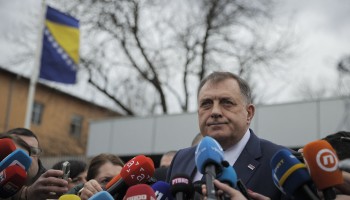
Former Senegalese President Abdoulaye Wade (right) with his son, Karim Wade, at the G8 summit in Deauville, France in May 2011.
A Budding Friendship
The emails included in the files released by the U.S. Justice Department trace the relationship between Wade and Epstein back to late 2010.
“The President of Senegal is sending his son to see me in paris,” Epstein wrote in November 2010 to a contact.
Five months later, the emails show, Epstein was planning a trip across West Africa with stops in Senegal, Sierra Leone, Mali, Morrocco, and Gabon.
Epstein’s travelling companions were to be Wade and Sultan Ahmed bin Sulayem.
Bin Sulayem is chairman and CEO of DP World, a company based in the United Arab Emirates with interests in cargo logistics, free trade zones and ports. Bin Sulayem did not respond to a request for comment sent to his media team about his friendship with Epstein.
The emails show that Wade and Epstein also got comfortable with each other around the time they planned the Africa trip. One email shows that Epstein had been coveting a palace in Morocco, and Wade had suggestions.
“Do not forget in the house the harem part,” Wade cracked to Epstein in November 2011. “Happy to manage it.”
Managing Change
In March 2012, Wade’s father lost re-election. Facing life outside of government, the younger Wade turned to Epstein for advice.
Emails show the two men discussing business strategies, including a suggestion by Epstein to create a Special Purpose Acquisition Company (SPAC). Sometimes called a “blank check company,” a SPAC involves an “empty” firm listed on a stock exchange. The firm merges with or acquires an existing company.
A perk, Epstein said, is no Initial Public Offering. SPACs face lesser regulatory scrutiny than a private company offering initial shares to the public. But Wade and associates then discussed a more conventional limited liability company to invest in projects across Africa.
A few days later, Epstein received an email referencing a power point presentation called “Project Pearl.” The U.S. Justice Department didn’t include the Project Pearl attachment in its release of files. But Senegalese investigative records from the same period identify a Hong Kong entity called Pearl Capital Investments Ltd, which involved the same associate who messaged Epstein. Several other men were the account’s beneficiaries.
It’s unclear what further role Epstein played in Wade’s business affairs.
Corruption Conviction
Wade was arrested in April 2013 and charged with illicit enrichment. He remained in detention as authorities built their case against him, which finally went to trial in 2015.
As Wade sat in jail, Epstein received a bill for legal services from Wade’s lawyer in Senegal. An invoice dated May 29, 2014, shows a Wade attorney billing Southern Trust Company, Epstein’s consulting and investment firm.
The invoice shows Wade’s lawyer asking for $500,000 for “fees relating to legal assistant in the follow up of operations and investments.”
Less than a year after that invoice was dated, in March 2015, Wade was sentenced to six years in prison.
In July 2015, Epstein sought advice from Thorbjorn Jagland, a Norwegian who at the time headed the Council of Europe, the continent’s leading human rights body. Epstein appeared to be asking about the possibility of filing a suit at the European Court of Human Rights challenging Wade’s conviction.
Also in 2015, a UN Human Rights Council body declared Wade’s detention arbitrary.
Other emails show Epstein receiving updates on efforts to pressure Senegal to release Wade. These included one from a lawyer who was involved in lobbying efforts directed at Senegal’s president, Macky Sall, who was elected after Wade’s father.
“My contact is working behind the scenes to help put pressure on Macky Sall and his administration,” Robert Crowe, a partner at Nelson Mullins, wrote to Epstein in April 2016 after a meeting at the U.S. State Department. “Our ambassador is helping.”
Crowe, who now has his own lobbying firm, did not respond to a request for comment.
Freedom and Exile
In June 2016, the Senegalese government pardoned Wade, and he went into exile in Qatar.
“Karim was released from jail last night,” read a June 24, 2016, email to Epstein from bin Sulayem.
“Thank you for everything you have done for him!!!!,” wrote Nina Keita, a former fashion model who was involved in Epstein's efforts to free Wade.
Emails show Keita had, a few years earlier, connected Epstein to her uncle, Alassane Ouattara, the long-ruling president of Côte d'Ivoire. Keita told OCCRP she did “not wish to comment.”
Months after Wade’s release, Epstein tried to bolster Wade by proposing a meeting in the Qatari capital of Doha for him with Larry Summers, the influential former U.S. Treasury Secretary. Summers did not respond to a request from OCCRP for comment sent to his spokesperson.
“Who is the guy you have set me up with,” Summers asked Epstein in a November 2016 email.
In his response, Epstein dismissed Wade’s criminal conviction as political, and sang his praises.
“He is the most charismatic and rational of all the africans and has theire respect,” Epstein wrote.