Reported by
Three people identified by U.S. congressional leaders as “powerful” accomplices of infamous financier Jeffrey Epstein appear to be ordinary New York area residents who said they’ve never met or worked with Epstein or his network.
The three have spoken to OCCRP and partners. They live and or work in the New York City area, and were publicly identified earlier this week when the two congressional leaders who fought to make the Epstein files public went to see the unredacted files held at the U.S. Justice Department.
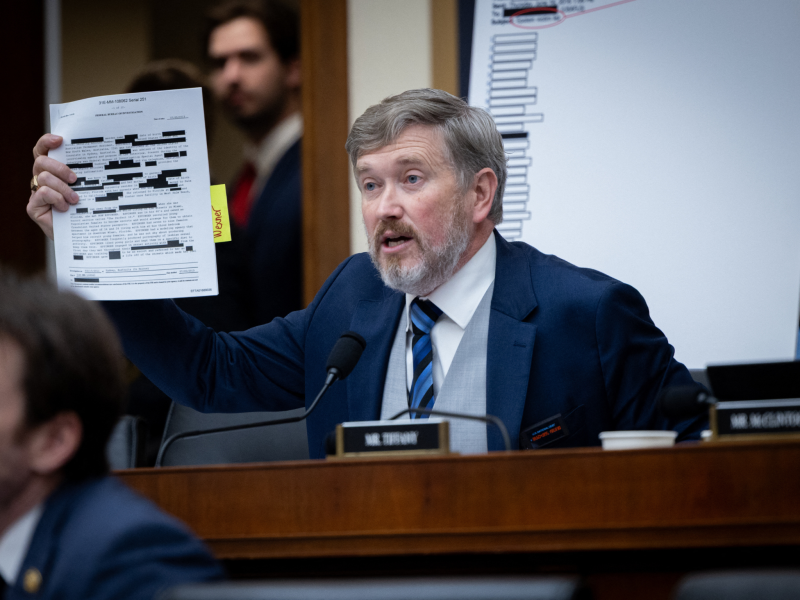
Speaking on the floor of the House of Representatives on Wednesday, Rep. Ro Khanna, a California Democrat, said Justice Department officials had improperly redacted names of six individuals. The officials, he said, “had acknowledged their mistake and now they have revealed the identity of these six powerful men.”
While two of the six men identified by Khanna and Kentucky Republican Rep. Thomas Massie were in fact powerful figures, they were already widely named in the documents and known to be associates of Epstein. One, Sultan Ahmed bin Sulayem, resigned abruptly on Friday as chairman of Dubai-based DP World, the global ports and logistics giant.
But several others men appear far from powerful and influential. Three of them identified by OCCRP and partners are a home improvement specialist, a systems engineer, and a mechanic, all without a record of serious crimes or involvement in major lawsuits.
“I watched a congressman’s speech where my surname and first name were mentioned. Although there are 10 people with my name and surname, someone posted a photo somewhere, and that makes it more complicated,” said Zurab Mikeladze, one of the men publicly named by Massie and Khanna, who has had his photograph widely disseminated online since the congressmen made their announcement.
“That photo was taken recently. The T-shirt is mine, the sweater is mine, it’s not Photoshopped or anything. But I don’t understand how that photo ended up there.”
An immigrant from the South Caucasus nation of Georgia, Mikeladze told OCCRP and its reporting partner, Georgian media outlet Monitori, that he had been a car mechanic in the U.S. for the past 27 years.
“Many things could be said about me except pedophilia,” he said, “I can’t imagine it.”
His name appears just once in New York court records, as a plaintiff in a minor insurance case in 2001.
A headshot of Mikeladze appears in the Epstein files as part of a largely redacted document. While confirming that he was depicted in the photograph, he said he had no idea who had taken it or how it ended up in the files,
“I’m looking into it. I’ve never heard anything like this about this person, Epstein. I’ve never met him. I just found out that they found him dead in prison,” Mikeladze said.
Another of the men, Leonid Leonov, appears in the same document, although the congressmen wrongly identified him as Leonic Leonov.
Reached by reporters, Leonov also expressed surprise and concern about being identified as a powerful person protected by redaction in the Epstein files. Leonov’s LinkedIn profile says he is an information technology professional, and he did not respond to follow-up requests for more information.
A third man identified by the congressmen, Salvatore Nuara, has an Instagram page showing he runs or ran a small home improvements business in Ozone Park, a working-class neighborhood in the borough of Queens. He too expressed surprise at being identified as a powerful person in the Epstein files.
The files contain several versions of the same document featuring the New York men, redacted to varying degrees. They were matched with their dates of birth in the documents, helping to mitigate the chance of mistaking them for someone with the same name.
OCCRP and partners reached out to Massie and Khanna, asking why these men were publicly named as “powerful” people protected by the Justice Department.
Massie’s office referred one of the collaborating reporters to a post he made earlier on the social media platform X, defending his identification of a fourth person, Nicola Caputo, who shares a name with a European politician. (That Nicola Caputa posted on X this week that he was aghast at having been associated with Epstein. “I categorically deny ever having had any type of contact with Mr. Epstein and or with his circle,” he wrote.)
“Inevitably, people who are not in the Epstein files will share names with people who are in the Epstein files,” Massie posted on February 12. “I have good reason to believe the Nicola Caputo in (file number) EFTA00077895 is NOT the same Nicola Caputo who served as a Member of European Parliament from Italy.”
His office did not respond to specific questions about the others identified.
Khanna’s office also did not respond to questions from OCCRP. Instead he referred reporters to a post on his social media account on X soon afterwards, defending the identification of the six men, which include the former owner of retailer Victoria’s Secret, Leslie Wexner, and Sultan Ahmed bin Sulayem, chairman of maritime and logistics giant DP World.
“The other men I mentioned should not have been redacted, and, while there is speculation, we do not know who they are or their background,” Khanna posted on Friday morning. “But there should be transparency, no redactions except to protect survivors.”
The release of a huge trove of some 3.5 million Epstein documents on January 30 came after years of civil lawsuits, a law passed by Congress, and campaign promises by President Donald J. Trump. But critics in Congress have seized on the large amount of redacted information in the files, while the Justice Department has defended the redactions as necessary to protect victims, or to avoid adversely affecting ongoing litigation.
Epstein was arrested in July 2019 by federal authorities on allegations that he had run a sex trafficking network. He died the following month in a New York jail awaiting trial in what a coroner’s report called suicide by hanging.
Paper Trail Media, the Times of London, The Guardian, and Le Monde contributed reporting.