Reported by
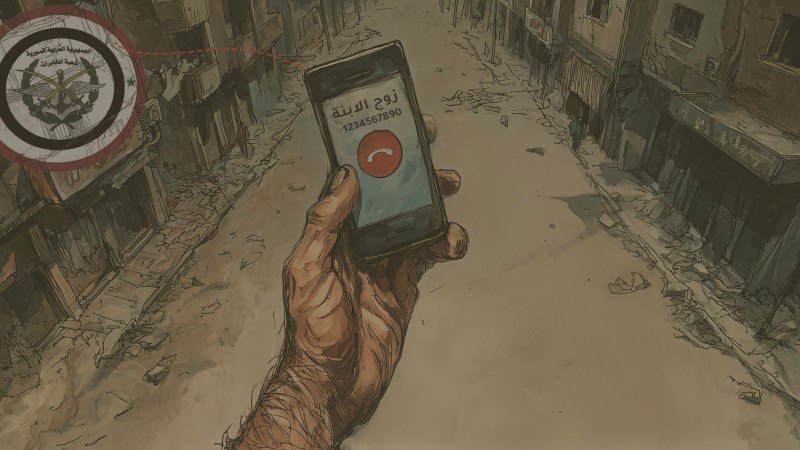
The private mobile phone operator Syriatel secretly collaborated with an intelligence agency under the regime of former Syrian dictator Bashar Al Assad, providing the country’s spies with unfettered access to customers’ numbers, data, and conversations.
Journalists uncovered documents after the fall of the Assad regime in December 2024 that showed the telecom company’s collaboration with Syrian intelligence before the regime’s ouster.
The discovery is part of the "Damascus Dossier," an investigation based on 134,000 Syrian intelligence services documents, obtained by German broadcaster NDR, and shared with the International Consortium of Investigative Journalists (ICIJ) and several other media organizations.
The documents, provided to OCCRP’s member centers — ARIJ in Jordan and DARAJ in Lebanon — expose the inner workings of Assad’s security apparatus, and its links to foreign governments and international organizations.
Syriatel’s connection to the regime has long been known. Syriatel’s then chairman Rami Makhlouf, is also Assad’s maternal cousin, and the subject of U.S.and EU sanctions for aiding the regime.
The newly-discovered documents include a 2020 report by General Intelligence Directorate’s Branch 251 addressed to the agency’s director, which details the interrogation of six people asked about various companies linked to Makhlouf, including Syriatel’s IT director.
At the time, Makhlouf was embroiled in a public spat with the regime run by his cousin, Assad, over alleged tax evasion. The interrogations appear related to the probe of Makhlouf’s businesses. The report on the interrogations makes several references to Makhlouf, including questions about properties and businesses he owned, sometimes under pseudonyms. The outcome of that probe is unclear.
Makhlouf, contacted via his lawyer, did not reply to reporters’ request for comment.
The interrogation of Syriatel’s IT director, as documented in the report, indicates that the telecom company’s customers' phone numbers and data were shared with military intelligence in a systemic way.
According to answers given during the interrogation, Syriatel’s IT department provided the Communications Directorate — an intelligence agency within the Syrian Ministry of Defence — with “all information related to subscribers and their communications.” The IT department uploaded the files containing that information into “a database belonging to the Communications Directorate,” including a back-up copy of the databases “given their importance to the Directorate.”
The former IT director did not respond to a request for an interview. The director’s information was provided during an interrogation by the notoriously-brutal Syrian intelligence agency, although the report does not indicate that torture was used.
Another former Syriatel employee, Nidal Zarifeh, corroborated some of the information found in the interrogation report.
“It was not a matter of choice,” he told ARIJ. “The information was available to the Communications Directorate, and consequently to the state, in a detailed and obvious way.”
“Syriatel’s staff — and I was one of them — largely had a view that we were serving the nation. We believed the regime would leave eventually and the network we were building must remain for the country. That’s why we worked on it,” he added.
Syriatel did not respond to requests for comment.
Systematic Surveillance
The General Intelligence Directorate — which prepared the interrogation report discovered by journalists— was Syria’s primary civilian intelligence agency under Assad’s regime.
The directorate was instrumental in internal repression and international intelligence operations. Since May 2025, it has been under new leadership following Assad’s ouster in December, 2024.
The government that took over after the fall of Assad says telephone data is no longer shared in a systematic way with law enforcement or intelligence agencies.
“The new Ministry of Communications and Information Technology is committed to regulating lawful access to citizens' data,” a ministry spokesperson said in an emailed response to questions. “Access to this data will be granted only through legal authorization and specific, time-bound court orders, and under the supervision of the relevant authorities.”
Aside from the 2020 interrogation report, journalists discovered internal memos exchanged between the Communications Directorate and the General Intelligence Directorate in 2024. They show that the Communications Directorate shared information on Syriatel customers’ numbers, as well as the content of their calls.
The memos indicate that Syriatel was not the only telecom company sharing data with Syrian intelligence. The documents reference another company, although it is not named.
Some memos from the Communications Directorate to the GID reference phone numbers and SIM card numbers, based on data “provided by both companies.” Others list the identities of number owners and the content of their conversations.
At least five of the numbers listed in the memos were attributed to Syriatel, according to a phone number tracker, although those memos did not specifically say the company provided the numbers to the intelligence agencies.
The agencies also discussed personal user data. A 2024 list from the Communications Directorate to the GID outlined 26 mobile phone users, including identifying details such as their names, parents' names, years of birth, addresses and ID numbers.
One of the memos read: “Attached [are] available text messages + the data and ownership of the mobile numbers that communicated with the two mobile numbers…within the required period. Please review.”
Activists Surveilled
Reporters tracked the holder of one Syriatel phone number cited in a memo to Fouad Adel Abu Hamdane, a political activist based in Suwaida, in the south of Syria. The intelligence services intercepted his communications, meaning he had to restrict his movements and live in fear of being grabbed and disappeared.
Abu Hamdane told reporters that he was wanted under the former regime because of his political opinions. “They surveilled us, all our movements, anyone who said his opinion on Bashar Al Assad was considered wanted.”
“They made things so difficult for us that we thought if we went to Suweida city, we expected that any intelligence officer or group would grab us and we would never return home. This was the style of the hated regime,” he added.
Ahmed Abazeid, a Syrian activist who was part of the opposition to Assad’s regime, told reporters that access to data and calls was available to various “security branches.”
“I know this firsthand because I've seen documents directly — unbelievable paper documents — that include recordings of citizens' calls via landline and mobile networks,” he said. “These recordings were handwritten.”
Abazeid, who is a coordinator of the Syrian Memory Institution, a non-profit research project focused on Syria’s post-2011 history, said he found the transcripts in a Suweida military security office in December 2024. He added that it was well-known in Syria that people’s phones could be monitored.
This meant “there was a reluctance to discuss political matters on the line,” he said.
The extensive surveillance of phone communications highlighted during the Assad regime the obsession among intelligence agencies with keeping tabs on the civilian population, according to Zarifeh, the former Syriatel employee.
“Assad’s regime was always concerned with not knowing something,” said Zarifeh. “Naturally, all Syriatel’s information and [other providers’] was available to the regime… and to the security and intelligence services.”
**Mariam Shenawy (OCCRP) contributed reporting.