Reported by
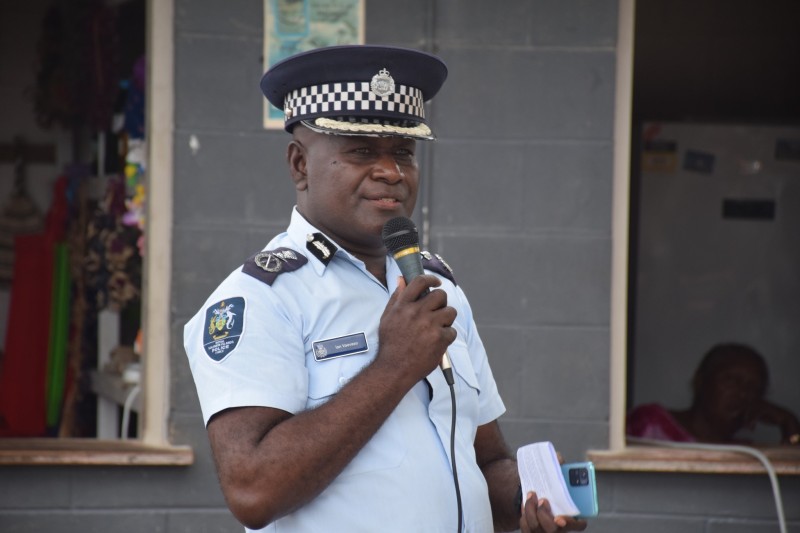
One of the frontrunners to become Solomon Islands’ top police officer is under investigation for allegedly mishandling drug evidence in a case that has prompted whistleblower complaints, and caused ructions among the rank-and-file.
An internal memo obtained by OCCRP’s member center, In-depth Solomons, reveals that prosecutors last year recommended suspending and criminally charging Ian Vaevaso, deputy commissioner of the Royal Solomon Islands Police Force (RSIPF).
The recommendation followed an investigation alleging that Vaevaso improperly destroyed key drug evidence, intimidated officers who opposed him, and lied to investigators when confronted.
In June 2025, the country’s top prosecutor issued a report recommending that Vaevaso be interviewed before the formal filing of charges.
He has neither been suspended nor charged. The case has been stalled by a standoff between the prosecutor and a police commission tasked with oversight.
Vaevaso continues to be a leading candidate to become commissioner, overseeing the police department’s 3,000 officers.
Vaevaso declined to answer specific questions regarding the allegations sent by In-depth Solomons but confirmed there is an active inquiry.
“It would be inappropriate and potentially prejudicial for me to comment publicly while such processes remain active and before any formal findings or decisions have been concluded,” Vaevaso said.
“I wish to assure the public that I continue to cooperate fully with all lawful inquiries and respect the role of independent institutions tasked with examining these matters.”
In an interview, Director of Public Prosecutions Andrew Kelesi confirmed the authenticity of the memo, which was prepared by one of his senior legal officers.
The memo, from mid 2025, said that there was "sufficient evidence to establish the criminal offence of abuse of office.” It recommended that Vaevaso and two other officers be suspended pending criminal investigation, and that “we file the appropriate criminal charges against the officers before the end of the month of June 2025.”
Kelesi said he had followed the memo’s advice and recommended that Vaevaso and the other officers be suspended, but that the police chief at the time and a commission overseeing police and correctional officers had failed to respond to his request.
“We provided legal advice on the criminal aspects of this matter and recommended the suspension of the three concerned officers, as there is sufficient evidence based on exhibits and witness testimony,” he said in an interview.
“However, the decision to suspend lies entirely with the RSIPF and the Police and Prison Services Commission (PPSC).”
Kelesi said that the memo was not a final decision and that he wanted to hear Vaevaso’s side of the story before deciding whether to charge him. He asked for the PPSC to interview Vaevaso, but that request was also ignored.
“My request is a thing that should have been done in just a week,” Kelesi said. “Now it’s almost a year [later] with nothing coming forth.”
“This is simply unfair for the public.”
David Suinara, the PPSC’s deputy secretary, denied responsibility, arguing that only the police chief can suspend an officer and that the request to interview Vaevaso should have come from the police.
But Kelesi said he had the authority to make the request, which was done with the agreement of the police chief and internal investigators to avoid conflicts of interest. Moreover, the PPSC remains in possession of the investigative files required to suspend Vaevaso, he said.
Mostyn Mangau, who was police chief at the time, said he was aware of the case but effectively cut out of the process.
“The file is with the PPSC, and never reached my office,” he said. “That’s the only reason I never acted on the case. Just because I am no longer there doesn’t mean they can put a blame on me.”
The impasse means that Vaevaso could soon take charge of the department. On March 22, Prime Minister Jeremiah Manele said the next police chief had been chosen, and would soon be announced.
Dumping Drugs
The case comes amid a surge of drug trafficking across the Pacific.
Small island states have become midway points for narcotics bound for the wealthier shores of New Zealand and Australia. The influx of cheap methamphetamine is also driving an increase in local addiction in some Pacific island countries.
In the Solomon Islands, three so-called “narco subs” were discovered in the past two years.

A "narco sub" that washed up on the beach in the Solomon Islands village of Ghoveo in August 2025.
The case that has entangled the frontrunner for the country’s top police position began in October and November 2023, when a pair of drug busts resulted in the seizure of unspecified amounts of ketamine and methamphetamine.
A few months later, in February 2024, police issued a press release with photos of the drugs apparently being dumped into the ocean.
The disposal of the drugs “generated significant concern within the RSIPF, with numerous officers questioning the legality and appropriateness of DC Vaevaso’s process,” according to a leaked report later written by Director of Public Prosecutions Kelesi.
That report was separate from the memo obtained by reporters, and was emailed to a handful of people, including In-depth Solomons.
Whistleblower Complaint
In August 2024, a whistleblower filed a complaint about Vaevaso with the Solomon Islands Independent Commission Against Corruption, which kicked off the probe into his actions
The commission referred the complaint to RSIPF’s Professional Standards and Internal Investigations Department for investigation, according to the public prosecutions report. Kelesi’s office was then tasked with offering legal advice.
Then, this February, an anonymous person claiming to represent RSIPF rank-and-file officers emailed leading members of parliament and the police to demand action in the case. Attached to the email — sent to In-depth Solomons and some anti-corruption organizations — was a partially redacted copy of the public prosecutions report that raised concerns about Vaevaso’s “process” of destroying drugs.
Among those who received the email was acting police commissioner Mathias Lenialu, who had only been sworn in a few weeks earlier. He responded directly to the email, calling the allegation “a one-sided story of the issue.”
“To our esteemed National Political Leaders and those copied in this email,” he wrote, “the RSIPF stands with DC Vaevaso and disassociate[s] itself from one or two police officers who are working hard to destroy the good reputation of DC Vaevaso with hidden interests and agendas.”
When questioned by In-depth Solomons, however, Lenialu said he wasn’t familiar with the case, couldn’t comment and referred questions to the Police and Prison Services Commission.

Solomon Islands police officers prepare to dump what they said was meth and ketamine into the ocean in February 2024.
The public prosecutions report, which was submitted to the PPSC and police internal investigators on June 27, 2025, cites eight witnesses and six exhibits.
It alleged that Vaevaso had bypassed proper channels and broken protocol by insisting subordinates hand the drugs over to him. When some officers raised concerns, Vaevaso allegedly “responded with hostility” and “may have used words which threatened” one with disciplinary inaction for her resistance.
“This persistent acquisition of complete control over exhibits through multiple stages, conducted outside proper forensic oversight, demonstrates highly irregular and suspicious behavior,” the report continued.
Vaevaso then allegedly stored the drugs in his private office for nearly a month, which created “ample opportunity for interference, mishandling, or tampering with critical evidence,” according to the report.
The deputy commissioner personally oversaw the destruction of the drugs at sea in an allegedly “intentional, premeditated, and clandestine nature.”
The report concluded with the recommendation that Vaevaso be interviewed in anticipation of a formal criminal investigation. It did not go as far, however, as the earlier internal public prosecutions memo, which recommended that Vaevaso and two other officers be suspended and criminally charged.
Vaevaso declined to comment on the allegations citing, in part, his potential promotion.
“At this time, I am unable to provide substantive comment on the matters raised,” he said. “As you may be aware, I am currently a candidate for the position of Commissioner of Police.”
NOTE: OCCRP’s Pacific Editor Dan McGarry passed away during the reporting of this article. He is greatly missed.
.jpg/d9292de12978009a64a9c800764c00e2/gramps-final-(1).jpg)

.jpg/0dd2cd6b459b48265605461518a8ae61/gramps-final-(1).jpg)