Reported by
Solomon Islands has appointed a new national police chief, elevating a top commander just weeks after it was revealed that prosecutors had recommended charging him for improperly destroying seized methamphetamine.
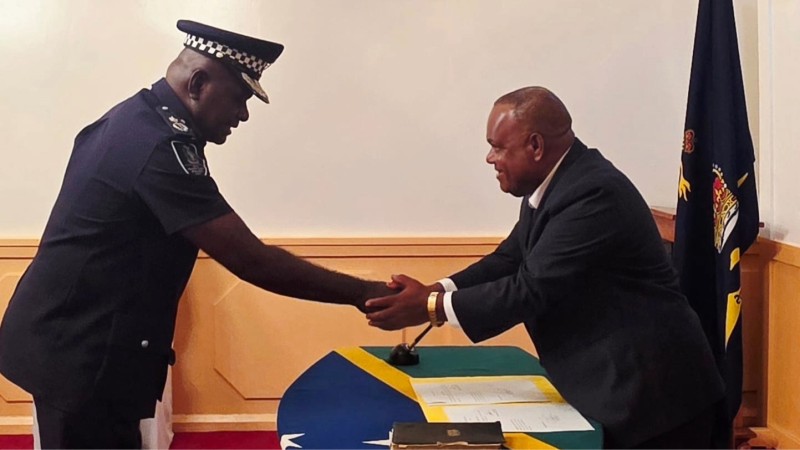
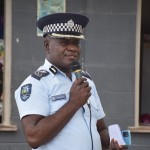
Ian Vaevaso was officially sworn in as commissioner of the Royal Solomon Islands Police Force on Friday. The appointment unfolded against the backdrop of a separate political crisis threatening to topple the government of Prime Minister Jeremiah Manele, furthering political divisions in the Pacific nation.
Vaevaso, formerly a deputy commissioner, has denied wrongdoing regarding an episode in early 2024 when he allegedly broke protocol by ordering subordinates to hand over confiscated methamphetamine, which he then dumped into the sea. An internal police investigation found evidence that he had improperly destroyed the drugs, intimidated dissenting officers, and lied to investigators.
The police force defended its new chief, dismissing the allegations as “misleading and fabricated” and characterizing them as part of an “ongoing propaganda campaign” aimed at fracturing the department. Vaevaso could not be reached for comment.
The swearing-in occurred less than a month after a joint investigation by OCCRP and our local member center In-depth Solomons reported that the case against Vaevaso had been derailed by a bureaucratic standoff.
According to an internal memo from the office of the Director of Public Prosecutions, Andrew Kelesi, obtained by In-depth Solomons, legal staff concluded there was “sufficient evidence to establish the criminal offence of abuse of office” and recommended that Vaevaso be suspended and criminally charged. Kelesi subsequently issued a confidential report recommending that Vaevaso be formally interviewed before a final charging decision was made. The prosecutor told reporters he had also advised suspending the commander.
Yet Vaevaso was never interviewed, suspended, or charged. The case stalled amid an impasse between the prosecutor, the police department, and a police oversight commission.
The decision to instead promote him to lead the 3,000-officer force drew immediate condemnation. Matthew Wale, the opposition leader in Parliament, called the appointment a “gross failure of judgment” that severely undermined public trust and accountability.
Wale noted that the Attorney General’s Office had recently dismissed the evidence against Vaevaso as insufficient and recommended closing the file, clearing the commander's path to the top job. The Attorney General’s Office could not be immediately reached for comment regarding the status of the case.
“No one under active investigation should be elevated to the top of law enforcement until the truth is fully established,” Wale said in a statement.
Transparency advocates echoed those concerns, pointing to a breakdown in institutional safeguards. Ruth Liloqula, the head of Transparency Solomon Islands, questioned the integrity of the vetting process that allowed Vaevaso to remain eligible for the role.
“If the D.P.P. and R.S.I.P.F. offices had evidence, he should have been charged last year,” Liloqula said. “Now, he’s in charge.”
The leadership controversy arrives at a perilous moment for law enforcement in the Pacific, which is experiencing a steep increase in transnational drug trafficking. Small island states like the Solomons have increasingly become transit hubs for narcotics bound for lucrative shores in Australia and New Zealand.
The influx of cheap methamphetamine has also begun driving a domestic addiction crisis in several Pacific island countries. Highlighting the scale and sophistication of the illicit trade, at least seven so-called narco-submarines have reportedly been discovered in the region over the past two years — four of them in the Solomon Islands.
.jpg/d9292de12978009a64a9c800764c00e2/gramps-final-(1).jpg)
.jpg/0dd2cd6b459b48265605461518a8ae61/gramps-final-(1).jpg)