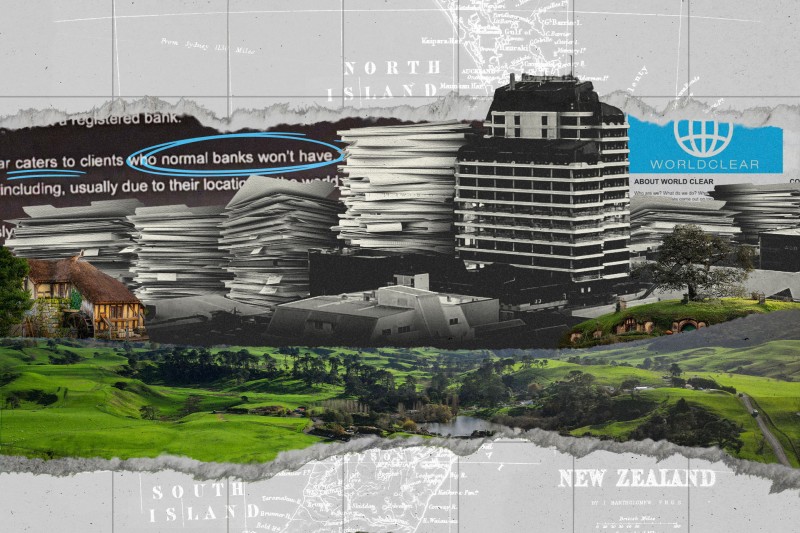

The rolling hills of New Zealand’s Waikato region are perhaps best-known as the home of the Hobbits.
This bucolic corner became the setting for The Shire in Peter Jackson’s movie trilogy “The Lord of the Rings,” dotted with round-doored underground dwellings and quaint thatched cottages.


Fans still flock to the movie set, which has become a permanent tourist attraction.
But just 50 kilometers away, in the riverside city of Hamilton, another epic story unfolded.
From the 10th floor of one of Hamilton’s few tall buildings, a financial services provider called Worldclear Ltd promoted slick international payment services and claimed to be handling transactions totaling hundreds of millions of dollars.
Now, a leaked cache of documents from inside the firm, obtained by Interest.co.nz and shared with OCCRP, 15min.lt, the Belarusian Investigative Center, and Expressen, reveals an operation that relied on manual workflows and was found by inspectors to have failed to comply with several anti-money laundering requirements.
With a staff of less than a dozen people, Worldclear processed millions in transfers for a colorful global clientele between 2014 and 2019, including: a wanted American-Canadian who was later found guilty of wire fraud, a Belarusian oligarch close to dictator Aleksandr Lukashenko, and a U.K. citizen later convicted over Europe’s massive Cum-Ex tax swindle.
The leaked files show Worldclear targeted higher risk clients facing banking or payment problems, though there is no evidence that Worldclear or its staff knowingly facilitated financial crimes.
Reporters also found that two minority shareholders in the firm had convictions for financial crimes, either before they took their stakes in Worldclear, or while they held shares. (Worldclear was not obliged to check the backgrounds of its minority partners.) One of them, a Swede called Mikael Magnusson, is subject to a 2023 Interpol notice for an unserved jail sentence in Panama for money laundering. Magnusson did not respond to reporters’ questions.

Mikael Magnusson pictured in Stockholm, Sweden.
Worldclear’s founder, New Zealand businessman and former financial advisor David Hillary, denied any wrongdoing by himself or the firm, saying neither had ever “knowingly or recklessly facilitated criminal offending, acted for the purpose of assisting any person to commit an offence, or designed or operated services for the purpose of concealing the source, destination, or beneficial connection of illicit funds.”
He added: “The fact that a customer or transaction may be characterized as high-risk does not support, and should not be used to imply, that Worldclear or I knowingly or recklessly facilitated criminal offending.”
The leaked Worldclear files included client lists, private transaction records, and internal correspondence, and showed customers deposited money into Worldclear accounts held at banks in New Zealand, the U.S., and Europe, among others.
Experts said that transferring funds through payment processors like Worldclear is usually slow and expensive – but that clients might use these firms because it could make it harder to trace their cash flows.
“Complexity is the friend of people with something to hide,” said Ray Blake, a financial crime expert and director of The Dark Money Files, a podcast which seeks to explain how financial crime works and the impact it has. “It makes it harder for investigators — who might work for the police, the compliance department, the tax authorities, audit bodies or the news media — to untangle the transactions and figure out what has really happened.”
Aaron Arnold, a senior associate fellow at U.K. think tank RUSI’s centre for finance and security, said that moving money through a financial services provider in a trusted jurisdiction like New Zealand would reduce the likelihood of transactions being held up by banks.
“Bringing in New Zealand lowers the [regulatory] temperature and may allow you to hold accounts with banking institutions that you might otherwise not be able to,” Arnold said.
The firm was taken off New Zealand's financial service providers register in February 2019 after it did not file confirmation that it was still operating, according to an email sent to reporters by the Companies Office, but it continued to exist. There is no evidence it was active after 2019 and Hillary did not respond to questions about its removal from the register or whether the company carried out any activity after that time.
These days, Worldclear’s former 10th-floor office stands empty and the building it once worked out of is being turned into a premium hotel.
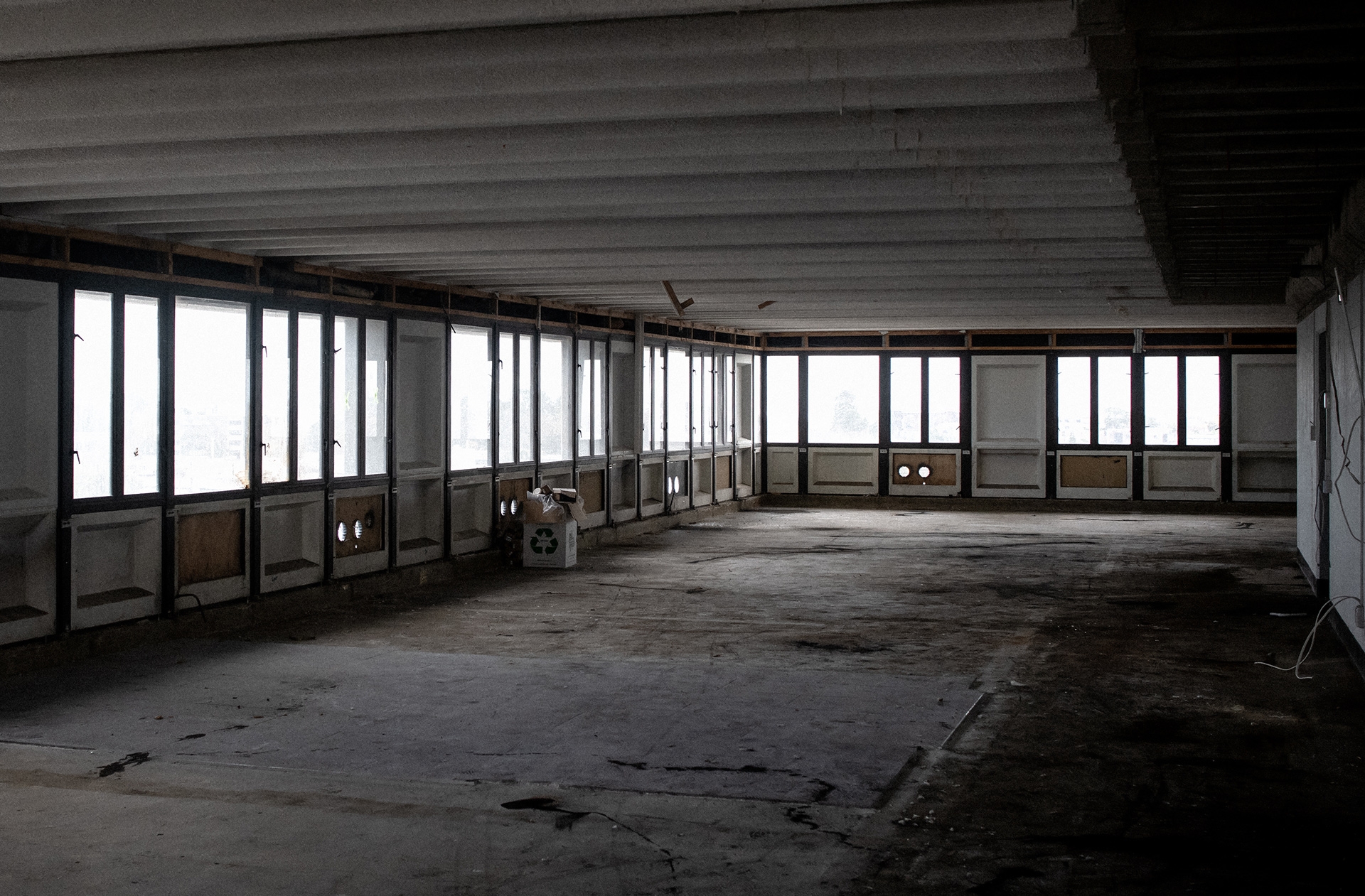
View of Worldclear’s former 10th-floor offices in Hamilton, New Zealand.
The Source of the Leak
At the center of the Worldclear Files investigation is a massive cache of internal files leaked by Richard Whitham, an ex-Worldclear employee. The data provides a window into the firm’s inner workings.

Former Worldclear employee Richard Whitham.
A DIY Operation With Compliance Issues
Hillary founded Worldclear as a financial services provider in 2014. According to its now defunct website, the firm offered “transactional banking services to international corporate and institutional customers.”

A screenshot of the “Who We Are” section of the Worldclear website.
At its launch, promotional articles cited Hillary as saying Worldclear wanted to meet a demand for multi-currency payment clearing services. It could do so thanks to its “state-of-the-art banking facility” and the backing of partners, including “major banks, accounting firms, and top-tier legal advisors,” Hillary is quoted as saying. “We offer a streamlined application process, while adhering to the highest security standards and AML (anti-money laundering) controls.”
The leaked internal data from Worldclear shows that it used third-party software, including one called EBANQ, to provide clients with an online platform to make payment and transfer requests.
Behind the interface, Worldclear relied heavily on manual work. For example, according to the leaked files, staff would set up EBANQ accounts for clients and then “action” transfers themselves.
Analysis of more than a dozen internal spreadsheets suggested that staff manually tracked and managed client funds. Daily excel workbooks contained warnings for employees, reminding them to confirm that balances lined up and giving them instructions to fix unreconciled transactions, such as bounced payments. (Hillary did not respond to a request to comment on Worldclear’s workflow.)
Despite these manual workflow processes, the sums involved were substantial. In an internal document from December 2017, Worldclear said it had “grown to process about NZ$500m in payment values per year,” the equivalent of around $355 million.
But as Worldclear apparently thrived, government inspectors found it had failed to fully comply with the anti-money laundering regulations it had to adhere to by law as a financial institution.
Among the leaked files, reporters discovered a report from New Zealand’s Department of Internal Affairs (DIA) that found Worldclear was only partially compliant with anti-money laundering requirements.
The DIA, which oversaw Worldclear’s compliance with New Zealand’s Anti-Money Laundering and Countering Financing of Terrorism (AML/CFT) Act, wrote the report after carrying out an on-site inspection of the firm in March 2018.
The agency found that Worldclear did not have adequate controls for “monitoring, examining and keeping written findings relating to complex or large transactions, unusual patterns or strange transactions or any other activity that may be connected to money laundering or terrorist financing.”
It also found that the firm did not consistently carry out customer due diligence, describing Worldclear’s background check process as “ad hoc.”
The report said that Worldclear relied on respondent banks to do enhanced customer due diligence — a level of scrutiny applied to clients deemed to be high risk — and concluded that the company had no functioning process to check Politically Exposed Persons (PEPs).
“Worldclear as a whole operates in an extremely high risk environment and does need to go above the normal expectations to verify its ultimate customers; the current process relies so heavily on third parties, however the definitive responsibility lies with Worldclear,” the report said.
The DIA issued a reprimand known as “remedial instructions,” which required Worldclear to address all the areas in which it was not fully compliant and have an independent audit within nine months of the report. However, the DIA told reporters that in 2019 Worldclear told them it had ceased operating the previous year and its supervision ended without a follow-up.
Reporters shared the DIA findings with two leading New Zealand anti-money laundering experts, Martin Dilly and barrister Fiona Hall.
Dilly said he believed the report’s findings suggested "non-compliance which potentially meets the threshold for criminal penalties under the AML/CFT Act" and arguably should have been shared with the police.
Hall expressed surprise that Worldclear had not faced stronger action from the DIA.
“Somehow Worldclear got away scot-free,” she said.
Asked why Worldclear’s case was not referred to law enforcement, the head of the DIA’s anti-money laundering unit Serge Sablyak said it would be rare for criminal non-compliance charges to be brought without trying other regulatory measures first, although serious cases could be referred to the police. In Worldclear’s case, the time limit for prosecution of criminal non-compliance charges has now passed, he said.
Hillary claimed to reporters that the findings were “false” and “damaging” and that the DIA’s assessment “far exceeded [its] legitimate supervisory feedback function.” He said the DIA had “ambushed Worldclear with a post-visit report purporting to find serious non-compliance... They are not lawful findings of contravention.”
“In seven out of the eight inspection items with 'not met' findings, the DIA officials did no inspection of Worldclear’s records or controls relating to the item at all,” Hillary claimed. “In the remaining one, the DIA officials inspected the relevant controls and records and found no non-compliance.”

David Hillary’s LinkedIn profile.
Hillary accepted that the report “found Worldclear to be seriously non-compliant,” but described the conclusion as “baseless.” He said the DIA did not take the step it should have if Worldclear were non-compliant — issue a formal warning — and therefore did not “institutionally [take] the position expressed in [the] report.”
In response to Hillary’s allegations, the DIA said that nothing in its records indicated that the findings were deficient or misleading.
The Fugitive Fraudster
The leak showed that the 2018 report was not the first time that the DIA identified deficiencies in Worldclear’s compliance procedures. A DIA report in 2015 said Worldclear had accepted non-certified due diligence documents for some of its customers.
In 2016, a separate report by an independent auditor — found among the leaked records — said that Worldclear had met its mandatory anti-money laundering requirements. But in a letter attached to the report, the auditor made numerous recommendations for improvements to Worldclear’s risk assessment and customer due diligence processes.
The letter questioned the onboarding process for a client called West Kingdom Holdings, describing how a beneficial owner for the company had been flagged as a “potential high risk customer” in a screening scan Worldclear had done via compliance platform MemberCheck.
While the letter does not say who the beneficial owner in question was, reporters discovered it was Michael Wilson – an American-Canadian who was facing extradition from Canada to the U.S. at the time over a multimillion-dollar investment fraud.

Michael Wilson's passport.
Leaked transaction records show Worldclear onboarded West Kingdom Holdings in December 2015, after the MemberCheck warning. Wilson had not yet been convicted by that time, but it was a matter of public record that he had been indicted on multiple charges of wire fraud. His brother had already been sentenced for his role in the fraud.
Asked about the MemberCheck scan, Worldclear founder Hillary said it had been referred to him for assessment and he had asked for further information, including a Canadian criminal record check that did not show any conviction. He said he had “incorrectly” concluded that the Worldclear applicant was not the same person as the one who had been flagged.
“Worldclear did not knowingly or recklessly carry out any transactions for Mr Wilson or his company while believing or suspecting that he was the person referred to in the MemberCheck flag, or that he had been accused of, involved in, or charged with financial crimes,” Hillary said.
Within weeks of becoming a Worldclear client, Wilson transferred $1.5 million to a West Kingdom Holdings bank account in the Caribbean. Soon after his payments landed, Wilson chartered a private jet, and — along with his wife, mother, and three dogs — fled Canada for Vietnam.
Wilson was arrested in Vietnam in June 2016 and returned to the U.S. in December that year.
An affidavit from an FBI investigator in a U.S. forfeiture application in 2016 said the use of Worldclear as an intermediary had “aided in disguising the true source of the funds transferred.” The following year, a federal judge in the case ordered the forfeiture of four accounts containing around $750,000 at Euro Pacific Bank.
(Internal Worldclear documents show that Euro Pacific Bank was also a Worldclear client. It is no longer licensed to do business after being suspended by Puerto Rican authorities in 2022 over imminent insolvency. The bank had relocated to Puerto Rico in 2017.)
Euro Pacific Bank did not respond to a written request for comment. Peter Schiff, who owned the bank, said it had been closed for four years and that he didn’t “know anything about” the Wilson case.
Wilson pleaded guilty to wire fraud over his investment scam in 2017 and was sentenced to 108 months in prison in 2018. He was released in January 2023.
Hillary said that once “Worldclear received further information linking Mr Wilson to investment frauds…Worldclear did not provide any further services to Mr Wilson, either directly or through any associated entity.”
Asked where the funds that passed through Worldclear came from, Wilson told reporters: “To the best of my recollection after ten years, the funds related to a private metals transaction. I don't have records available to reconstruct the details.”
He added: “I served my sentence, completed my probation, and have focused since on family and travel. I've tried to put that chapter behind me and move forward constructively.”
In a document sent to New Zealand Police that discussed some of Worldclear’s clients and business, Hillary conceded that Wilson’s transfers via Worldclear “appear to have been the proceeds of [Wilson’s] investment frauds,” but argued the money had already been “successfully laundered…before any of the funds were sent through Worldclear.” (The document was connected to an issue over mutual legal assistance and neither Hillary nor Worldclear were under investigation. Hillary did not respond to reporters’ questions about it.)
Not A ‘Normal Bank’
The leaked internal files suggest that Worldclear targeted clients who may have been having problems with mainstream banks. One draft marketing document in the cache reads: “Correspondent banking problems?? USD payment problems?? Accounts closed??...We may be able to help.”
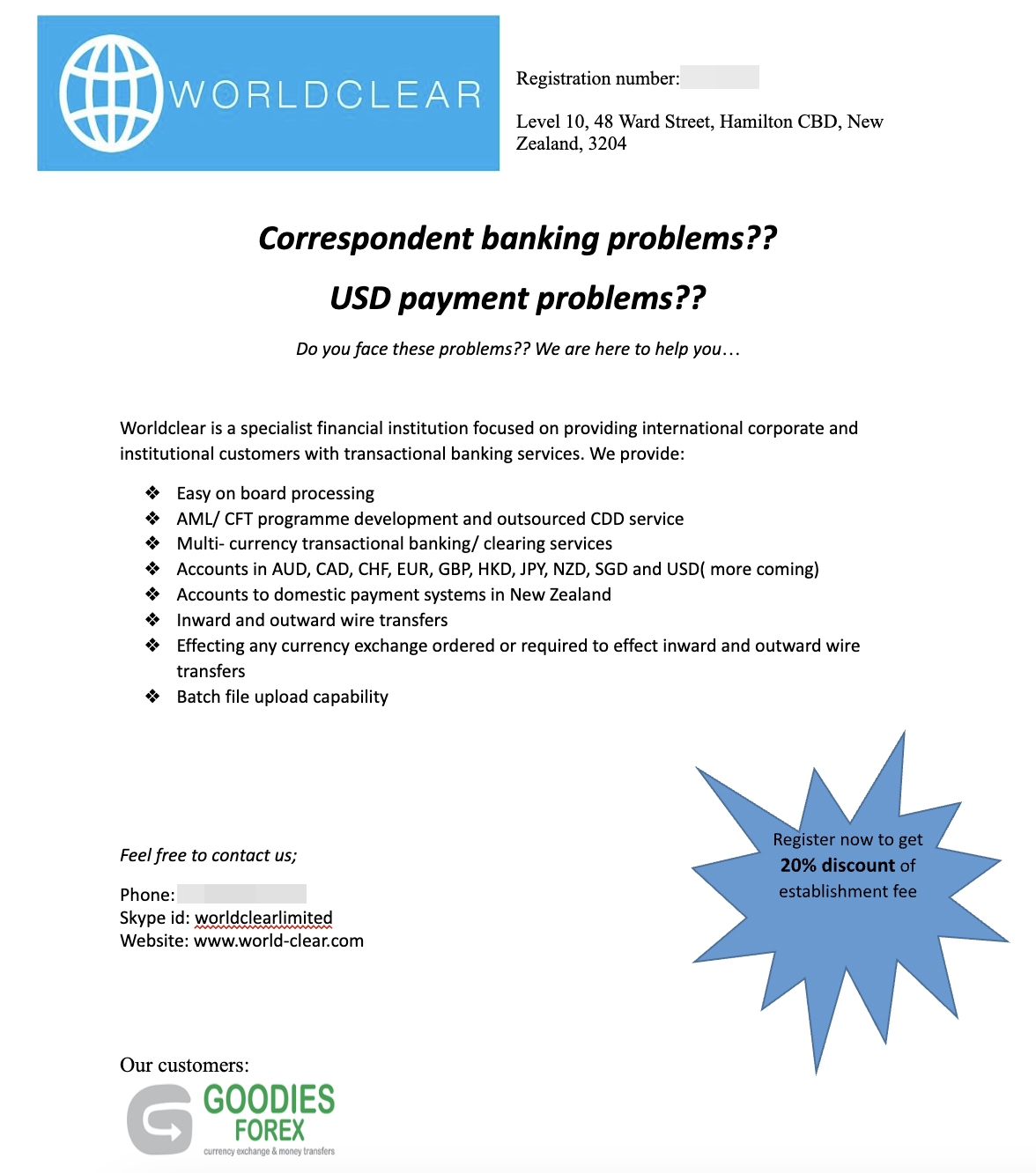
Worldclear’s draft marketing document.
This business model was echoed in a 2018 statement Hillary made to police, where he said that Worldclear “caters to clients who normal banks won’t have,” describing their difficulties as usually “due to their location in the world or their business structure.” (The statement was given as part of an investigation against former Worldclear employee Whitham.)
Hillary declined to comment on specific clients or transactions, but denied any wrongdoing, reiterating that “neither Worldclear nor I knowingly or recklessly facilitated criminal offending.”
Among those who turned to Worldclear was Andrew Strempler, who was convicted of conspiracy to commit mail fraud related to the illegal sale of prescription drugs in the U.S. in 2013. Strempler applied for two company accounts in 2016, following his release from jail.
Minority Worldclear shareholder Magnusson recommended Strempler as a Worldclear client to Hillary, describing him as “an honest and reliable person,” the leaked records show. Strempler declared his conviction to Worldclear, which deemed him of “acceptable character” to become a client. Strempler did not respond to a request for comment.
The leaked files also show Worldclear processed at least $2 million in 2017 on behalf of Guenther Klar, a British citizen who was later convicted in Denmark in 2024 of defrauding Danish tax authorities of $45 million.
According to court records, Klar stored some of his tax fraud proceeds in the Cayman Islands bank Global Fidelity, which had a Worldclear account. In the years that followed, Global Fidelity made large payments on Klar's behalf via Worldclear:
In October 2017, Klar paid $1 million to a United Arab Emirates company via Global Fidelity’s Worldclear account. A leaked compliance letter shows Klar described the payment as part of a $2 million loan.
Two months later, Klar made another $1 million payment via Global Fidelity, which used its Worldclear account to transfer the funds. The Worldclear files show Klar as the originator and the beneficiary of that payment, with two different apartments at the Ritz-Carlton in Dubai listed as his sending and receiving account addresses.
He also used Global Fidelity — which in turn used Worldclear — to pay expenses including hotels, flights, school tuition fees, flowers, and designer shoes.
Authorities in Luxembourg told reporters Klar is in detention awaiting trial for aggravated tax fraud and tax evasion. Requests for comment sent to his former lawyer and the Luxembourg prisons service went unanswered. Hillary declined to comment on Klar's transactions.
Although Klar’s tax fraud scheme was not public knowledge and Klar was not under investigation at the time of the Global Fidelity transactions sent via Worldclear, anti-money laundering expert Dilly questioned why Klar and Global Fidelity routed any of his payments in such a complex way.
“There would be so many easier ways to do this, more cost-effectively, more efficiently, more quickly, than putting them through an intermediary at the other end of the world,” Dilly said.
Light-Touch Regulations ‘Risk’ To New Zealand’s Reputation
The new information revealed in the Worldclear files raises questions over whether the firm should have been more closely scrutinized at the time it was operating – and whether New Zealand’s light-touch regulations and controls on financial services providers are leaving the door open to potential abuse, experts said.
Worldclear was listed on New Zealand’s financial service providers register as offering services including money transfers and foreign currency exchange.
That meant that despite its claimed high volume of transactions, apparent appetite for high-risk clients, and its provision of some banking-style offerings, Worldclear was not subject to the same level of scrutiny as a registered bank would have been.
Simon Papa, who previously worked as a lawyer at New Zealand’s Financial Markets Authority and is now director of Auckland law firm Cygnus Law, which specializes in financial services, said a listing on the financial service providers register did not equate to rigorous vetting. “The register is more about bringing yourself to the attention of the authorities and the public,” he said.
“For things like money remittance, currency exchange, acting as a custodian, you don't need a license to do that, you just need to be on the financial service providers register. So in that sense we're still fairly lightly regulated,” he added.
New Zealand’s regulations have come in for criticism in recent years from global anti-money laundering watchdog the Financial Action Task Force (FATF).
The chief executive of Transparency International’s New Zealand branch, Julie Haggie, said the watchdog has “warned the [Justice] Ministry that we need to fix the problems before our next FATF review, or risk being greylisted, which is not good for New Zealand.”
One weakness that has been flagged by the FATF is the lack of requirement for financial services providers like Worldclear to vet minority shareholders.
In Worldclear’s case, reporters found that the firm's two minority shareholders had convictions for financial crime.
Swedish man Magnusson took a stake in 2015 via his software company EBANQ Holdings B.V., registered in the Seychelles, which supplied Worldclear’s customer-facing EBANQ platform.
In 2017, Magnusson was sentenced to nine years in prison in Panama on money laundering charges. Magnusson did not have the conviction at the time his company first acquired shares in Worldclear.
Reporters discovered that in 2023, four years after Worldclear ceased operations, Panama successfully requested an Interpol red notice for Magnusson’s arrest. (The red notice was issued under his previous name Carl Michael Magnusson. He changed his name to Mikael Magnusson in 2018.)
EBANQ Holdings B.V. continued to hold a stake in Worldclear until October 2024.
Magnusson did not respond to questions sent by email, and declined to comment when approached by reporters from Expressen.

Mikael Magnusson pictured in Stockholm, Sweden.
Magnusson currently lives in Stockholm. Malin Kühn, senior public prosecutor at Sweden’s Unit for International Judicial Cooperation, said that Swedish law does not permit Swedish citizens to be extradited to a third country outside the EU.
Hillary declined to comment on Magnusson’s shareholding in Worldclear or his conviction. He did not respond when asked if Magnusson had informed him of the Panamanian sentence.
Reporters found that a company owned by a Venezuelan man called Arturo Jose Trujillo Villalobos also took a stake in Worldclear in 2017 and held it until April 2022. Trujillo had been convicted in 1999 of conspiracy to sell forged Venezuelan government bonds.

Arturo Jose Trujillo Villalobos’s passport.
Trujillo did not respond to a request for comment. Hillary told reporters that Trujillo had never been convicted of any financial crime “so far as I knew then and know now.”
New Ventures
It is unclear what relationship Magnusson, Trujillo, and Hillary had prior to Worldclear. However, an account in the name of David Hillary wrote a glowing Amazon review of Magnusson’s 2013 book “The Land Without a Banking Law: How to Start a Bank With a Thousand Dollars,” six weeks before Worldclear was founded.
Magnusson’s book features instructions on how to register a company as a financial services provider in New Zealand at a low cost “with the legal capacity to offer banking services to any number of clients resident anywhere in the world.”

Magnusson's book “The Land Without a Banking Law: How to Start a Bank With a Thousand Dollars” on Amazon.
Hillary’s apparent review described Magnusson as “the master who worked on creating these structures for many years,” and praised him for defending freedom in financial services. The review characterized government regulation as a “disease.”
The sentiments seem to tally with views Hillary has expressed elsewhere. In a blog which he ran called Sue 4 Insult, last updated in March 2019, Hillary described tax as a kind of “human parasitism.”

David Hillary's Sue 4 Insult blog.
Hillary declined to comment on his past relationship with Magnusson and Trujillo. Magnusson and Trujillo did not respond to detailed questions about their past connections with each other, or with Hillary.
Reporters found that the three men have since been involved with various companies registered in New Zealand and Sweden.
In May 2025, Hillary registered a New Zealand company called Trusfinco Baninvest, with Trujillo serving as the firm’s director. Its website said it was a financial service provider, but that site has since disappeared. New Zealand’s Ministry of Business, Innovation and Employment said Trusfinco had never been registered as a financial service provider.
Hillary and Trujillo did not respond to questions about Trusfinco.
Meanwhile, Magnusson continues to develop the EBANQ software once used by Worldclear.
In December 2025, EBANQ’s website described how it offers its own Banking-as-a-Service (BaaS) module, which it said would enable instant virtual IBAN creation and streamlined payment operations.
Anti-money laundering expert Dilly warned that New Zealand’s image as low-risk for corruption still makes it a potential target for abuse.
Failure to ensure that reputation is not being exploited would endanger New Zealand’s global standing, he said.
“If we are not seen as being trusted and well-regulated, then our lives all get a lot harder and a lot more expensive in terms of dealing with the world economy. It's as simple as that.”