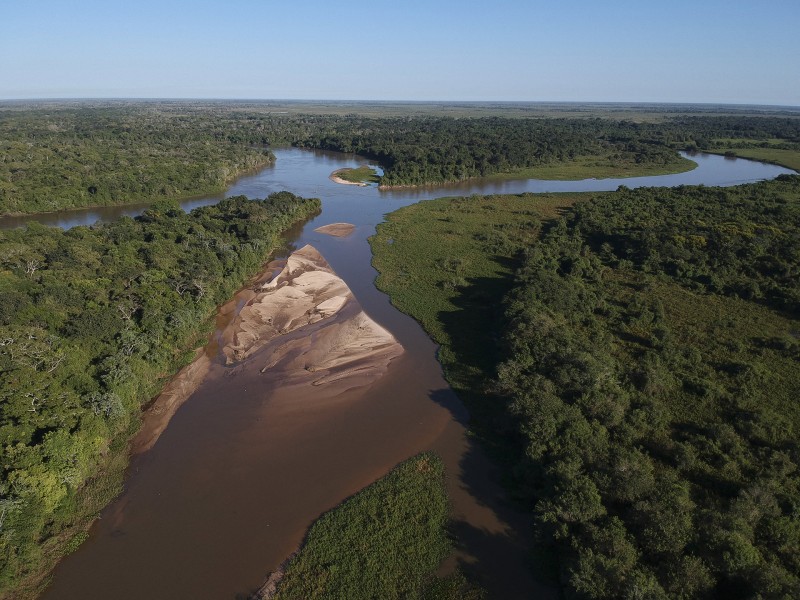
Organized crime groups are increasingly driving deforestation in the Brazilian state of Mato Grosso, the government’s environmental agency told OCCRP.
Illegal logging in protected areas increased by 85 percent in a one-year span from August 2023 through July 2024 as compared to the same period from 2022 to 2023, according to a recent report by the Instituto Centro de Vida (ICV), an environmental non-profit.
In the past, such deforestation was predominantly carried out by individuals and local groups, according to the Mato Grosso State Secretariat for the Environment.
“Today, there is a greater presence of structured criminal organizations with logistical, financial, and even armed capacity to operate in remote and sensitive areas,” the secretariat said in a statement to OCCRP.
The western state of Mato Grosso borders Bolivia and is largely covered by Amazonian rainforest. Logging is illegal in large swaths of forest, some of it home to indigenous peoples.
Of the total 49,000 hectares illegally logged during the one-year period analyzed by ICV, 17,800 hectares were in protected indigenous territories.
Ewésh Yawalapiti Waura, executive director of a local NGO called the Xingu Indigenous Land Association, said deforestation is a long-standing issue, but has intensified in the last six years.
He said members of his organization have documented 700 illegal clearings in Xingu territory, which is home to about 7,000 people from 16 ethnic groups spread across 2.8 million hectares.
“It’s all devastated now,” he said. “Our rivers are dying. There are indigenous people involved in the practice, and that creates conflict in our meetings.”
More than half of the illegal deforestation documented by ICV took place on land that is privately-owned, but still subject to the ban on logging. However, logging on private land declined to its lowest level since ICV began keeping records in 2013.
That’s because there is so little privately-owned forest available now, according to Vinícius Silgueiro, coordinator of ICV’s intelligence nucleus.
“There is a movement, driven by the lack of available forests on these properties, which puts increasing pressure on protected areas where timber resources are still found,” he said.
Other protected areas, known as “conservation units,” saw 4,677 hectares deforested, accounting for 10 percent of unauthorized logging during period analyzed from mid-2023 to mid-2024.
One conservation unit alone, the Guariba/Roosevelt Extractive Reserve, lost 1,800 hectares.
Raimunda Rodrigues, a 58-year-old mother of four, was born and raised in the Guariba/Roosevelt Extractive Reserve. She is part of a community known as the “ribeirinhos,” who live along rivers and make their living by fishing and extracting resources from the forests.
Rodrigues said she and the 70 families in her village find it increasingly hard to harvest rubber, Brazil nuts and Copaiba oil. The oil is extracted from several tree species and has uses including traditional medicine, food flavoring and an ingredient in varnishes and lacquers.
“It used to be rich in fruits, fish, and animals here, but today there is nothing left,” she said. “Catching a fish now takes a huge amount of work.”
The Mato Grosso State Secretariat for the Environment said authorities are working to improve their ability to fight illegal logging.
The secretariat said funds for combating environmental crimes have increased from 32 million Brazilian reais (about $5.8 million at current exchange rates) in 2020 to 125 million reais ($22.9 million) in 2025.