“State capture is when a narrow interest group is manipulating state policies or state functions for their own benefit,” says OCCRP Chief Impact Officer Alexandra Gillies, describing it as a process that systematically hollows out public institutions for the benefit of an elite few, at the expense of everyone else.
Analyzing 51 OCCRP investigations in 23 countries, the new report “Chronicling Capture: How Investigative Journalism Covers State Capture” identifies prominent trends in how state capture spreads in diverse political contexts, developing the very features that make it so dangerous as well as difficult to document and prove.
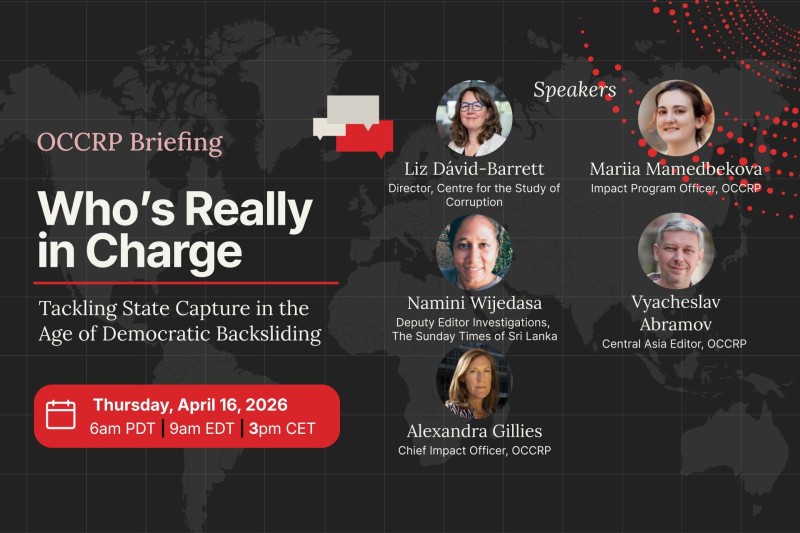
The report served as a centerpiece of the briefing’s discussions, moderated by OCCRP Central Asia Editor Vyacheslav Abramov.
In the briefing, OCCRP Impact Program Officer Mariia Mamedbekova outlined the three main pillars of state capture. The first, and often the hardest to investigate, is the capture of policy formation. This practice typically happens behind closed doors or is hidden within legitimate political processes, such as lobbying and campaign donations.
The second pillar is the capture of policy implementation. Mamedbekova noted this is often the easiest form of state capture to investigate, as it leaves the clearest evidence trail. Examples include various procurement-related abuses, such as state agencies tailoring contract requirements so only one company can qualify.
The third is the capture of the institutions designed to hold power to account — courts, auditors, and the media — turning the very bodies designed to expose wrongdoing into tools that instead strengthen the position of those doing the capturing.
Looking at OCCRP's reporting in Kyrgyzstan between 2021 and 2025, the report found all three pillars of state capture at work under President Sadyr Japarov and his close associates. Mamedbekova noted that journalists documenting state capture’s spread faced “increasing pressure and growing attacks” throughout.
Such attacks on journalists are a common tool of state capture, as they help those in power to control public narratives. As Gillies explained, politicians do so either because they are actively engaged in state capture themselves, or because “they've been captured by an external force, and that's part of the agenda they're being pushed to carry out.”
Beyond state pressure, private actors engaged in capture use SLAPP lawsuits, smear campaigns, disinformation campaigns, and propaganda to discredit and silence journalists.
Another challenge is getting people to recognize that state capture is an actual problem, said Namini Wijedasa, deputy editor of investigations at the Sunday Times of Sri Lanka.
“It’s become so commonplace now in countries like Sri Lanka, where I operate out of, that it’s almost normalized," said Wijedasa.
Not all hope is lost, though.
One way to push back against state capture, Mamedbekova said, is to “let the journalists continue to do their work.”
Liz Dávid-Barrett, director of the Centre for the Study of Corruption at the University of Sussex, echoed this statement, saying a “gradual build-up of evidence… starts to persuade people that there is something really important going on here.”
As for how to avoid state capture in the future, Gillies said we need to “hone in on… encouraging that type of investigative reporting… and then treat it like an early warning system.”
OCCRP Briefings are monthly events open to all OCCRP Advocates, Guardians, and Defenders. Join today and get access to past and future briefings. Contributions go directly toward funding our global network of investigative journalists.