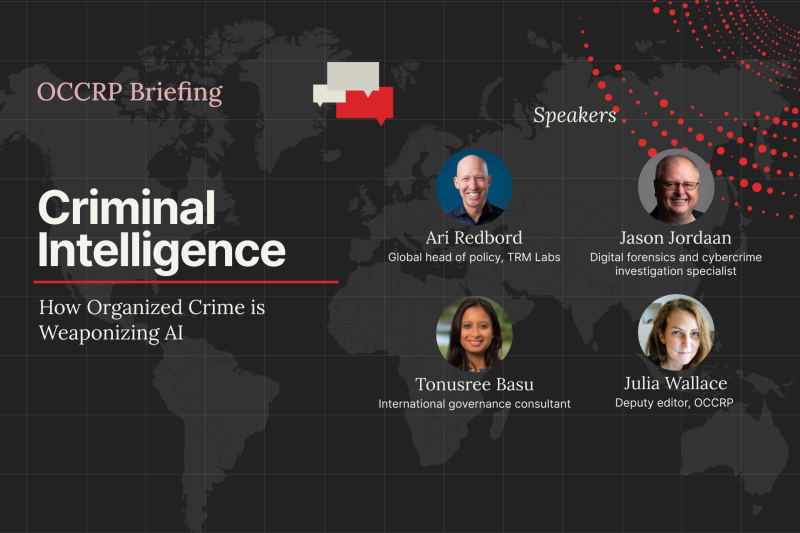
This OCCRP Briefing brought together Jason Jordaan, Ari Redbord, and Tonusree Basu — experts in digital forensics, financial crime policy, and international governance — to discuss how AI is reshaping the criminal landscape, and what that means for those working to counter it.
Organized crime groups have always been early adopters of new technologies, and AI is no exception, noted Jason Jordaan, a digital forensics and cybercrime investigation specialist.
“They have the resources, they have the capacity to engage with these new technologies, and they engage them quite easily. They'll try as many things as they can to see what sticks,” he said.
All agreed that organized crime is undergoing a rapid technological transformation. Once reliant on human labor and relatively crude digital tools, criminal networks are now embracing artificial intelligence to scale fraud, launder money, and evade detection at unprecedented speed.
Ari Redbord, global head of policy at TRM Labs, said the most immediate impact of AI adoption is not the creation of entirely new crimes, but the ability to carry out existing ones at far greater scale.
“Crime is becoming more organized in part because every transaction is global. It’s easier to communicate, and I think AI is supercharging a lot of that activity,” said Redbord.
Redbord was formerly a senior advisor for terrorism and financial intelligence at the U.S. Treasury and worked with teams from the Office of Foreign Assets Control (OFAC) and the Financial Crimes Enforcement Network (FinCEN), tackling some of the world’s most sophisticated threat actors, including North Korea and international drug cartels.
He warned that this evolution represents a shift from a law enforcement challenge to a national security issue, and increasingly a “civilization-level” threat.
“You don't just take out one colonial pipeline in a ransomware attack, you take out hundreds. You don't just take out one UK health system, you take out thousands. Supercharging this type of activity is a civilization-level threat.”
Jordaan, who has trained agencies including the FBI and the U.K.’s National Crime Agency, emphasized that this growing threat is also compounded by a critical lack of understanding within law enforcement. He warned that the “good guys” often view AI as “technological mumbo-jumbo” and lack a fundamental understanding of the mathematics behind the AI algorithms.
“Because investigators don't necessarily understand how AI works, they don't know how to essentially address the use of AI by threat actors out there,” said Jordaan.
“What really keeps me up at night is that threat actors use the technology, and then us as the good guys don’t actually understand how the technology works at the big time.”
Tonusree Basu warned that while much of the AI debate focuses on building more and better tools for implementation, the key challenge is a governance one.
Basu, who has spent significant time working on transparency and anti-corruption reforms with the World Bank and the United Nations, argued that regulation is essential and should not be seen as anti-innovation. She also highlighted the extreme concentration of power and resources in the AI sector, noting that just six or seven companies control the majority of data centers and key infrastructure.
“The ecosystem is very centralized, and a lot of these governments and law enforcement agencies all procure (their AI tools)… Very few actually build their own.”
Instead, she said, effective governance — similar to safety standards in industries such as automotive manufacturing or medicine — is necessary for innovation to function responsibly.
“You need basic regulation for the technology, innovation, and the research to work. Basic accountability tools that hold platforms accountable, that hold bad actors accountable, and protect vulnerable groups.”
Another challenge, Basu noted, is that AI regulation is limited by national borders, while cybercrime is inherently transnational. Basu emphasized that data-sharing mechanisms between countries are almost non-existent, leaving regions like Southeast Asia vulnerable to becoming hubs for unregulated cyber activity.
“We're seeing very little to govern things like data sharing, cooperation between regulatory and enforcement agencies, even to just track threats. What populations are being targeted? Where is some of this activity? There are some regions that are seeing the scale of activity be higher just because of these regulatory gaps.”
Both Basu and Redbord raised the need to strengthen collaboration between the public and private sectors, bringing together governments, financial intelligence units, the banking sector and civil society in order to share information.
Redbord said: “We don't live in a world anymore where the government has access to all the data they need, and the private sector, they may have the data, but they don't have the authority that the government has.”
Despite the grim outlook, it was emphasized that the solution lies in rapid upskilling. Redbord urged that the next generation of compliance officers and investigators must be "AI-native" in order to stay relevant.
“This whole thing is about speed, right? AI enables bad guys to move faster, and we need to leverage it for the good guys to move faster as well,” said Redbord.
"The genie is out of the bottle," Jordaan said. "We have to embrace it, we have to understand it and not be scared.”
OCCRP Briefings are monthly events open to all OCCRP Advocates, Guardians, and Defenders. Join today and get access to past and future briefings. Contributions go directly toward funding our global network of investigative journalists.