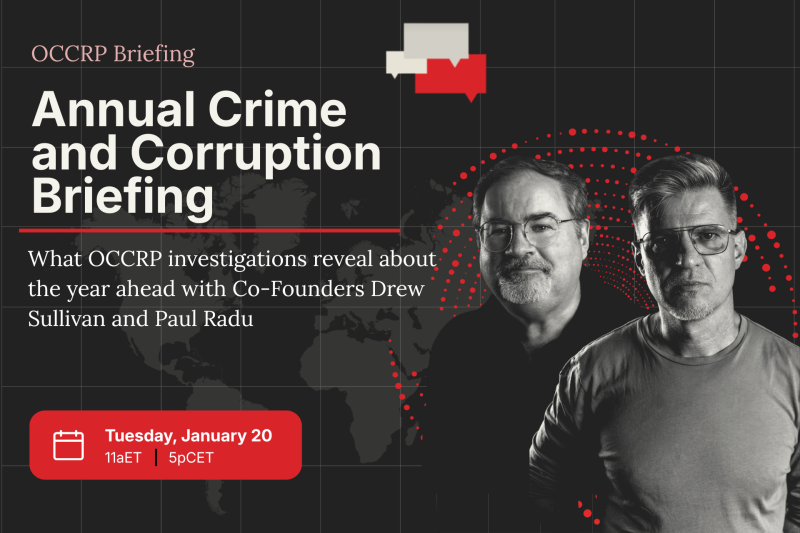
Artificial Intelligence is changing the way people operate across the globe, and the world of crime and corruption is no exception.
“These are golden times for criminals. 2026 is the year when white-collar organized crime will take over all sorts of organized crime,” OCCRP Co-Founder Paul Radu said.
This shift is partly driven by a tactic called “predictive kompromat,” where criminals use AI to cross-reference public records with leaked data to blackmail multiple targets at once. ("Kompromat" is a Russian term for "compromising material.")
By gaining leverage over specific targets like bankers, politicians, and shipping executives, wrongdoers can force cooperation to move and launder money on a massive scale.
Predictive kompromat allows criminals to “develop a cross-border network without moving from [their] chair,” Radu said.
OCCRP Co-Founder Drew Sullivan agreed, saying the internet changed the world “by a factor of a thousand,” but that AI would change the world “by a factor of a trillion.”
Criminals can now use AI to impersonate family members or convince people to support a specific political candidate, Sullivan said.
As these tools become more powerful, it’s going to be easier to “control people from abroad” and “steal votes across… a global landscape,” he said.
OCCRP is adapting to these high-tech threats by taking “investigative reporting into a completely new place… to become more like a research and development center for the world," Radu said.
Sullivan said the role of OCCRP’s journalism goes beyond just reporting: “Media is not about an incremental change in what’s happened since yesterday, it’s about telling people how the world really works, and how they can be involved in changing it.
"The public is our partner in this. We have to empower them, we have to help them.”
To thrive in this changing landscape, Sullivan and Radu offered advice to people who are working to fight crime and corruption.
Sullivan stressed the importance of learning AI, no matter what business you’re in. It can “give you ideas on things you should be looking at, and can help identify connections in people you thought were pretty clean, who actually may not be.
“AI really is only limited by your creativity," Sullivan said.
As with all OCCRP briefings, attendees were given the opportunity to ask questions, which ranged from asking about OCCRP’s recent distributed denial-of-service attack to whether new technology might create fresh vulnerabilities for criminals.
AI can be beneficial to investigators while analyzing leaks, Sullivan said, and that a single lead can shine a light on hidden crimes and collapse criminal networks in ways that were never before possible.
The final question invited the co-founders to share their thoughts on what those fighting crime and corruption should focus on next.
Radu’s advice was to “pick your battles.”
He urged attendees to focus on “attacking the infrastructure that allows the crime, rather than losing a lot of time and resources in tackling… smaller crimes. Because the smaller crimes are always part of something bigger."
Once criminals find a successful way to attack an organization, they exchange their methods with other criminals, Radu said: “crime is a commodity.”
This strategy works because most organizations don’t share information with each other. By staying silent, these organizations allow criminals to stay one step ahead of them and repeat the same patterns.
The only way to take away this power is to start communicating about the attacks they face, noting that criminals are “counting on you not communicating… and this is where a lot of their power comes from,” Radu said.
As we continue into 2026, “It’s really a fraught time,” Sullivan said. “That could lead to either violence or a really positive change, and that really is up to us.”
OCCRP Briefings are monthly events open to all OCCRP Advocates, Guardians, and Defenders. Join today and get access to past and future briefings. Contributions go directly toward funding our global network of investigative journalists.