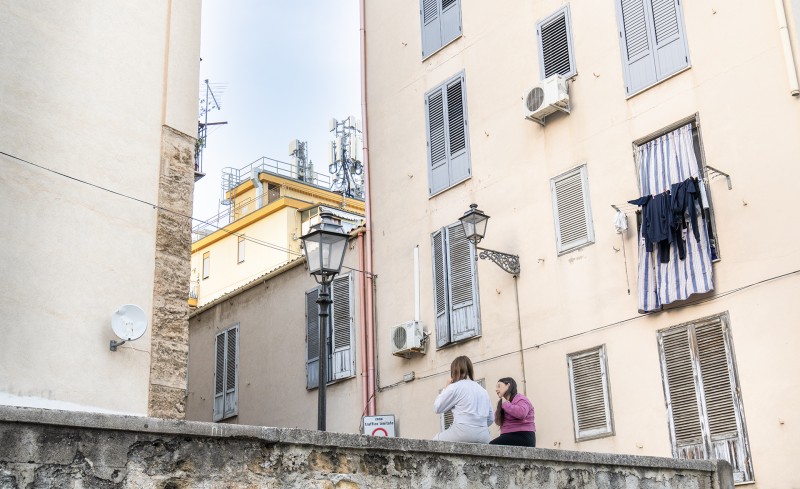
From her modest office overlooking Palermo’s juvenile prison on the island of Sicily, Claudia Caramanna is working to strike the Italian mafia where it hurts most: the family.
Since becoming head of the city’s juvenile prosecutor’s office in 2021, she has opened hundreds of cases aimed at stripping organized crime figures of parental responsibility and placing their children with foster families, distant relatives, or protected communities, she said.
The goal is to sever “the genetic code passed from parent to child that keeps the Cosa Nostra alive,” she said, referring to the Sicilian mafia, adding that “children raised in mafia families don’t have the freedom to choose a life without crime.”
Caramanna is also trying to persuade mothers — many of whom are raising children alone while their partners serve long prison sentences — to leave behind organized crime.
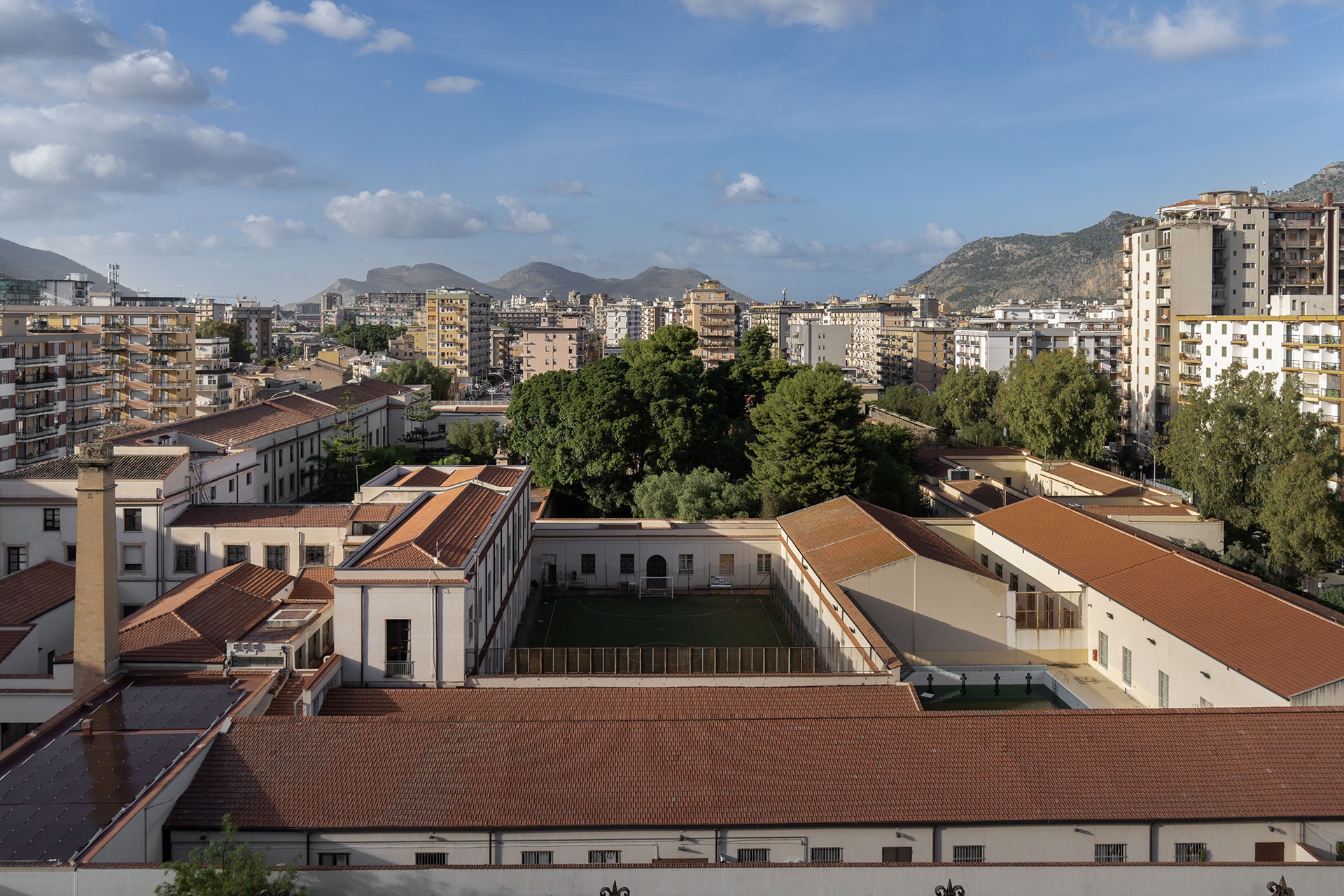
Malaspina juvenile prison in Palermo, Sicily, Italy. Separating children from their mafia-aligned parents is used as a last resort to target mafia families.
A draft law aimed at providing state support to children and mothers who leave mafia families has just been filed in the Italian Parliament and will be officially presented on January 15 as part of a first step in a potential legislative process.
“The law is urgent,” said Senator Enza Rando, who sits on the Italian Parliament’s Antimafia Commission, adding that she hopes gaps in the national law can be addressed by the draft bill. Mothers and children who escape the mafia currently have no right to state protection and are exposed to reprisals, she said.
Caramanna’s effort builds on juvenile judge Roberto Di Bella’s “Free to Choose” (Liberi di Scegliere) campaign, which started more than a decade ago in the Calabria region — the base of power for the ’Ndrangheta, now Italy’s most powerful mafia syndicate.
Supported by Italy’s main anti-mafia organization, Libera, Free to Choose helps settle children and their mothers in secret locations away from their parents, severing the blood ties and loyalty that define mafia organizations. Typically, parental responsibility may be revoked when a parent has been convicted.
The program — which was initially condemned as an effort to deport children by detractors, including some clergy — is now funded by the Italian government and the Italian Bishops’ Conference, the main body governing the Catholic church in Italy.
One woman who fled her ’Ndrangheta husband for protective custody said in an audio statement recorded by Libera and provided to OCCRP that her “ordeal began” when she fell in love and became pregnant.
She felt a “growing worry” that her children might “take the wrong path,” she said, adding that her decision to leave was “driven by maternal instinct” and the desire to “raise my children as normal, honest kids.”
“As a wife, I was treated mostly like a slave. I had to endure continuous humiliations without ever being truly taken into consideration. I was always put aside … Regarding my children, until he was arrested, the final word was always my ex-husband's.”
“To all the women who are thinking of taking this step, I say: Don’t be afraid. Disobey the mafia. Disobey these families.”
Shielded From Retaliation
According to both Caramanna and Di Bella, minors are the mafia’s first workforce, frequently recruited into criminal activity before adolescence. Since 2021, data show that juvenile drug offenses in Palermo have nearly doubled, reaching pre-COVID era levels. “There is a reason why minors under 14 are involved in illicit activities: they can’t be prosecuted,” Caramanna explained. “And they have no idea how serious their actions are. It’s what they were born into.”
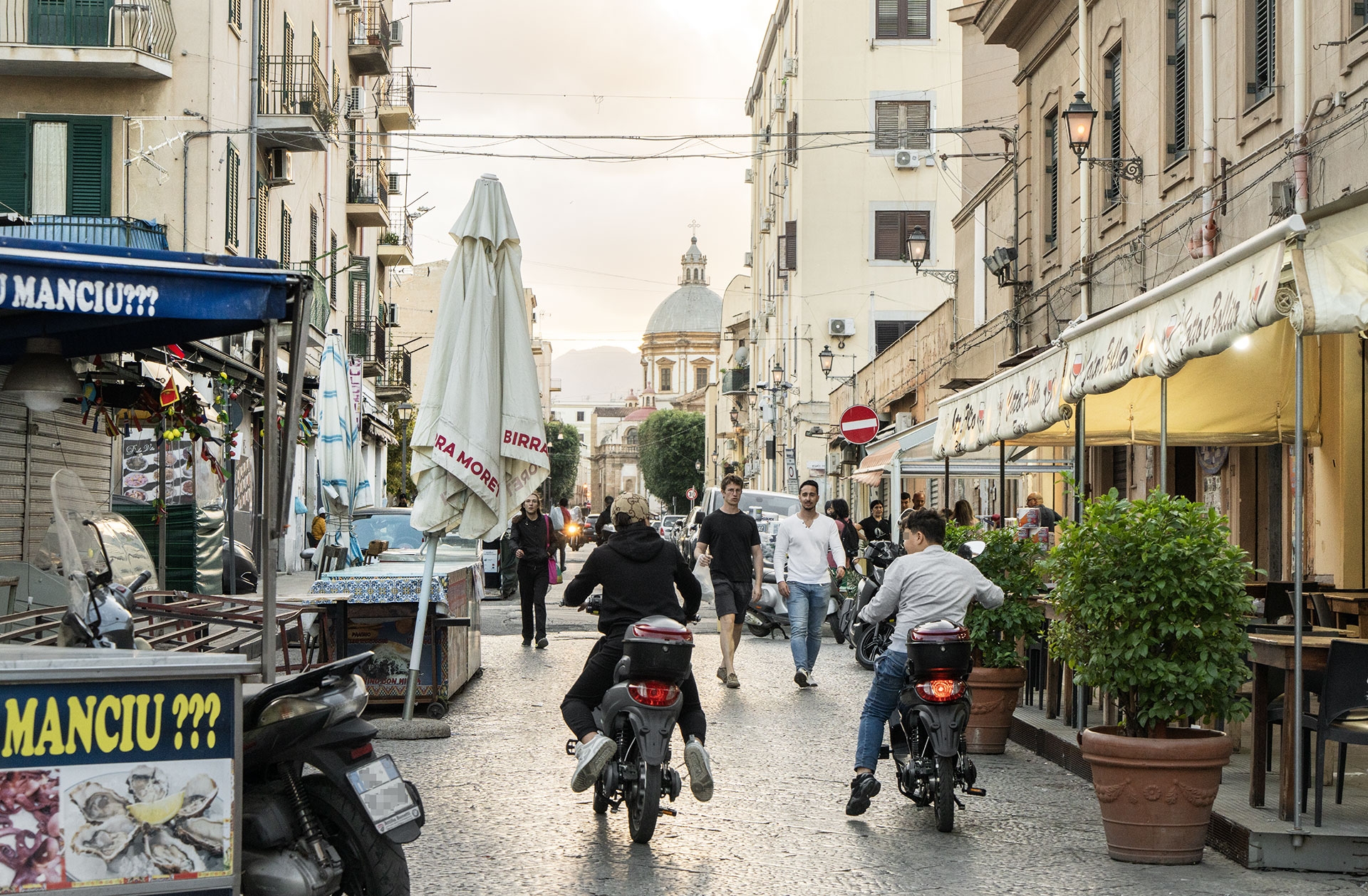
Children riding motorbikes in the neighborhood of Ballarò, Palermo, Sicily, Italy. Data shows juvenile drug offenses have nearly doubled in the city since 2021.
“In cases where the program takes on children removed from mafia families, they are placed in foster homes with specially trained families,” said Giorgio De Checchi, a Catholic priest who oversees Libera’s program.
The program maintains contact between children and family members who are willing to break with the mafia, he said, while controlling interactions with those who remain involved.
When mothers leave with their children, De Checchi said Libera provides them with a place to stay, helps protect their identities to shield them from retaliation, and offers professional training and help finding jobs — a process that can last from one to three years.
According to De Checchi, the success of the removals relies on integrating the children — and their mothers, if they go along — in new communities where they can build up friendships and trust with others.
“The crucial element is to provide meaningful emotional bonds and ties to where they move. It’s the relationships that make the difference; otherwise, they will return to the environment where they feel recognized.”
The program’s initiator Di Bella told OCCRP that the idea to remove minors from their families struck him while handling the case of a boy who Di Bella said was the son of a murdered ’Ndrangheta boss.

Juvenile Judge Roberto Di Bella, who started the “Free to Choose” (Liberi di Scegliere) mafia-family separation program more than a decade ago in Calabria, Italy.
The boy’s three older brothers had all passed through his courtroom and ended up in prison, he said. Di Bella said he acquitted the boy over the vandalization of a police car — but then decided to try to remove him from Calabria.
He was transferred to Sicily, where he was supported by a social worker and a psychologist, and enrolled in an educational program, according to Di Bella.
In 2020, Di Bella moved to head the Juvenile Court in Catania, Sicily, and brought the program there to counter the Cosa Nostra syndicate.
He said the justice system has removed more than 200 minors from known mafia families across Italy. According to Di Bella, among those who have already become adults, 80 percent have chosen not to be involved in organized crime.
The program has also enabled 34 women to leave mafia households, he said, adding that “we realized that children could also be a pull factor, giving mothers the courage to break away.”
“They began to talk, to confess their suffering: ‘At night I can’t sleep until my son comes home, for fear he will be killed.’ When we started to remove the children, paradoxically, we also allowed mothers to leave, breaking them free.”

A memorial dedicated to 26-year-old Emanuele Burgio, killed on May 31, 2021, in Palermo's Vucciria district, Sicily, Italy. Emanuele's father was previously convicted of mafia-related offenses.
The program has also had unexpected consequences, said Di Bella: It has convinced three high-profile mafia bosses to become state witnesses.
An Extreme Measure?
Yet some placements have failed. In a “small minority of cases,” young people have gone back to the mafia and engaged in drug trafficking and extortion activities, said De Checchi.
“It would be misleading to pretend that every time we succeed. But offering them an alternative perspective is always worth the effort; it is a chance to give them another point of view.”
But outside critics still question the wisdom of tackling the problem through drastic measures like removing children from their families, instead of more gradual reforms.
Costantino Visconti, a professor of criminal law at the University of Palermo told OCCRP that “there is no such thing as the mafia’s genetic code.”
“After the shock of seeing a father arrested, there may be a second shock when told you must be removed from your parents. Are we sure this builds trust in public institutions? I think there should be a public debate about it.”
“I don’t believe the justice system should take the lead, except in the most extreme cases. Revoking parental responsibility should be the last option, used only when mafia involvement completely conditions family life.”
As a general guideline, taking a child from their family should “always be seen as an extreme and exceptional measure” used only to safeguard the child’s well-being, Italian Ombudsperson for Children and Adolescents Maria Terragni told OCCRP.
“Even in the best-case scenario, the separation from one’s family of origin is always traumatic and something the child will carry for life.”
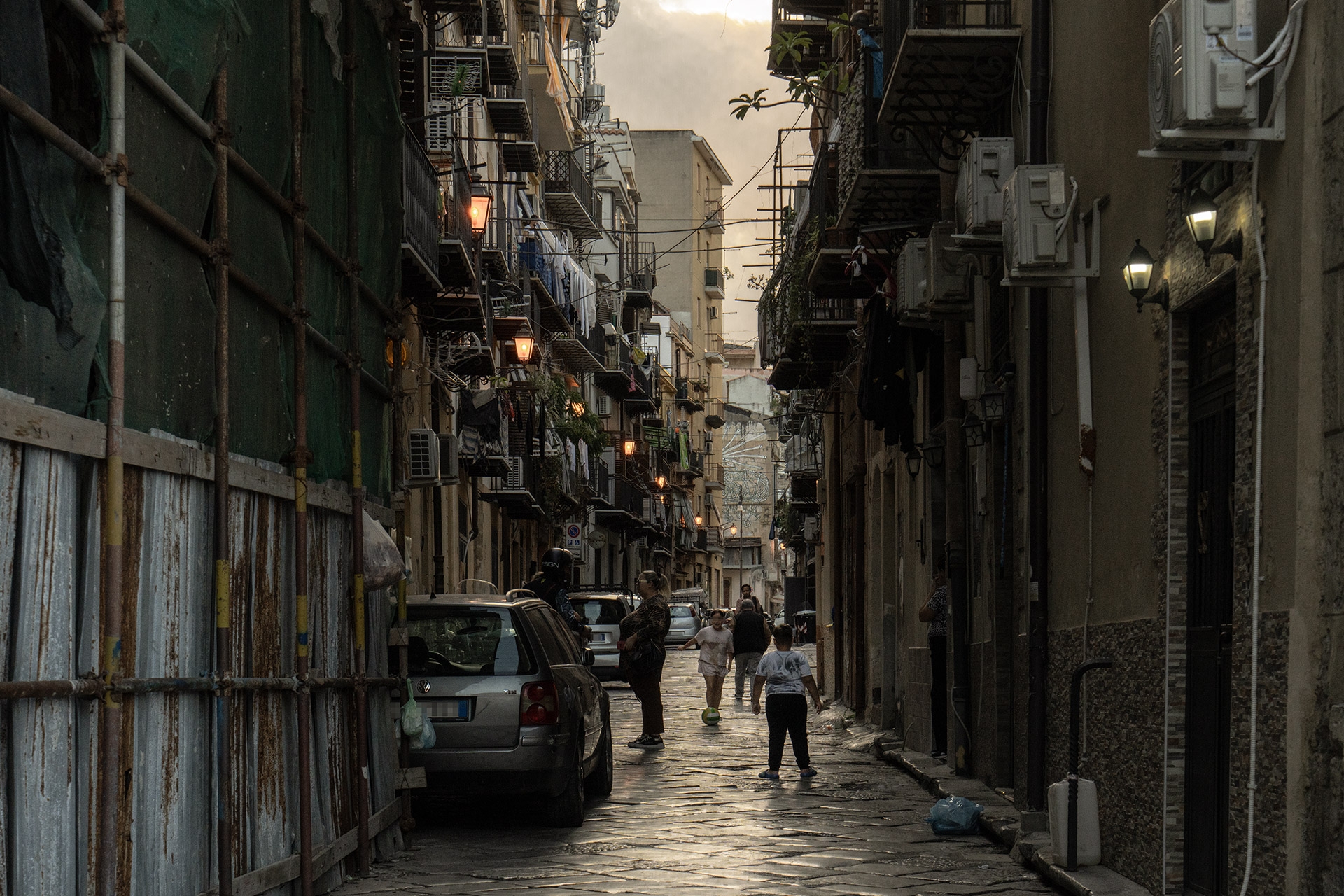
Children playing in the streets of Palermo, Italy. The city is one of the seats of the Sicilian Mafia, known as Cosa Nostra.
The Free to Choose program was described as “an essential part of child-protection measures” in Calabria by Anna Sergi, a professor of sociology at the University of Bologna, in a 2018 study.
But there is still a lot to be done to train all the professionals involved in these cases adequately, said Di Bella, adding that implementing the measures can be particularly difficult because social workers are hindered by fear of mafia reprisals.
The current legal framework’s biggest weakness is highlighted by one of the Free to Choose program’s most notable supporters: Senator Rando, who has been involved with the project since its inception and even sheltered some mothers fleeing mafia marriages.
“Right now, these women can’t even change their names, which means they can’t legally work,” she told OCCRP, while emphasizing the importance of the new proposed law to protect women and children escaping mafia families
“Having the chance to earn money is their way to freedom. But if they sign a work contract, the mafia can track them. Many of them face death threats,” she said.
The proposed draft law, shared with OCCRP, would establish national assistance for mothers and children fleeing the mafia, including surveillance, security protection, and cover identities.
A Cycle of Violence
At her Palermo office, Caramanna stressed her careful approach to proposing the revocation of parental responsibility, adding that it is never a permanent measure, but one that is periodically reviewed.
As a mother of three, she said she was aware of the trauma family separation can cause, even in cases where the child has experienced abuse or neglect.
“It’s always a painful decision, but sometimes it’s the only way to try to save a child,” she said, adding that her parental responsibility caseload is growing because of improved systems and information sharing.
“There are constant, serious threats. When I learnt from wiretaps that they know my daughter's name and age, it's terrible. When the threats concern me, I carry on. But when they involve my children, I have an even greater responsibility,” she said.
Before ending the interview with OCCRP, Caramanna glanced out the window toward the juvenile prison.
“If we want them to choose differently, we have to offer something. Jobs, stability, dignity. Otherwise, they go back to dealing drugs and the cycle begins again.”