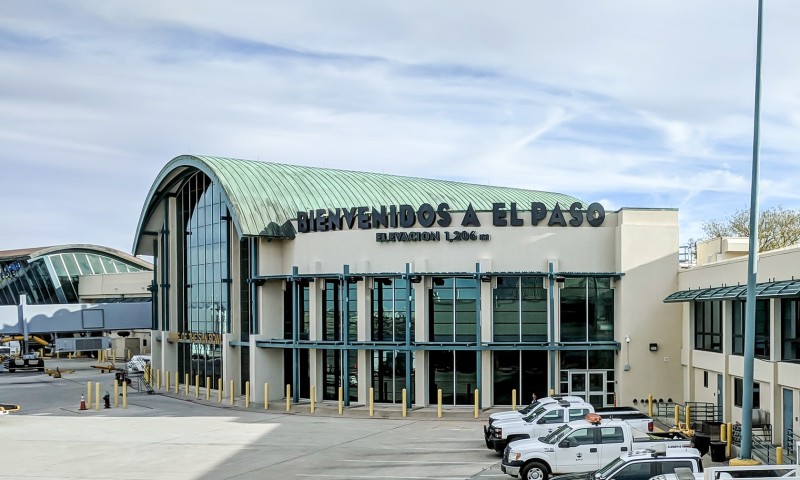
Airspace over the Texan border down of El Paso was abruptly closed last week when U.S. officials used a laser to shoot down what they said were Mexican cartel drones — but which reportedly turned out to be a party balloon.
In the wake of the debacle, Vanda Felbab-Brown, director of the Brookings Institution think tank’s Initiative on Nonstate Armed Actors, spoke with OCCRP about the real ways in which Mexican cartels are deploying drones, and what the future holds as these violent groups face heat from the Mexican and U.S. governments.
We're now hearing this was party balloons, not a phalanx of Mexican cartel drones, hovering over El Paso. But in your work you have discussed the ways some cartels do indeed use drones. Can you tell us a bit about what they're used for?
Mexican cartels have been using drones for over a decade, for a wide variety of purposes. This includes monitoring where law enforcement is present. This includes smuggling drugs within Mexico to prisons, as well as other contraband like cellphones, but also across the U.S.-Mexico border. As drone payloads have become larger, this has become more feasible, although obviously the current drones are still not efficient for moving large amounts of cocaine.
They have also been using drones to conduct actual military attacks. This includes attacks against law enforcement officials. And they have been using drones for attacking their rivals or controlling populations in Jalisco. In Michoacán, the Jalisco New Generation Cartel has been using drones to [lay] mine fields to attack villages, and depopulate areas in order to control places where they aren’t as embedded as rival cartels.
U.S. President Donald Trump has said the cartels are running Mexico. How accurate is a statement like that?
Well, the cartels are certainly running parts of Mexico. Across the country, you have various parts of rural areas that are really controlled by the narcos. That doesn't mean that the criminal group declares [the area to be] a republic of the criminal group, but they dictate terms to law enforcement and government officials on a wide variety of policy decisions, including whether officials can [provide licenses to] open more alcohol shops or bars, for example. They, of course, control how much or how little law enforcement at the local level can operate.
They have tremendous influence at the state levels through corruption and intimidation networks. And they have taken over not just illegal economies, but also many legal economies in Mexico, such as retail of consumer goods, alcohol, cigarettes, legal fisheries and legal logging. At least until the arrival of President Claudia Sheinbaum’s administration in 2024, they were expanding their territorial control, control over populations, control over legal economies and government officials, as well as elections.
Within the Sheinbaun administration, we see much more of a pushback against the cartels. This has been in part the result of Trump administration pressure. The Sheinbaum administration came in determined to do more for its own reasons, following the abject failures of the Andres Manuel Lopez Obrador administration, which essentially gave the cartels a carte blanche.
But in my view, it's undeniable that the pressure from the Trump administration in various forms — the designation of the cartels as foreign terrorists organizations, tariffs, the verbal linkages between the USMCA [free trade agreement among the U.S., Mexico and Canada] and security issues, and of course, the threat of U.S military actions — are all creating very significant incentives for the Sheinbaum administration to take on the cartels more.
The one caveat I would say is if the Trump administration actually resorts to military actions, that will burn a lot of the leverage that it has achieved with the Sheinbaum administration. It is the threat of military action, the shadow of the foreign terrorist organization designation, as well as the tariffs that have created significant influence.
When the airspace over El Paso closed, some commentators thought it indicated the U.S. was about to attack Mexico. Did you think that?
I do think that military action is very well possible. Certainly, when running for president in 2024, Trump and most U.S. Republican politicians endorsed military strikes in Mexico. They believed this would be the end of the cartels. I don't believe so. Nothing short of a prolonged multi-year counter-insurgency operation would be sufficient to destroy the cartels and of course the United States doesn't have any appetite for that and Mexico would not put up with it.
So the military operations that are on the table are airstrikes, drone strikes, or limited special operations forces raids, which amount to the destruction of some drug labs and the arrests of some high value targets – policies that have been underway in Mexico with different levels of intensity over the past 20 or 25 years. They might feel good for some U.S. politicians, but they are not fundamentally going to change the lack of rule of law in Mexico and the high power of the criminal groups.
Last month, you wrote about how the cartels might respond to U.S. attacks. Can you briefly tell us what you think might happen?
How the cartels might retaliate will be a function of what kind of strikes would actually take place. If you have one or two limited strikes, it’s business as usual for them. Whether they are conducted by Mexican security with U.S. intelligence, or by U.S. military forces directly, they simply ride it out.
The cartels will try to mobilize political opposition against the strikes by amplifying nationalist messages, perhaps putting pressures on politicians to oppose U.S. actions and wrapping themselves in the mantle of nationalist Robin Hoods.
If we were to see sustained action by U.S. forces, then there are a variety of counter measures, from attacking Mexican government officials or Mexican forces to potentially attacking U.S. agents on the ground in Mexico, or U.S. military forces in Mexico. Consulates could become a target. But those are really high levels of escalation, and these are not going to be the first responses of the cartels.
They'll first try to go after the Mexican targets. Eventually, the target list could also include U.S. people living in Mexico, of which there is at least one million, perhaps more. And ultimately, even perhaps targeting the homeland, not so much through violent assassinations — that is in the realm of the imaginable, although very, very unlikely.
And what about the possibility of cartel drone incursions?
The future is here. Criminal groups are using drones for a variety of reasons. And as we will see the increased use of commercial drones within countries, and perhaps across countries, to move products, in a few years, it will be harder and harder to distinguish which drones are legal drones carrying legal goods and which are drones carrying contraband.
Obviously, there will be mixing of those. Criminal groups might want to steal the electronic signatures of registered drones to pretend they are carrying legal cargo. Both increased legal traffic and illegal traffic, of course, generates all kinds of risks to air traffic, including inadvertent accidents.
And so both criminal groups flying drones and responses toward them might hamper civilian air traffic. Obviously, there will be an effort to optimize military and law enforcement responses, deploying countermeasures that have less disruptive effects. But both of them may snarl up traffic and hold up civilian uses of space, whether it's for passengers or for cargoes.