Reported by
With U.S. sanctions lifted, international mining companies are poised to dive back into the vast reserves of Venezuelan gold buried beneath the country’s lush southern jungles.
But it’s unclear how they plan to deal with the armed groups that run the mines, and experts warn that it will be difficult to eradicate them without triggering violence.
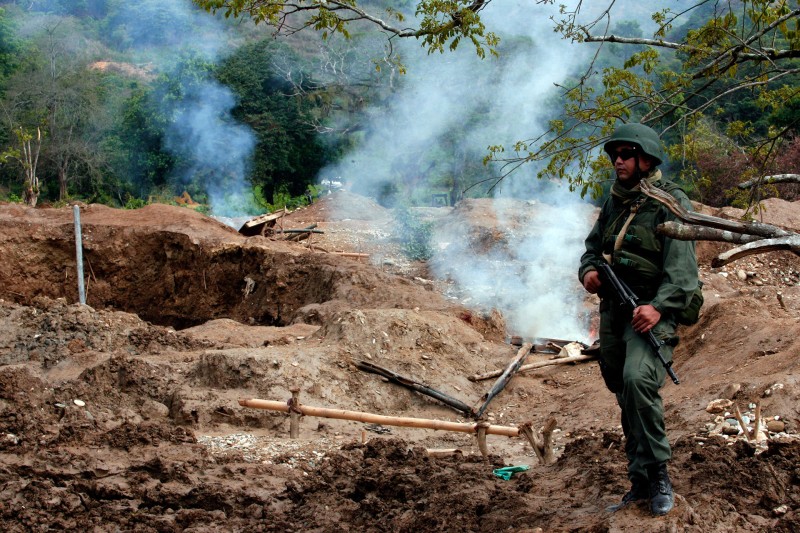
Following nationalization 15 years ago, Venezuela’s gold sector has become rife with environmental and human rights abuses under the watch of a mix of local criminal gangs and Colombian guerillas who run the trade. Many international brokers won’t touch gold from Venezuela, with much of it now smuggled out of the country and rebranded with a different origin.
But after capturing former Venezuelan President Nicolas Maduro earlier this year, the U.S. has lifted sanctions to allow gold imports, and the current Venezuelan government is eager to capitalize on the opportunity. A new mining bill vowing to clamp down on illegal mining and clean-up the sector has passed its initial vote in Venezuela’s legislature.
Washington has said that any gold imports will have to “meet standards of U.S. law,” and that companies will be required to provide “supply chain due diligence plans to determine the chain of custody of the gold.”
Experts warn this will be difficult as long as militias remain in control of the mines.
Currently, the supply chain is a “black hole” of “blood gold laundering” where illegal and legal gold sources intermingle, said Cristina Burelli, an analyst with the Venezuelan nongovernmental organization SOS Orinoco.
“A very complex, difficult job of dismantling the criminal structure that exists there has to happen first,” she said.
Bram Ebus, a researcher with the U.S.-based non-profit International Crisis Group, said there is no way to enter the sector without “confronting armed actors willing to use local populations as human shields, or extort foreign corporations.”
For any foreign companies involved, this means that “financing terrorist organizations becomes a plausible risk.”
The process is nevertheless moving at what one U.S. official has dubbed “Trump speed,” with global commodities trader Trafigura having already signed a multimillion-dollar deal with Venezuela's state-owned gold mining company, CVG Minerven, at the start of the month.
The deal was inked four days before Washington issued General License 51, which officially unblocked the gold trade.
“This agreement complies with a licence issued by the Office of Foreign Assets Control of the US Department of the Treasury,” Trafigura said in an emailed response to questions from OCCRP.
When asked about how the company would make sure the gold they trade was not tainted by conflict or rights abuses, they said: “We are working with our counterparty jointly to implement a responsible sourcing programme.”
A person familiar with the matter, who withheld their name as they were not authorized to speak to the media, told OCCRP Trafigura would not have signed on without already having received the required licenses from OFAC.
They added that Trafigura needs “assurances” that any gold imports will be free from human rights and labor violations, because U.S. customs will be “very strict” on what they let through.
Meanwhile, a person close to another major mining company, Gold Reserve, told OCCRP that the firm is starting negotiations with the Venezuelan government to reclaim the operations it lost to nationalization.
The individual, who was not authorized to speak to journalists, said the major challenge to returning will be securing the blessing of leaders of the local armed groups: “This is a project of national interest [and] without them, it’s going to be difficult.”
Gold Reserve did not respond to requests to comment, though its CEO Paul Rivett previously told Bloomberg that the company plans to quickly make efforts to reclaim gold and copper concessions that were seized by the Venezuelan state.
The London Bullion Market Association, a gold certification agency, said it is "closely monitoring the updates in relation to sanctions on Venezuelan gold” and did not comment directly on the ethical issues around the supply chain.
A spokesperson for Venezuela’s government did not respond to a request for comment before publication. The office of U.S. Interior Secretary Doug Burgum did not respond to a request for comment before publication.
Critical Minerals
Speaking from Caracas on March 4, Burgum hailed the unblocking of sanctions on Venezuela's gold as a strategic necessity to break China’s global monopoly on critical minerals.
But no one has explained how the Venezuelan government plans to regain control of the Orinoco Mining Arc, a zone that was created by Maduro in 2016 for the extraction of gold, coltan, and diamond, and makes up 12 percent of the country’s territory.

Former President Nicolás Maduro speaking at a press conference with international reporters in Caracas on May 17, 2016.
The draft Venezuelan law rebrands the mining zone as an investment opportunity, and calls for a new mining security force to dismantle illegal operations and combat illicit mining extraction.
But it avoids any mention of the armed gangs or guerrillas who control the territory.
In the last decade, local gangs, criminal syndicates, military units, and Colombian guerillas maneuvered for control of the mines, according to multiple reports, including one from the International Crisis Group.
The United Nations High Commissioner for Human Rights has also documented serious human rights abuses in the region, including sexual exploitation and trafficking.
A former miner who worked in Venezuela’s gold belt, and who requested anonymity for security reasons, described a system of state complicity in corrupt, lawless fiefdoms that any foreign company will have to negotiate with to access the mines.
He said that gold miners pay a 10 percent tax on daily profits from each mine to the boss of local criminal gangs known as ‘sindicatos.’ The boss then pays the government “its share and the government stays out of it,” the former miner said.
The sindicatos organize light municipal work and prevent violence, the miner explained. He added that army and government officials receive a cut from gold sales, but do not police the mines.
“If those systems — those sindicatos — didn’t exist, there would be robberies, kidnappings, chaos, fighting,” he said.
Going Over Old Ground
The draft mining law being fast-tracked in Caracas allows for international arbitration to settle disputes — a large incentive for companies like Gold Reserve to return.
Gold Reserve, initially a Canadian company that is now headquartered in Bermuda, started mining in Venezuela in the 1980s but was kicked out in 2011 when former President Hugo Chavez nationalized the mines, and declared all gold state property. The company then pursued the state for more than $1 billion in lost investments.
Gold Reserve’s major area of exploitation in Venezuela covered the Brisas and Las Cristinas deposits, which hold an estimated 52 million gold ounces. Combined, the deposits make up the largest gold-mining project in South America, and the fourth‑largest globally, according to company documents.
In 2016, the company reached a partial agreement with Maduro’s government to resume operations, but the joint‑venture never materialized and Gold Reserve parted ways with Venezuela once again.
But Washington’s moves to allow gold imports, along with Venezuela's expected legislation, are opening the door for Gold Reserve and other companies anew.
According to the person close to Gold Reserve who spoke to OCCRP, the negotiations to restart operations are “just beginning.”