Reported by
Since October, Cambodia's Prince Group has been under siege from authorities around the world, including the U.S. which dubbed it a “transnational criminal organization.”
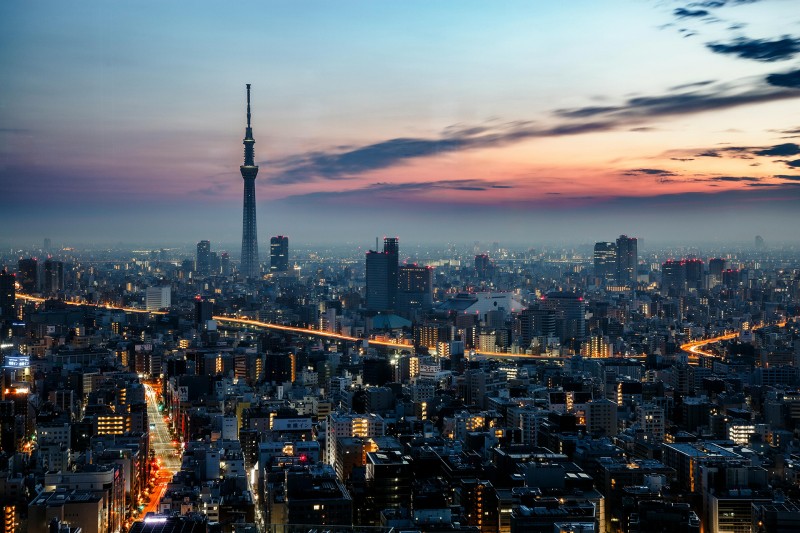
Japanese authorities have so far remained silent, but flight and property records show that directors of several firms linked to the Prince Group have established a footprint in that country too.
In its October 14, 2025, sanctions announcement, the U.S. alleged that the Prince Group operated “industrial scale cyberfraud operations” in Cambodia, which were run out of “compounds reliant on human trafficking and modern-day slavery.”
A Prince Group spokesperson dismissed allegations against the conglomerate and its chairman Chen Zhi, who has been sanctioned and indicted in the U.S.
“Mr. Chen and his companies were not a criminal syndicate but a collection of legitimate businesses serving millions of people and employing tens of thousands of people across the globe,” the spokesperson said by email.
“Chen Zhi and the Prince Group of companies are innocent of the wild and unfounded accusations made by the U.S government, parroted in jurisdictions around the world,” the spokesperson added.
Among other global actions against the Prince Group, the U.S. has sanctioned dozens of companies, and the U.K. has frozen more than $200-million worth of property held by directors and entities linked to the conglomerate. The U.S. Treasury Department released a map showing Prince Group "offshore hubs and shell companies” in jurisdictions including Hong Kong, Laos and the British Virgin Islands.
Japan is not on the map, and authorities there have not made any public statements about investigating the Prince Group. A person who answered the phone at police headquarters in Tokyo said they were unable to answer questions.
However, Japanese media have reported that individuals tied to the Prince Group have traveled to the country and purchased properties. Japanese media have not named those individuals, but property and flight records show who they are.
Tokyo Mansions
OCCRP’s Japanese media partner, Tansa, obtained records showing that a director of companies linked to the Prince Group owns land in Chiba prefecture, on the eastern outskirts of Tokyo. That man, Chen Bo, purchased property in 2019 in a gated community called “One Hundreds Hills.” A 2,365-square-meter home sits on the plot of land.
Originally from China, Chen Bo acquired a Cambodian passport in 2014, according to the government’s citizenship gazettes.
While Chen Bo has not been sanctioned himself, Cambodian corporate records show he served as a director at nine companies that were. These include Byex Exchange Co. Limited and Tian Xu International Technology Plc, which the U.K. sanctioned for allegedly providing financial services to the Prince Group.
The mansion on the outskirts of Tokyo adds to another one Chen Bo bought downtown, near Zenpukuiji Park, just days before the U.S. and U.K. imposed sanctions on Prince Group. Shortly after those sanctions came down, he transferred the property to his wife.
Japanese media have reported that the two properties are together worth about $7 million, although they have not named him as the owner. The financial sources used by Chen Bo to secure these real estate holdings remain unclear.
Chen Bo did not respond to requests for comment emailed to his companies. A person who answered the phone at CCU Commercial Bank PLC, where he is listed as chairman, said there was no “staff member called Chen Bo” and hung up. A person who said he was his former assistant at another company he chairs, Billion Wisdom Investment Co Ltd., said Chen Bo “is in China now.”
Corporate filings link Billion Wisdom Investment to another China-born Cambodian passport holder named Su Chang, who serves as co-director. Land records show that Su Chang purchased an apartment at Wellith One Aoyama, a prime development in the heart of Tokyo’s Minato neighbourhood, in 2021.
Su Chang did not respond to requests for comment emailed to his companies. The person who answered the phone at Billion Wisdom Investment said the company directors were not in Cambodia, and did not provide contact details.
Japanese land records show one more director of a Prince Group-related firm with real estate in Tokyo: Brendon Luo purchased a luxury apartment in the downtown neighborhood of Shibuya in May 2025. He is also from China and holds a Cambodian passport, according to the government gazette.
Also known as Luo Pinghua, Brendon Luo is listed in the Cambodian corporate registry as a director at Prince Plaza Investment Co. Ltd. The head of the Prince Group, Chen Zhi, is listed as the firm’s chairman. While Brendon Luo has not been personally sanctioned, the U.S. Treasury Department targeted Prince Plaza Investment as part of the Prince Group network.
The Treasury Department did not specify the exact commercial activities of Prince Plaza Investment, but listed it among more than 100 sanctioned companies it said were “owned or controlled by, or purport to act for or on behalf of, members of Prince Group TCO [transnational criminal organization].”
Brendon Luo did not respond to requests for comment emailed to his companies, including Prince Plaza Investment. A person who answered the phone at Prince Commercial Trading Co. Ltd., where he is listed as chairman, said Brendon Luo was not present and that he could not provide contact details.
Jets to Japan
Flight records obtained by OCCRP show that Su Chang was a passenger on recent private jet flights into Japan together with Hu Xiaowei, who has been sanctioned by the U.S. and U.K. in relation to the Prince Group.
Su Chang has not been accused of illicit activity or targeted by sanctions.
OCCRP recently revealed that Hu Xiaowei goes by at least four different identities, and had previously unreported ties to both the Prince Group and its sanctioned chairman, Chen Zhi.
The U.K. government froze several properties belonging to Hu Xiaowei after OCCRP reported on his multiple identities, and revealed that he had purchased London properties worth more than $44 million.
The jet that made multiple trips to Japan in recent years is owned by CN Breeze Limited, a shell company Hu Xiaowei controls through Future King Inc., his British Virgin Islands entity. He owns Future King under his alias, Wu An Ming, according to recent Hong Kong stock exchange filings.
Flight records show the jet made multiple trips to Japan beginning in March 2023. They included at least two trips from Phnom Penh to Japan following the U.S. Treasury Department’s October 2025 announcement of sanctions against 146 entities and individuals.
Earlier this month, Hong Kong’s Department of Justice applied for a freezing order against Future King Inc., along with other assets belonging to Hu Xiaowei, OCCRP reported.
International Actions
The U.S. and U.K. spearheaded the crackdown on the Prince Group in October 2025, sanctioning more than 100 targets. Since then, several other countries have taken measures against people and entities allegedly associated with the conglomerate.
Over the course of November and December 2025, South Korea, Hong Kong, Singapore and Taiwan, as well as Thailand, announced various actions. These included sanctions, freezing or seizing hundreds of millions in assets, and arrests and criminal charges against people allegedly linked to Prince Group.
Then in January 2026, Cambodian authorities arrested the Prince Group chairman Chen Zhi, and extradited him to China. State media in China reported that authorities suspect he and his associates of running fraud operations and concealing the proceeds.
In the statement emailed to OCCRP, the Prince Group spokesperson rejected such accusations.
“What few factual allegations that have been made, have been broad and generic with no evidence, or proven to be composed of outright falsehoods and impossibilities,” the spokesperson said.
In early 2026, the U.K., Hong Kong and Taiwan announced more measures against individuals and entities allegedly linked to Prince Group. These include indictments and freezes on properties and other assets.
To date, no evidence directly links the properties purchased in Japan with the proceeds of crime. But even if Japanese authorities suspected a connection, they’d have fewer legal mechanisms to freeze or seize assets than their counterparts in other jurisdictions.
The Financial Action Task Force, a multinational anti-money laundering watchdog, flagged shortcomings in Japanese enforcement in its most recent Mutual Evaluation Report for the country in 2021.
“Japan has a stated commitment to deprive criminals of property through the seizure and confiscation of crime proceeds, however the scope of restraint and confiscation pursued is not in keeping with Japan’s risk profile,” the report says.
One key tool for law enforcement in many jurisdictions is civil forfeiture. In the U.K., for example, authorities can freeze assets that can then be seized under civil forfeiture laws if the subject is unable to prove they acquired them with legitimate funds.
Not in Japan.
As a retired senior police officer told OCCRP — anonymously as he was not authorised to speak to journalists — there is “no civil forfeiture in Japan.”
Additional reporting by Jack Adamovic Davies.