Reported by
A sanctioned banker accused of financing Iran’s Revolutionary Guard owns a luxury villa in Marbella through the Spanish subsidiary of a U.K. company, records show.
The U.K. sanctioned Ali Ansari last year for allegedly “financially enabling the work of the Islamic Revolutionary Guard Corps (IRGC),” which has committed widespread abuses while enforcing the rule of Iran’s theocratic government.
Ansari’s lawyer, Roger Gherson, did not answer questions about his client's villa in Marbella, a city on Spain’s southern Costa del Sol, but he dismissed accusations of links to the IRGC.
“Mr Ansari, in response to damaging allegations in the international media, vehemently denies any financial relationship with Iran’s Islamic Revolutionary Guard Corps,” Gherson said in an emailed response to questions.
British authorities did not provide details in their sanctions notice supporting their allegation of Ansari bankrolling the IRGC.
In a March 12 public statement, Ansari noted that Iranian authorities had dissolved a bank he held shares in, and said he was now being unfairly targeted internationally.
“In the context of intensifying geopolitical tensions between Iran and the United States, efforts are underway in the United Kingdom and certain other countries to impose restrictions and sanctions against me without the presentation of credible evidence,” he said.
Ansari added that he had instructed his lawyers to “initiate formal proceedings” against sanctions imposed by the U.K.
British authorities allege that Ansari “funds the work of the IRGC,” which it called “one of the most powerful military organisations in Iran, reporting directly to the Supreme Leader.”
Aside from its military role, the IRGC has extensive business interests that have been widely reported and include telecommunications, transport, oil, and construction. An article published by the Center for Strategic & International Studies, a U.S. research institution, called the IRGC "the most powerful controller of all important economic sectors across Iran.”
While Gherson denied that his client had any links to the IRGC, Ansari said in his public statement that actions taken by Iranian authorities against him showed that the British allegations are false.
Ansari cited as evidence the dissolution of Ayandeh Bank, which he held shares in. Iran’s Central Bank saved the lender from collapse in October 2025, ordering its merger with state-owned Melli Bank.
“I was subjected to extensive legal and regulatory pressures — a process that ultimately led to the bank's dissolution,” he said. “It is self-evident that had there been any organized relationship or special political backing, such an outcome would not have occurred.”
In its decision to dissolve Ayandeh, Iran’s Central Bank pointed to years of mismanagement.
Ayandeh had racked up 5 quadrillion Iranian rials in debt (around $4.67 billion at the time), about double what it held in deposits, according to Hamidreza Ghaniabadi, Director General of Banking Supervision at the Central Bank. He spoke in a video statement published on October 23, 2025, by the state-affiliated Tasnim News Agency.
Ghaniabadi also told Iran’s state news agency, IRNA, that “more than 90 percent of Ayandeh Bank’s funds were allocated either to parties related to the bank or to projects managed by the bank itself.”
Continental Properties
The failure of Ayandeh Bank was part of an economic crisis that sparked the most recent wave of mass protests in Iran.
Iranians began taking to the streets at the end of 2025 to demonstrate against soaring inflation and plummeting standards of living. Many protestors soon began calling for the government’s removal.
The IRGC and other security forces cracked down, carrying out mass arrests, as well as torturing and killing thousands of people, according to rights groups. OCCRP reported that families of people killed during the protests accused authorities of demanding payment to retrieve their bodies.
In October 2025 — the same month Ayandeh Bank was dissolved, and about two months before the protests erupted — the U.K. slapped sanctions on Ansari.
By that time, he had acquired an extensive property portfolio around Europe.
U.K. authorities have frozen more than 100 million British pounds ($134 million) worth of Ansari’s real estate in that country, according to public statements from government ministers. It is unknown if the frozen properties include a $52.8-million London mansion that OCCRP previously revealed.
In January, the Financial Times reported that Ansari had acquired hundreds of millions of euros’ worth of commercial real estate in several European countries.
OCCRP’s discovery of the luxury villa in Marbella adds yet another property to Ansari’s known holdings.
Chain of Ownership
The Spanish villa is not directly owned by Ansari. Reporters had to dig through a chain of corporate links to determine his ownership.
Using a Cypriot passport, Ansari controls a London firm called Veritas Reales Investment Limited, according to Companies House, the U.K.’s corporate register. The firm was incorporated in 2019 by a U.K. property developer who has since divested. Companies House now lists Ansari as the sole “Person with Significant Control.”
In its corporate filings, Veritas Reales Investment is described as a company involved in the “buying and selling of own real estate” and the “receiving and lending of money.”
Records from the Spanish Business Registries show that the London firm controls a local subsidiary, Veritas Reales Marbella SL.
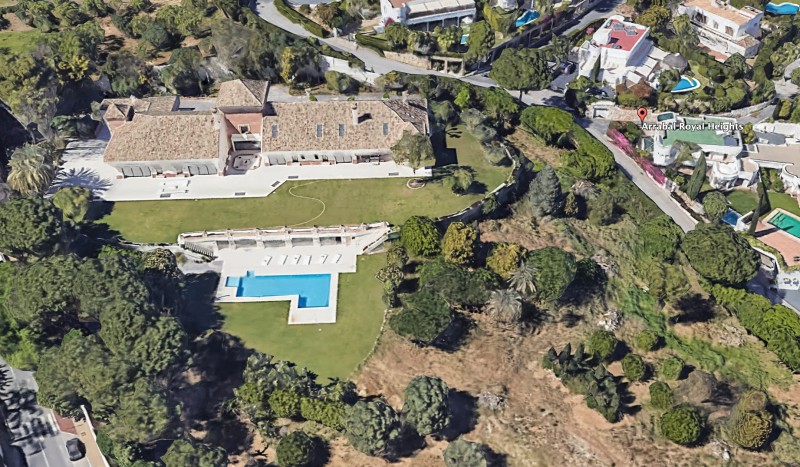
Veritas Reales Marbella owns the villa and land in Marbella’s exclusive gated community of Altos Reales, or “Royal Heights,” acquired for an undisclosed sum in 2020.
Ansari’s lawyer, Gherson, did not answer questions about the U.K. and Spanish firms.
Reporters were unable to determine the purchase price of the villa and its value today. But an archived webpage from a local real estate agency shows that the property was marketed in 2013 for 15 million euros (around $19.5 million) as an “Outstanding Residence with Spectacular Views.”
Photos in the accompanying sales brochure featured a six-bedroom villa with an imposing central tower framed by mountain peaks. A terrace overlooked an outdoor pool, and views of the Mediterranean Sea. Those views match images available on Google Earth 3D.
The 2013 listing also noted features including a chandelier “bought from a 15th century church,” as well as “temperature controlled wine cellars and comfortable staff quarters.”
According to the U.K.’s Companies House, Veritas Reales Investment Limited’s annual filings are overdue. The firm is facing the prospect of being forcibly dissolved within the next two months, “unless cause is shown to the contrary.”