



A week has passed and Dritan Gjika, an alleged cocaine kingpin known as “Tony,” is still waiting to be paid.
“Look sir, your partner told me that he would send the money yesterday, then later he told me today,” Gjika tells a business partner. They are discussing the sale of “material” shipped via container from Ecuador to Spain.
When the man tells him to “calm down” and not be so “distrustful,” Gjika’s exasperation bursts through.
“Sir it’s not distrust it’s respect! … Everything arrived well, a price was agreed on together that you liked. I don’t need to wait until he sells it slowly over there in order to be paid!”
Later, he clarifies: “It’s just business and we need speed.”
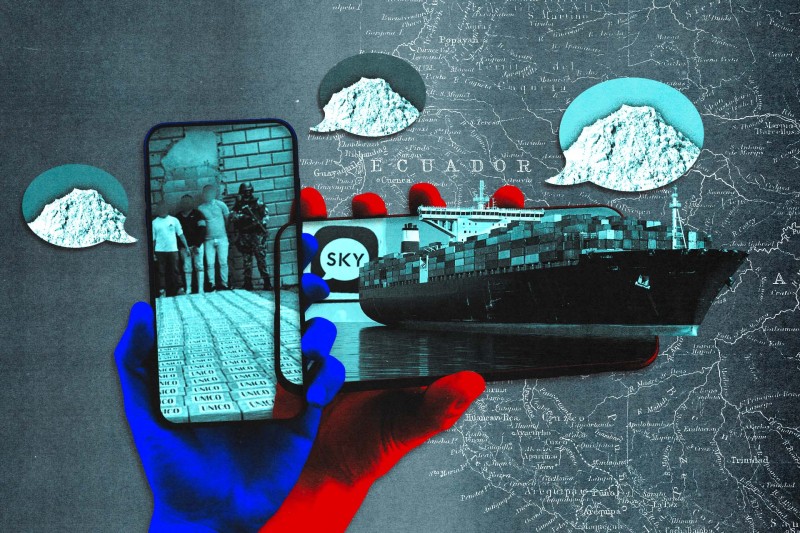
This tense exchange did not take place in the Italian restaurant or shiny office building in Ecuador's bustling port city of Guayaquil where Gjika and his associates were known to meet. Instead, it was carried out in the way that most people communicate today: over text. The only difference is that these men were writing to each other through the encrypted messaging platform SkyECC, a favorite tool of criminals and other underworld figures until it was broken open by European police in 2021.
After the platform’s decryption, Sky chats were shared with authorities worldwide, including in Ecuador, where the Albanian-born Gjika is wanted on charges of organized crime and money laundering.
OCCRP has obtained hundreds of pages of Gjika’s Sky chat logs, which were filed by Ecuadorian prosecutors as evidence in the criminal case against him and members of his alleged network.
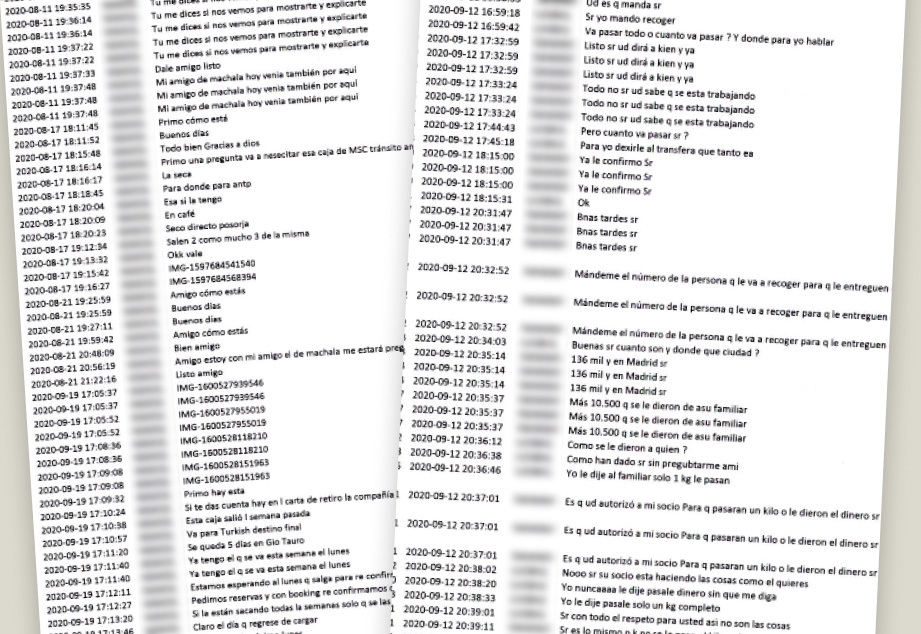
Reporters sifted through hundreds of pages of chat logs that were selected by prosecutors as evidence.
The text messages, which run from May 2020 to March 2021, provide an unprecedented glimpse inside the day-to-day operations of a powerful drug-smuggling organization whose corporate-like structure stretched across borders in a relentless pursuit of profits.
The messages also reveal the depth of the group’s infiltration of police and ports in Ecuador, a once placid country that has in recent years been transformed into a superhighway for cocaine.

An image included in a police report of Dritan Gjika (left) and other men convicted or accused of belonging to the criminal organization he allegedly led dining together in an Italian restaurant in Ecuador.
At least 17 people charged with belonging to or aiding the criminal organization have been convicted in Ecuador, 15 of whom are awaiting appeal. Four others were convicted of laundering the proceeds from this illicit trade, making transfers of more than $43 million between 2015 and 2023.
Yet Gjika, the man prosecutors allege is the leader of this network — and who is now one of Ecuador’s most wanted men — managed to slip out of the country undetected. He was later arrested in Abu Dhabi in May 2025, and is now awaiting extradition to Ecuador, where he is under a judge’s orders to face the court upon his return. (His lawyers did not respond to requests to comment, but in a pre-trial hearing in Ecuador they argued there was insufficient evidence to prove their client had committed a crime, and questioned the legality of how the Sky messages were originally obtained).

Dritan Gjika’s ID information, as seen in a police report included in prosecutors' case files.
According to intercepted chats, Gjika maintained direct involvement in nearly every arm of his alleged operation, from the hiring of drivers to the management of shipping schedules and the exact calculation of outstanding debts. He valued reliability and diplomacy, and appears to have commanded fierce loyalty from his colleagues.
“I’ll go with you wherever you tell me brother… and with my eyes closed,” one of his frequent interlocutors, who the chats suggest managed connections with Colombian suppliers, wrote after Gjika said he had “a lot of work” to offer him in December 2020.

Despite hailing from a country thousands of miles away, Gjika appears to have achieved a striking mastery of slang-heavy Spanish, peppering his texts with colloquial greetings and turns of phrase — as well as cryptic language when it came to discussing the details of his work.
To help decode these conversations, reporters cross-checked the content of the chats against thousands of pages of court records containing police reports and testimonies, plus other files from the prosecutors’ investigation. Reporters also consulted experts, including to verify the meaning of the group’s coded lingo.
In their world, it emerged, a “box” may signify a shipping container that can be "impregnated" with “things” — i.e. filled with packages of cocaine. “The uglies,” meanwhile, refer to police.
In one unusually candid conversation, however, Gjika’s apparent business partner reflects on their line of work, and openly describes it as “traqueteando,” a common slang term in Latin America for drug trafficking:
Now 49, the Albanian first landed in Ecuador in 2009 under a temporary visitor visa, joining a wave of Balkan nationals who have moved closer to the source of the cocaine supply chain in recent decades.
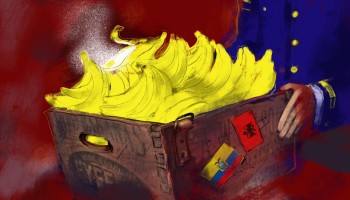
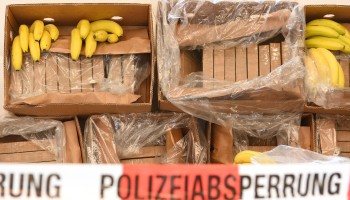
While Ecuador is not itself a producer of the narcotic, it has emerged as Latin America’s primary export hub, with Albanian, Mexican, and Colombian crime groups muscling in to take advantage of its booming maritime trade in goods like bananas — a favorite target of smugglers because of the fruit's need to move through ports quickly.
According to Renato Rivera, a researcher at the Global Initiative against Transnational Organized Crime (GI-TOC), Albanian traffickers brought a distinctive corporate culture to Ecuador’s cocaine business that focused more squarely on money-making than on engaging in turf wars to gain territorial control.
To this end, the network allegedly run by Gjika was fluid and did not appear to maintain a fixed alliance with either of Ecuador’s top criminal gangs, he said.
“These types of people don’t ‘marry,’ so to speak. They don’t form strategic alliances with any of the criminal groups,” said Rivera. “Rather, it's a business model based on market opportunities.”
Making Contacts
According to Ecuadorian authorities, the criminal organization allegedly led by Gjika had a pyramidal corporate structure with the Albanian at the top, followed by a “management level” of senior directors that included his alleged lieutenant, the Argentine-Italian national Mario Sánchez Rinaldi.
In February 2024 Sánchez Rinaldi was arrested in Spain, where some 70 people and legal entities allegedly connected to the trafficking network are still under investigation. (An Ecuadorian lawyer for Sánchez Rinaldi, who remains in detention in Spain, told OCCRP he was not authorized to comment on the case.)
To facilitate their transatlantic shipments, the group allegedly used legitimate export companies in Ecuador as a cover for their drug smuggling. The profits were then laundered through these legal businesses as well as real estate purchases.

A photo from an Ecuadorian police report of a red Toyota identified as a car driven by Gjika in Guayaquil.
The Sky chats reveal the granular details of how this cocaine ‘multinational’ operated, from the monthly supplier contracts to the specific cash points used to collect their profits. The conversations provide a window into how the group navigated logistical hiccups and innovated in response to interventions by law enforcement. And, crucially, they reveal what made the work of this operation possible: a remarkable level of access to Ecuador’s maritime ports and the huge volume of shipping containers dispatched around the world daily.
Ecuador’s police, customs, and port authority did not respond to requests to comment.
‘Two tonnes a month — minimum’
According to prosecutors, the smuggling network chiefly sourced its cocaine from laboratories in neighboring Colombia, the world’s top grower of the coca plant, whose leaves are crushed up and purified through various chemical processes in order to extract the powdery drug.
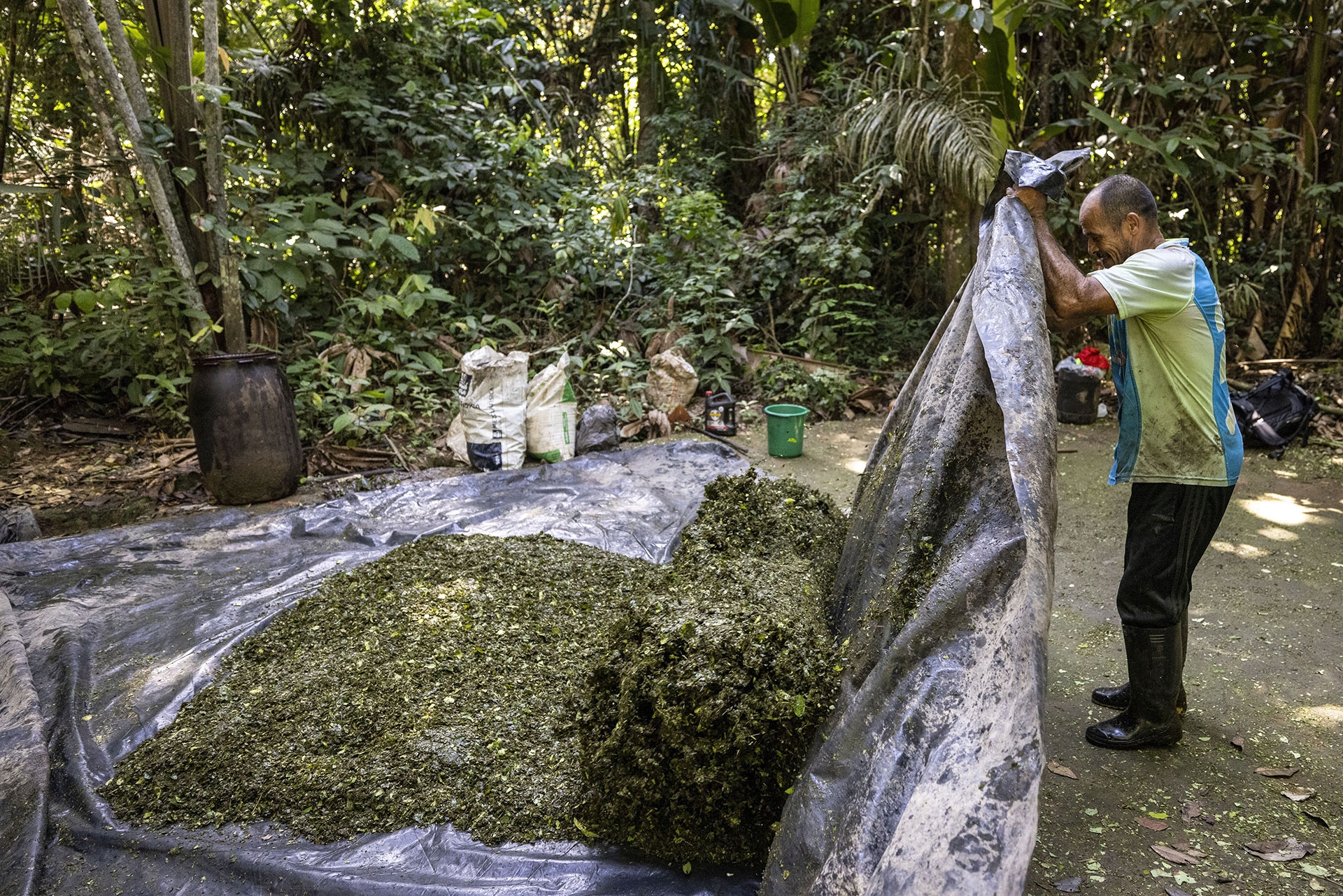
A man processing coca leaves in the heart of the Amazon, Colombia, in November 2023.
The Sky chats show Gjika took the lead in negotiating deals to ensure a steady stream of the narcotic, brokering contracts for multiple tonnes to be delivered on a monthly basis — a notable amount given that, at the time, cocaine seizures in Ecuador rarely topped one tonne.
“Friend my cousin told me you have good things,” he wrote to an apparent supplier in January 2021.
“I’m interested but what makes me a little scared is that I don’t know the people, I know you and you seem to be very serious and a kid who has his feet on the ground,” he added.
The supplier told Gjika he was managing two “kitchens” — a slang term for the labs where cocaine is extracted from coca leaves — and asked for the Albanian's trust to accept his business.
In another conversation, Gjika described a contract for a “minimum” of “6 T” with another apparent supplier in Colombia who said he had five so-called kitchens at his disposal.
Yet, sometimes, the plan goes awry.
The following day, on February 1, 2021, five men were arrested in the Ecuadorian province of Los Ríos with half a tonne of cocaine found inside of their cargo truck, cut into 1-kilo packages branded with the logo UNICO.

A image of the drug bust featured in the Ecuadorian newspaper El Universo.
After hearing the news, Gjika wrote to the man who had offered to supply “6 t” to inform him of the incident.
Gjika starts to express suspicions about how this operational failure could have occurred, noting that the drivers of the shipment hadn’t been following his schedule.
Later, the pair confirm the worst: The “merchandise” was seized too.
The discussion that follows shows Gjika trying to parse what went wrong, and what the consequences should be. He wants to know what happened to an individual they refer to as “the taxi driver,” who was not arrested. While it is never clearly stated, the chats suggest this could describe one of the “patrollers” the men discuss dispatching to accompany the shipments in a separate car.
What happens next is not known, as the chat log ends with Gjika’s interlocutor asking for his BC1 — a reference to a rival form of encrypted device operated by the company Number 1BC, which has drawn customers looking for alternatives after news spread that Sky and other similar firms had been compromised.
Rotterdam to Russia
In order to transport this steady supply of cocaine abroad, chiefly to Europe, the network allegedly led by Gjika amassed control over a “large part of the foreign trade logistics chain,” according to Ecuadorian prosecutors. For the trial, investigators collected proof of the group’s involvement in at least 11 drug shipments from the port of Guayaquil to European terminals in 2020 and 2021.

The Sky chats reveal the breadth of these export operations, with numerous discussions of shipping schedules and deliveries of “boxes” to ports in places like:
The Netherlands and Belgium
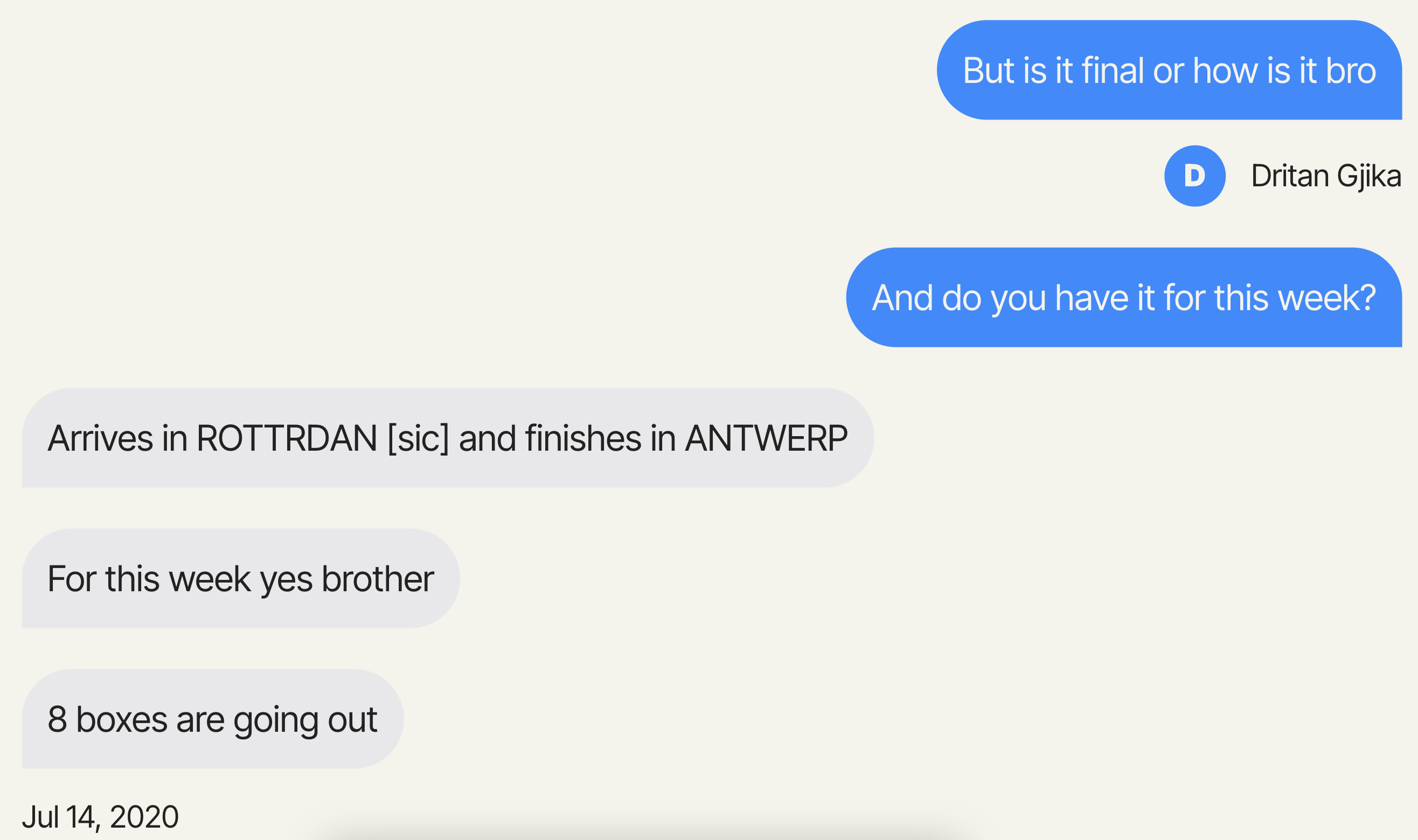
Turkey and Italy
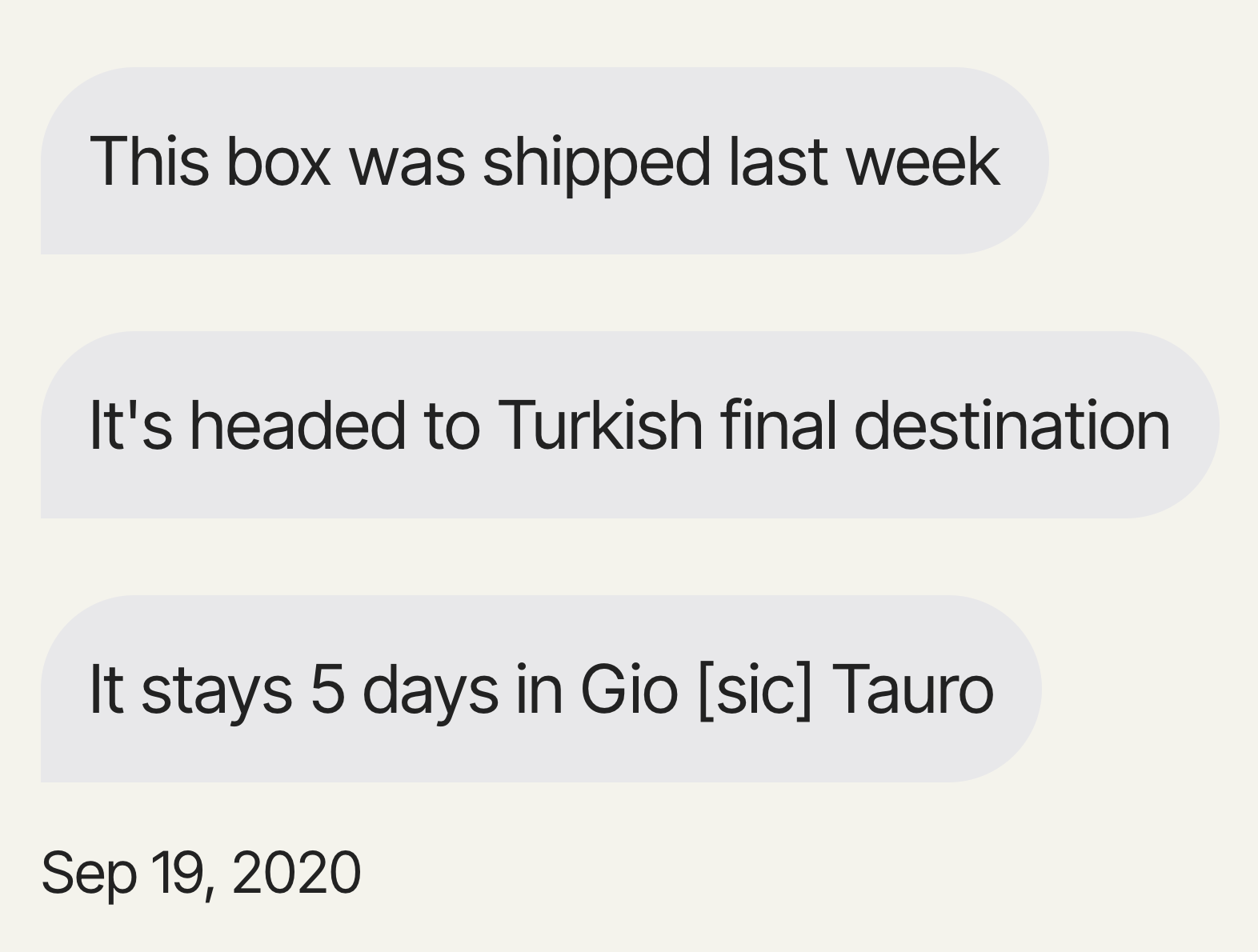
Spain and Germany
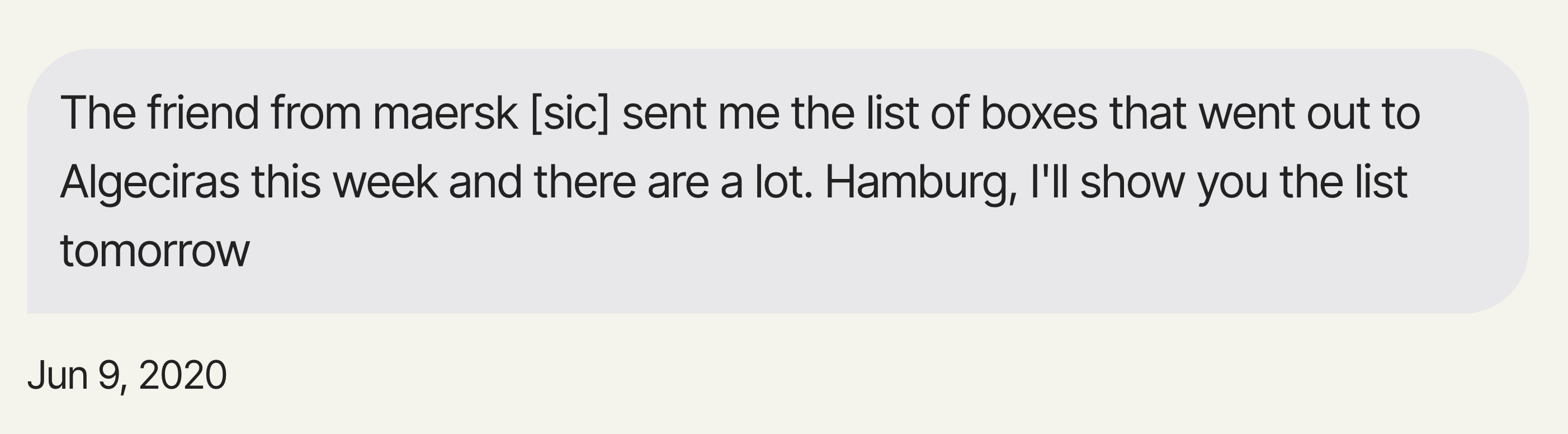
and Morocco and Portugal. 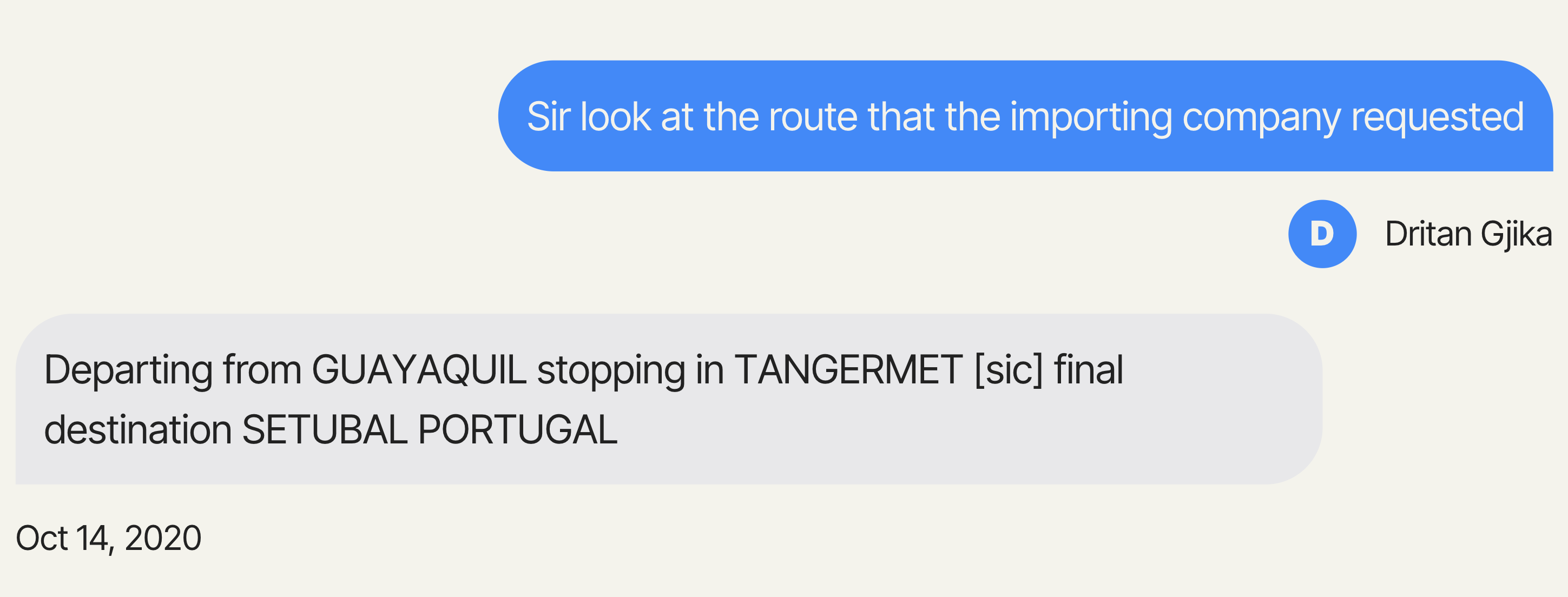
There are also discussions about the search for new markets and routes, including in countries as far afield as India
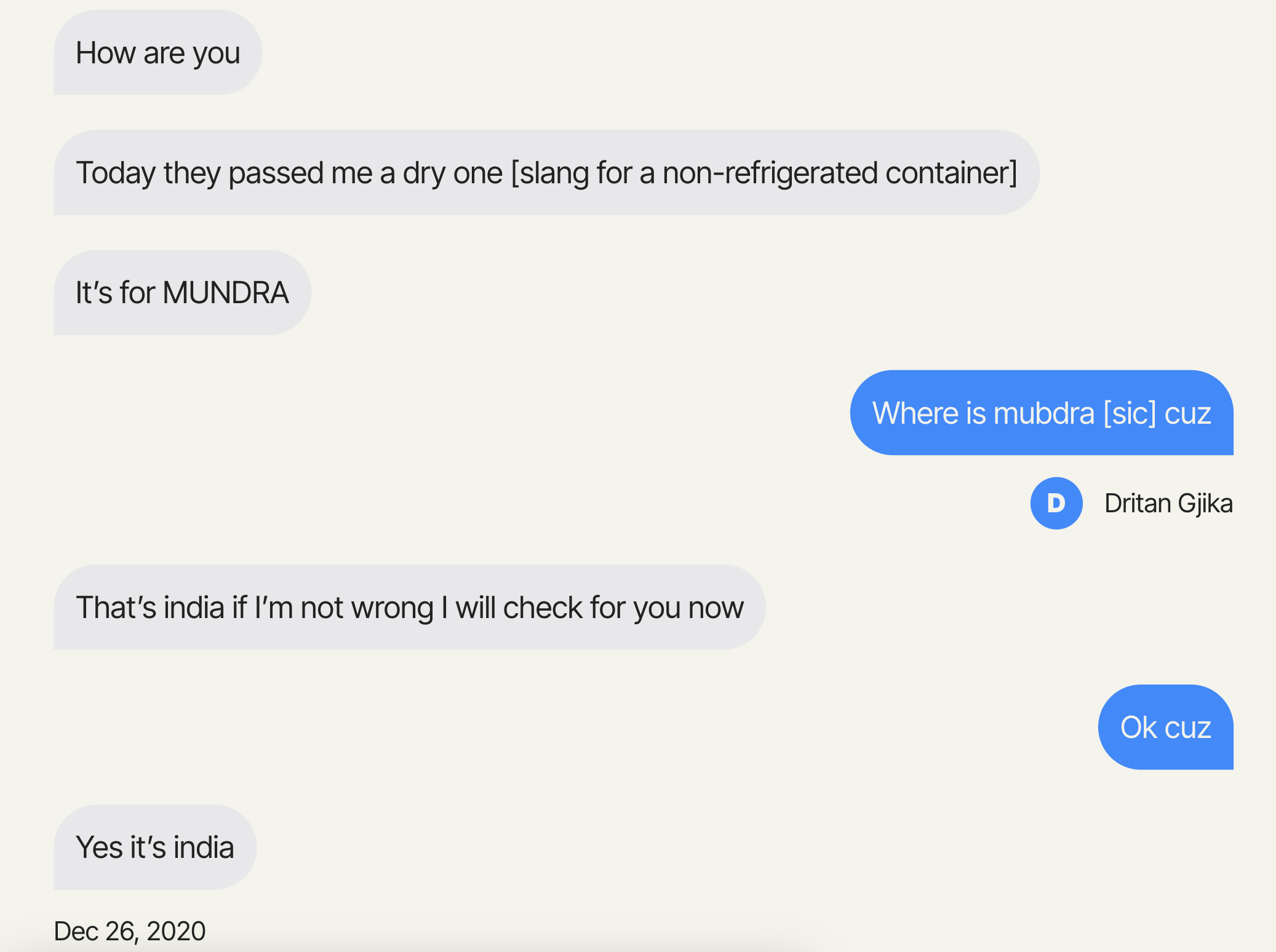
and Russia.
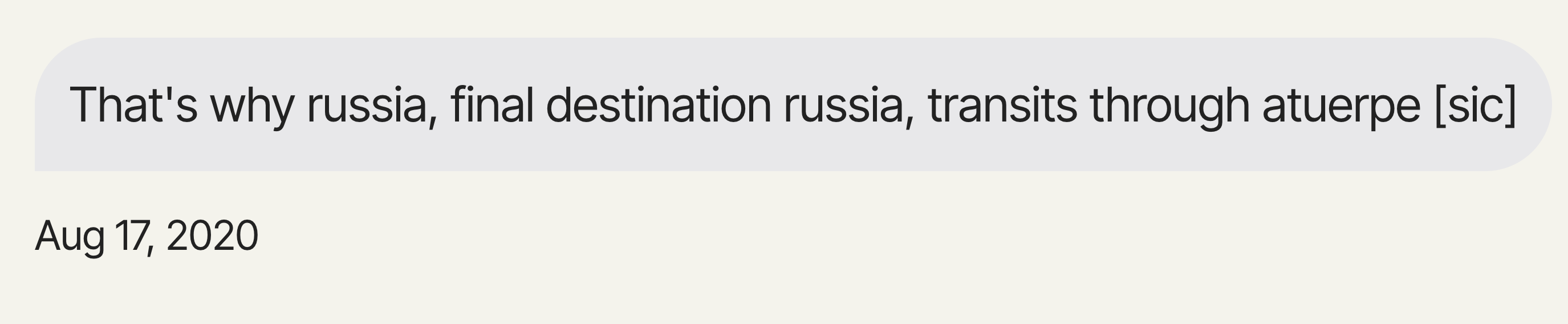
When reached for comment, authorities in the ports of Antwerp, Algeciras, and Hamburg told reporters to contact police or customs for further details on efforts to combat drug trafficking, while the operators of ports in Mundra, Gioia Tauro, Tanger Med, and Rotterdam did not respond.
To pull off their transatlantic feats, the network cultivated informants inside Ecuador’s ports, according to prosecutors, who cite the chats as evidence of the traffickers’ access to “privileged information” from the computer systems of terminals in Guayaquil.
The casual nature of the Sky conversations reflects their apparently seamless infiltration of these facilities, with the men discussing their work at the ports in a routine and ordinary manner.
“No problem whatever port it is we’ll get it out don’t worry,” Gjika wrote in reference to four of Guayaquil’s port terminals in a conversation about which shipping route an importer planned to use.
“Sir, I take full responsibility [for what happens] in the port !!” he later added, though cautioned that he could “not guarantee” anything if there was an “information leak,” or if the “cops come down on me” on the day of the job.
When reached for comment, Contecon, one of the three port terminals in and around Guayaquil mentioned in the chats, said the port “collaborates closely with [the] Ecuadorian State to ensure a safe and secure trade through our facility.” The other two ports did not respond to requests to comment.

View of a port in Guayaquil, Ecuador.
The group's ability to contaminate containers appears to have relied on “friends” who had direct access to the ports.
“The friends inside are about to give me the box to work on in one hour maximum,” reads a message Gjika received in August 2020.
Among those convicted in Ecuador was a police officer who was in charge of examining containers at a port. Another officer with the same role was declared a fugitive in 2024, while a third was found to be innocent.
But the group’s links to Ecuador’s police force went even deeper. A retired police officer named Héctor Pesántez, who prosecutors said went by the alias “Glock,” was convicted of serving as one of the group’s senior figures. In the chat logs, he can be seen feeding Gjika inside information from Ecuador’s anti-narcotics police.
According to his indictment, Pesántez was responsible for recruiting others in supervisory roles in order to facilitate trafficking through the ports. (He did not respond to OCCRP’s requests to comment, but in court he pleaded not guilty and is awaiting an appeal).
“I contacted the friends,” the retired officer wrote Gjika in July 2020. “They tell me there have already been some staff changes, even the anti-narcotics national director is new. They have changed the schedule for days off.”
He then advises Gjika to adjust his agenda to align with when their “friends” will be on duty:
According to Daniel Pontón, a Dean of Security Studies at Ecuador’s state university, the government has struggled to properly secure its ports, which are mainly operated by private companies granted concessions by the state.
“The problem is that Ecuador does not have adequate control of the ports. Neither a unified, nor coherent, nor intelligent strategy. It is a gaping hole; it is like having a person bleeding out, and if you don’t put on a tourniquet, they are going to die,” he said.
Company to Company
The Sky conversations touch on various methods the group used to sneak their contraband inside shipping containers. One of those, which law enforcement describes as the “blind hook method,” sees smugglers simply place the drugs next to legitimate cargo, as opposed to mixing it in with the legal goods or hiding it in a more elaborate fashion.
There are also clues that the group employed more sophisticated methods. In another exchange, Gjika and an interlocutor discuss efforts to prepare a container with a welder and some paint. The result, Gjika says, is that “the scanner doesn't catch it, absolutely confirmed.”
From the back-and-forth, it seems possible the pair are discussing storing cocaine in the structure of the container itself — an approach that Spain’s Interior Ministry said the group started using to conceal smaller batches of the drug after a 1.1 metric tonne shipment was intercepted by Dutch authorities in 2020.
Some chats also directly reference the group’s use of what they, and Ecuadorian police, refer to as the “company to company” method. This is when traffickers minimize their risks by directly controlling the export companies that carry the cocaine, and by partnering with importers run by their collaborators.
According to court records and Ecuador’s business registry, Gjika, those convicted or accused of participating in the trafficking network, or their close relatives owned or managed more than 30 firms in the country.
Among these, three companies either owned or administered by Gjika and his alleged right-hand man Sánchez Rinaldi were alleged by prosecutors to have facilitated drug trafficking. Two worked mainly as banana exporters.

Images from a police report of banana-packing handled by Agricomtrade, a company that according to prosecutors was one of the companies that was co-owned by Gjika and used to smuggle cocaine.
Spain was also a logistical node for the group’s cocaine shipments. In a letter seeking assistance from Ecuadorian authorities, Spain’s national court alleged that Sánchez Rinaldi, described as an “important businessman” based in the Costa del Sol, managed a “powerful” group of food import and export businesses that allowed him to “facilitate the logistics” of cocaine trafficking for third parties.
The businessman was allegedly responsible for securing the drug’s entry into Spain’s port of Algeciras, and for “facilitating importing companies in Europe,” Spain’s national court said in another letter sent to French authorities.
Cashing in
When the product does successfully arrive on European shores, the chats appear to show Gjika negotiating its sale to distributors. He frequently takes part in conversations — some of them tense — over prices, quality tests on the product, and distribution plans.
“Do you have merchandise up there ???” a Sky user, who Ecuadorian authorities described as a possible coordinator of the group’s cocaine shipments into Spain, asked him in July 2020. “I need in Spain there is nothing.”
“If you have in Holland I can look for a truck to bring it down to Spain,” the Sky user offered. “You tell me the price there and I’ll bring it down.”
A few months later, Gjika checked-in with an Ecuadorian collaborator who was convicted of participating in the criminal organization and who, according to prosecutors, at one point relocated to Spain. “Sir, how is the price there?” Gjika asked him, before plotting his next move.

A police file extract shows screenshots from Sky ECC chats depicting cocaine packages labeled with “BMW," one of several brands the group allegedly used to mark its cocaine bricks, including those found on cargo seized in the Netherlands.
Once prices are sorted, often after significant haggling, the chats include conversations about how to collect earnings via an underground cash delivery network that appeared to be operating out of cities worldwide, from Cali to Madrid, Brussels, and Birmingham.
The quantity of cash passing hands is often staggering. In Barcelona, Spanish authorities said their agents detected multiple cash deliveries linked to the group, including one that led to the seizure of one million euros hidden inside a vehicle.
Separately, in a December 2020 conversation over Sky, Gjika discusses a series of transfers of Colombian pesos worth the equivalent of $2.3 million to be collected in Cali.
References to such “tokens” are frequent, as they refer to a string of numbers — usually the serial number of a dollar or euro bill — that are used as a type of password shared with the cashier to ensure the money is released into the right hands.
While this type of underground transfer system allows its users to circumvent the strictures of banks, it carries its own risks. In an August 2020 conversation, Gjika and a man known as the “Engineer” appear to discuss the details of a cash collection operation in Quito that did not go according to plan.
Citing the Sky chats, police linked this cash operation to a Chinese national who was ultimately convicted of collaborating in the group’s drug trafficking and laundering their money. (He pleaded not guilty, and has appealed the ruling. His lawyers did not respond to requests to comment).
Just over an hour later, the “Engineer” — who would later be convicted of collaborating with the trafficking organization — reports back that “The Chinese” was short on cash, and that the full amount could not be collected.
The “Engineer” then asks if he can take some of the money to pay members of his team, and Gjika apparently agrees he can keep “100,” which a police report suggests is shorthand for $100,000. They seem to agree to meet the following day for a business chat so that Gjika can show him “where and how [the money] is invested.”
But when Gjika’s part of the cash arrives the following day, it’s “10” less than he expected.
When pressed, Gjika’s collaborator says the missing $10,000 must have gotten lost when another associate “got scared” on the busy commercial street where the exchange took place near a “chifa” — a reference to a restaurant serving a fusion of Chinese and Ecuadorian cuisine.
After sending some audio messages, whose contents are not detailed in the chat logs, the two men appear to have resolved the issue.
When reached for comment, a lawyer for the man known as the “Engineer,” Julio César Lalangui Medina, noted that his client’s appeal is still pending, with a hearing scheduled for June 25, 2026 and that there is a “broad and deep legal debate internationally regarding the validity, authenticity, integrity, traceability, and legality” of using Sky messages as evidence.
‘We’re changing everything’
As early as September 2020, Gjika had apparently caught wind that the Sky devices they were using were no longer safe.
“We’re changing everything, because many people say that Sky is no longer reliable,” he texted a colleague, encouraging him to buy one of the BC1 phones.
But the men would keep using Sky for nearly six months more, with the last message in prosecutors’ files dated March 2021.
Their use of Sky would eventually spell the unravelling of the Ecuadorian network, yet whether the man prosecutors characterize as its leader will face justice remains uncertain. Despite having been arrested nearly a year ago, the United Arab Emirates has yet to extradite him. (The country’s Foreign Affairs and Justice ministries did not respond to requests to comment.)
In the meantime, cocaine — and the bloodshed that follows in its wake — continues to surge through Ecuador at record levels.
Rivera, the security expert, noted that as international traffickers boost the country’s cocaine trade, local gangs keep jostling for a slice of the pie.
“The financing they provided and the interest in moving more cocaine through Ecuador generates conflict among local groups, and those conflicts generally manifest as fights for territorial control,” he said.
“Therefore, it isn't their presence itself, but rather the funding they’ve brought for the movement of cocaine that indirectly generates greater violence.”