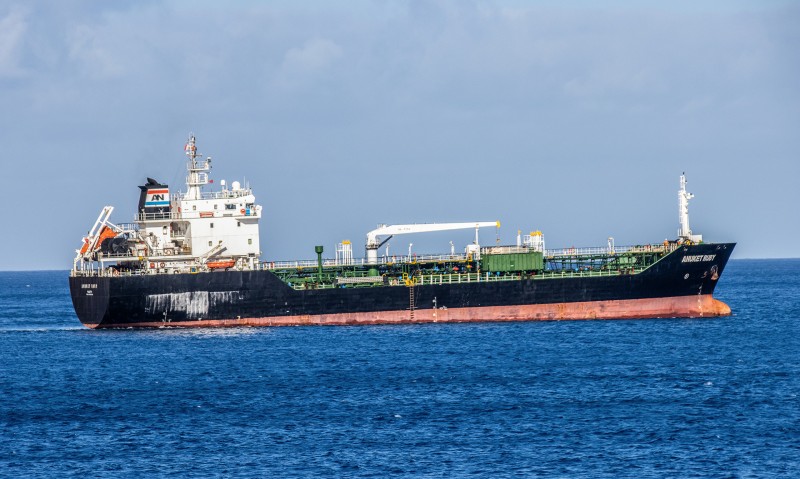
As Russia seeks to circumvent sanctions and sell its oil overseas, tankers have been hiding their routes in the Black Sea before stopping at ports in Georgia, according to a report by iFact.
Journalists with iFact, OCCRP’s Georgian member center, analyzed maritime traffic data from 2024 to 2026. They looked at 19 oil tankers that sailed from Russian ports and turned off their Automatic Identification Systems (AIS) in the open water.
International maritime law requires ships to maintain their AIS signal throughout a voyage. Turning off their transponders meant the Russian tankers’ routes across the Black Sea were unknown.
Oil tankers that are part of Russia’s “shadow fleet” often disable their AIS systems as one of several tactics to “avoid detection and enforcement” of sanctions, according to a report last year by the Royal United Services Institute, a U.K. security think tank.
Gocha Beridze, a former senior official with Georgia’s Border Police and Coast Guard who left the service in 2023, said he had documented numerous instances in which Georgian ports and waters were used “to evade sanctions through various tricks and means.”
“Vessels switch off AIS signals, falsify port data, and use various tactics to conceal their movements,” Beridze said.
He also described observing ships loitering off Georgia’s coastline — behavior that raised “great suspicion” of ship-to-ship oil transfers, a common method for skirting sanctions.
While they looked specifically at oil tankers, journalists were not able to confirm exactly what cargo eight of the ships were carrying. However, they did confirm that 11 tankers whose AIS signal consistently disappeared after departing Russia were carrying oil.
One of them, the Panama-flagged Waler, made at least two voyages shipping oil from Russian ports to Georgia’s Poti port in December 2024 and February 2025. The ship’s transponder was turned off during both trips.
In December 2025, Ukraine sanctioned the Waler, accusing the tanker of using “deceptive practices” to export Russian oil. Corporate records indicate that the vessel is operated by a Turkish company, which did not respond to iFact’s requests for comment.
Georgia has not joined the sanctions imposed by the European Union and G7 countries in response to Moscow’s February 2022 full-scale invasion of Ukraine. But Georgian officials have repeatedly insisted that sanctioned Russian oil and petroleum products are not transported through the country's territory.
Most recently, Georgia’s Revenue Service said it had “strengthened controls within its remit to prevent any attempt to use Georgia’s customs territory to circumvent international sanctions.” The Revenue Service added that it works in coordination with the Georgian Maritime Transport Agency to inspect vessels and shipowners, and bar sanctioned ships from entering national ports.
The Maritime Transport Agency told iFact that all vessels entering Georgian ports are subject to “strict control, in full compliance with international law and national legislation.”