Reported by
Forty-seven Nepalis recently rescued from scam centers in Myanmar shared harrowing stories of their ordeal upon arriving home late Wednesday evening at Kathmandu’s Tribhuwan International Airport.
OCCRP spoke with a dozen of the Nepalis rescued in recent months as Myanmar’s military authorities have raided, shuttered and demolished some cyber-scam compounds along the Myanmar-Thailand border.
“I was not paid my salary. In one punishment, I was hung up by my arms for 18 hours and locked in a cell for three days. When I didn’t follow their rules, I was disciplined,” a rescued man who asked to be unnamed told OCCRP after exiting the airport at midnight on a frigid winter evening.
He and his fellow travelers were lured by friends, relatives, social media contacts, or foreign-based Nepalis who promised via social media platforms that they could earn $700 to $1,500 a month.
“One of my friends told me it was an easy computer job, but it wasn’t the same as I was told,” said another man, 29-year-old Madan.
Instead, Madan and the others were trafficked to scam centers, where they were beaten, starved, or threatened if they failed to meet daily online scam and cyber-fraud targets. Those who resisted or attempted to escape were warned they would be sold to other criminal groups, they said.
Cyberscam syndicates largely rely on human trafficking to fuel their illicit operations, recruiting people from across Asia with legitimate-sounding job offers and then forcing them to work in scam centers.
With lack of economic opportunities at home, Nepalis can be particularly vulnerable; around 2,000 young people leave Nepal every day to find work in other countries.
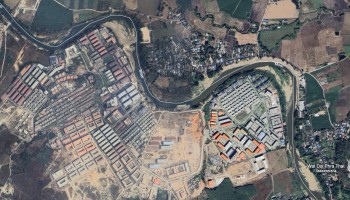
The Nepalis interviewed by OCCRP had traveled to Thailand or India, and were then brought across the border into Myanmar, where they were held in compounds. Madan said he worked at one of the companies in KK Park, in Myanmar’s Myawaddy Township, one of dozens of cyber scam centers on the Myanmar-Thailand border.
He told OCCRP he was forced to target Americans and Europeans in cyberscams, but “I couldn’t meet their target. So they told me I could leave only if I paid six lakhs (in Nepalese rupees, or about $4,200). Even after I paid, they still didn’t let me go. I was trapped.”
Some of the rescued Nepalis said they were falsely accused of failing to meet work "targets" and were subjected to fines or extortion. Several also reported being forced to pay a ransom to secure their release. Family members in Nepal were contacted and pressured to send money for their release, they said.
Dhan Bahadur Oli, the Nepali Ambassador in Thailand, led the coordination effort to bring the Nepalis back, working with Thai authorities, Myanmar’s local security agencies, and Nepali government institutions.
Oli’s embassy has urged all Nepalis to beware of fraudulent online job offers, “easy money” schemes, or social media contacts promising high-paying digital jobs in Cambodia, Laos, Thailand, or Myanmar. Over the past three years, 365 Nepalis have been returned home from scam centers, he said.
Krishna Prasad Pangeni, chief of Nepal’s Anti-Human Trafficking Bureau said Nepalis are being lured by a large, “sophisticated” criminal network.
“There are still many Nepalis in [cyber] camps waiting to come home; we don’t know how many. We are investigating, and we’ll file cases against the Nepali trafficker [who lured them there],” Pangeni said.
Reached at his home east of Kathmandu Thursday afternoon after reuniting with his family, Mandan told OCCRP: “I never thought I would be back alive. I am having a good time with my daughter and wife.”
However, after returning to Nepal with no money, he has to find a way to pay off a loan of eight lakhs Nepali ($5,595).
“I need to get out of the country as soon as possible to pay back my loan.”