Reported by
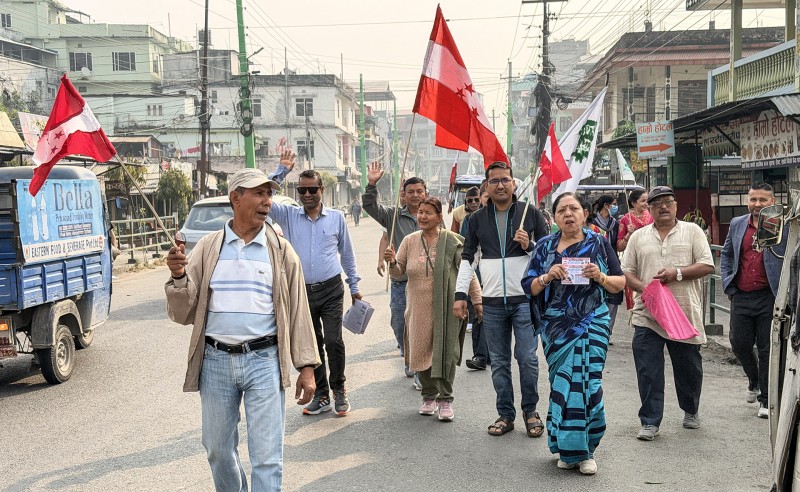
Six months after the protests driven by fury over entrenched corruption toppled Nepal’s elected government, political parties are now campaigning for the March 5 general elections with a shared message: each claims to be the best choice to curb graft.
Their proposals span sweeping asset investigations of senior officials, the use of artificial intelligence to detect corruption, and - in one case - a call to reinstate the death penalty for major offenses, despite the country having abolished capital punishment in 1990.
And it is the same parties that were targets of the protests that are now touting themselves as champions of integrity. But many of those who took part in the demonstrations — sparked by a ban on social media and fueled by anger over endemic corruption — remain skeptical that the current crop of candidates will deliver real reform.
“They say they will investigate corruption, but we aren’t sure if they will totally implement this,” said 25-year-old Rakesh Kumar Mahato, who was shot in the spine during the protests and remains paralyzed.
Since September, the country has been under an interim government led by former Chief Justice of Nepal Sushila Karki. She moved the general election forward nearly two years ahead of schedule in response to the youth-led Gen Z movement.
It is the first time on the election rolls for 915,000 youth among the 8.9 million voters eligible to cast a ballot for the 275-member House of Representatives.
But the young protestors who shook the foundations of Nepal’s establishment are not widely represented in the contest. According to Election Commission of Nepal data, candidates below the age of 30 account for just 5.6 percent of those standing for office.
For its part, the Election Commission has this year introduced stricter transparency rules, requiring all campaign expenses to flow through dedicated bank accounts. Any donation higher than Rs. 25,000 ($172.50) must be deposited directly into those accounts, and donors of larger sums must provide tax identification numbers.
This seeks to address a clear place for reform. A Nepal Investigative Multimedia Journalism Network investigation last year revealed that political parties had evaded taxes, submitted statements of income and expenditure that were lower than the actual figures, and systematically flouted donation disclosure laws.
Yet a pre-election assessment by the Asian Network for Free and Fair Elections found the new political finance rules had “weak enforcement and minimal deterrence, reinforcing a perception that expenditure limits do not meaningfully constrain the real campaign economy.” This risked vote-buying, patronage and inducements and also keeping out marginalized candidates, concluded the assessment.
When interviewed by OCCRP, Nepali human rights defenders also questioned whether the major political parties were committed to following finance rules.
“What’s lacking is internal transparency,” National Human Rights Commission Secretary
Murari Prasad Kharel said. “Will these leaders disclose their own assets? How will they manage internal party governance?”
Activists, voters, and election observers also questioned the lack of specific proposals on how political parties would carry out their anti-corruption strategies.
“Forming a commission is not enough if they lack an implementation strategy,” former Acting
Auditor General Shukdev Bhattarai Khatri said. “We have seen two dozen commissions and committees in 70 years to investigate corruption … Their reports are buried.”
Widespread anger over that kind of inaction triggered last year’s protests, in which more than 2,000 were injured and 77 killed, many of them shot by security forces. Amid the violence, crowds burned a number of buildings, including the Supreme Court and parliament itself.
As the March 5 vote nears, security remains a concern. Following reports of clashes between rival party members, interim premier Karki has ordered security agencies to remain on high alert.
The most watched race is in the constituency of Jhapa 5, where four-time Prime Minister KP Sharma Oli — forced to resign during the September uprising — is fighting for his political survival against Balendra Shah.
Shah, a rapper and former Mayor of Kathmandu, recently joined the Rastriya Swatantra Party to challenge the “old guard” on their home turf. While there is no official opinion polling for elections in Nepal, his new party is widely considered the frontrunner.
In his election commitment letter, Balen pledged to “raise strong voices against irregularities and corruption.”
In his own commitment letter, former PM Oli pledges that if his Communist Party of Nepal is re-elected again, this time will be different.
"In the past, when our party was in government, we started the work of curbing corruption and made some progress,” the letter said. “Zero tolerance will be adopted in curbing corruption."