Reported by
Hours after being sworn in as Nepal's new prime minister on Friday, Balendra Shah, a 35-year-old rapper and structural engineer, announced that his government would pursue criminal charges against the country's former leadership for their role in a deadly crackdown on youth-led anti-corruption protests last year.
The bold move, announced Friday following the first meeting of the newly formed cabinet, signals a seismic shift in the Himalayan nation’s political landscape. Shah’s Rastriya Swatantra Party (RSP) swept into power in a landslide election following the so-called "Gen-Z" protests that toppled the political establishment.
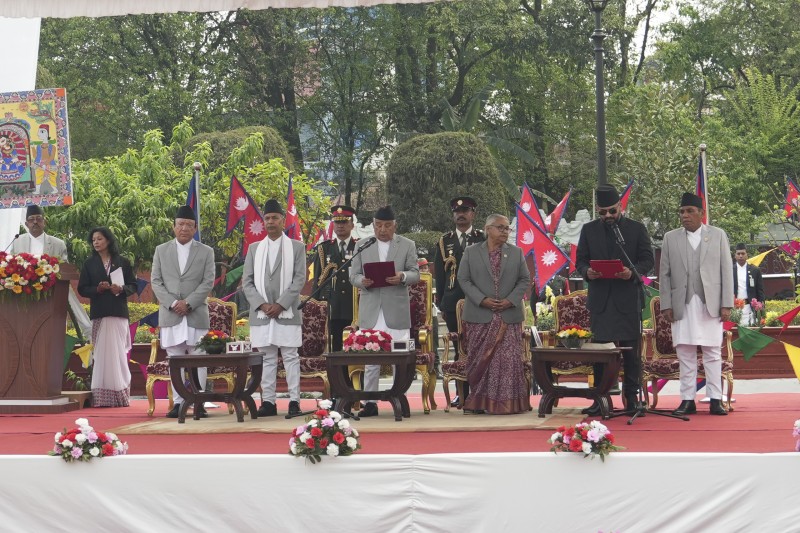
Sworn in by President Ramchandra Paudel at the presidential palace amid the chanting of Buddhist monks and Vedic recitations by 108 young Hindu priests, Shah takes office with a sweeping mandate for accountability. In a staggering victory, he defeated the former prime minister, K.P. Sharma Oli, by nearly 50,000 votes in Jhapa-5.
Now, Shah’s government is turning its sights directly on Oli and his top deputies.
The new cabinet’s first official act was a commitment to fully implement the findings of a high-level state commission which investigated the violent suppression of the September 2025 uprisings.
According to the report seen by OCCRP, the commission recommended criminal prosecution against Oli, former Home Minister Ramesh Lekhak, and former Inspector General of Police Chandra Kuber Khapung.
Sasmit Pokharel, the new Minister for Education, Science, and Technology and the government’s newly appointed spokesperson, told journalists that relevant agencies have been directed to "immediately implement" the commission's recommendations. He added that a special study committee will be formed to specifically address the disciplinary actions of the security agencies.
The September 2025 protests, which initially began as a peaceful youth movement opposing the government's sweeping ban on 26 social media platforms, left 76 people dead and more than 2,500 injured.
The commission's report accuses the former leaders of "extreme reckless negligence." It found that they acted as "mere spectators" during a continuous four-hour clash outside the Federal Parliament on Sept. 8, allegedly failing to order a cease-fire or implement harm-minimization measures as security forces used indiscriminate, lethal force against the crowds.
If convicted of criminal negligence resulting in mass casualties, the former prime minister and his top security officials could face three to 10 years in prison and fines of up to 100,000 rupees.
The crisis ultimately spiraled into nationwide chaos on Sept. 9. While the commission acknowledged it could not fully investigate the sheer scale of the ensuing riots, it noted that the movement was quickly co-opted by organized criminal elements. Petroleum products were used to set fire to the Parliament, the Supreme Court, and other government buildings.
The report offered a scathing assessment of the country's security and intelligence apparatus, blasting the National Investigation Department for failing to track the digital planning of the riots on platforms like Discord. Noting that security forces "fired blindly" due to a lack of institutional guidelines, the commission outlined an urgent blueprint for police reform, mandating the immediate implementation of strict rules of engagement and scenario-based training.
For Shah and his young cabinet the commitment to the report is part of a broader anti-corruption crusade. The RSP campaigned on a promise to investigate the assets of senior officials and reopen corruption scandals dating back to the restoration of democracy in 1990.
"If anyone asks you for a bribe, tell the police," Sudhan Gurung, Minister for Home Affairs told journalists and government officials on Friday after assuming his new role. "There will be zero tolerance for corruption."