Reported by
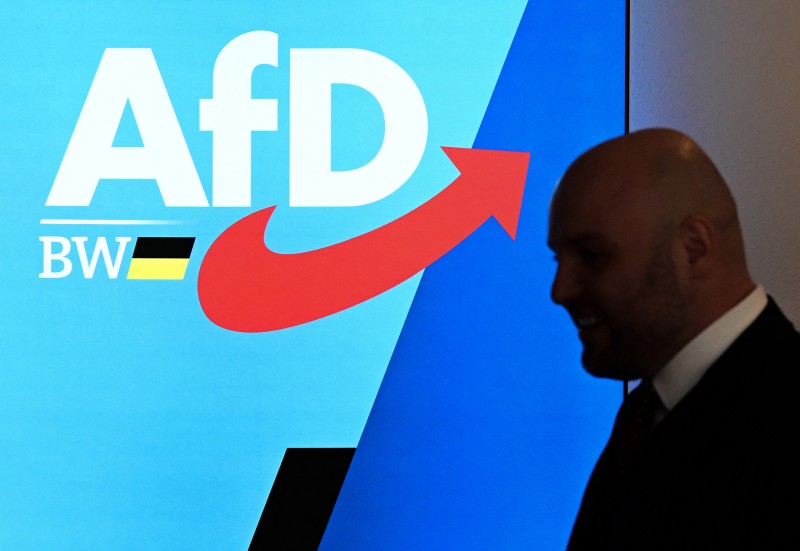
A delegation from the far-right Alternative for Germany (AfD) party has concluded a weeklong visit to the U.S., where members met Republican politicians and officials to air claims of political suppression at home.
One member of the delegation also took the opportunity to post an article to social media that made false claims of money laundering and corruption among NGOs, including OCCRP.
The head of the delegation, Markus Frohnmaier, said in an X post that he was in Washington D.C. to find new partners for his party and to “strengthen” the position of the AfD.
During the visit, party member Petr Bystron posted a video on X showing himself in front of the U.S. Capitol. The caption read: “The nightmare of the establishment is coming true: their strongest opponents on both sides of the Atlantic are joining forces. The patriotic turn begins.”
Bystron also shared an article from the right-wing online outlet Journalistenwatch.com, which reported that he had spoken to Justice Department pardon attorney Ed Martin — described as “a close confidant of President Donald Trump” — about “the systematic abuse of the judiciary to suppress the political opposition in Germany and the EU.”
The article claimed that the Trump administration had agreed to look into “alleged money laundering and corruption networks within international NGOs in Europe.” It named OCCRP and four humanitarian aid groups, calling them a “complex of left-wing NGOs.” Journalistenwatch did not cite any proof that the Trump administration planned to probe the NGOs.
The White House declined to comment.
Martin posted a photo of him shaking hands with Bystron with the comment: “Good morning, America, How are ya?” The longtime Trump loyalist, who is not responsible for such investigations, did not answer requests for comment from OCCRP.
Meeting the AfD delegation in Washington was “wonderful,” Florida Republican Congresswoman Anna Paulina Luna said on X. “Allies in the EU are especially important right now, and we could not ask for better partners.”
Bystron, a member of the European Parliament, has repeatedly attacked OCCRP after it reported in March that German prosecutors had requested his parliamentary immunity be lifted to investigate claims he received payments from a Russian disinformation network, and mentioned a separate probe into images he posted online appearing to show politicians giving Nazi salutes.
In November, the AfD requested the Bundestag clarify whether the German government had any contact with OCCRP or provided financial support. The party falsely alleged that OCCRP seeks to influence elections in Germany and the EU. Both the Bundestag — Germany’s parliament — refused to investigate OCCR and OCCRP denied the allegations
The AfD did not respond to a request for comment.
The European Parliament lifted Bystron’s immunity in April, allowing the Munich Public Prosecutor’s Office to probe whether he received payments from the operator of the online outlet Voice of Europe in exchange for supporting Russian interests in the Bundestag.
Bystron served in the German parliament from 2017 until 2024. Voice of Europe has since been shut down and sanctioned by the EU and Czech authorities for spreading disinformation and attempting to influence European Parliament elections.
Bystron denies all accusations, describing the investigations as judicial pressure on him and his party. A Munich court fined him 11,250 euro in October for sharing a photo montage deemed to depict the banned Hitler salute. The ruling is not yet final, according to Die Zeit.
The AfD, Germany’s second-largest party in the Bundestag, is known for its hardline stance on immigration, Euroscepticism, and opposition to liberal democratic and climate policies. Its popularity appears to be rising among young Germans. The party views investigations against its members as attempts to undermine freedom of opinion in Germany.
The far right has become entrenched in German society and is experiencing a surge in support among youth, according to a report by Bundesverband Mobile Beratung, an umbrella organization for counseling teams combating right-wing extremism.This growth has been driven by established neo-Nazi networks, conspiracy ideologues, right-wing populist online outlets, and above all the AfD, the organization said.
Mainstream German parties have largely refused to form coalitions with the AfD due to its extreme positions. The party has also been under scrutiny by Germany’s domestic intelligence agency, the Federal Office for the Protection of the Constitution, over concerns that some factions undermine the democratic order. Debate over a potential ban has persisted, but legal and political hurdles remain high, and the party continues to operate under heavy surveillance.
During the visit to the U.S., Frohnmaier said in New York that in Germany, “the ruling establishment has lost its mind!” It has turned his country into “a land of prosecutors and censors.”
“They want to ban my party, the Alternative for Germany, just as they tried to remove President Trump from the ballot. Why? Because they are petrified. Because they know the ‘silent majority’ is no longer silent,” he said.