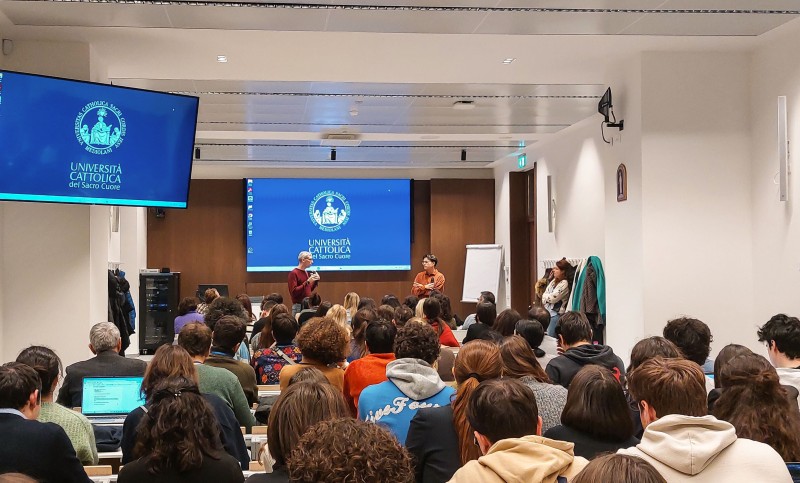
More than 30 investigative journalists from across Europe joined with students at the Università Cattolica del Sacro Cuore School of Journalism from January 14 to 16 for the first-ever Next-IJ Investigathon. Together, the participants worked on concrete, data-driven investigations by collaboratively testing hypotheses, mapping networks, and developing cross-border story ideas, using analytical tools such as OCCRP’s Aleph Pro and Transcrime’s DATACROS.
What is an Investigathon?
An investigathon is an intensive, collaborative event designed to prepare and launch real investigative reporting, not simulations. Participants work in cross-border teams on high-priority topics, collectively sifting through data, sources, and tools to identify story angles that can be pursued independently or together afterwards.
The goal of an investigathon is twofold: to respond to urgent investigative challenges and to spur innovation in the use of data, technology, and collaboration in public-interest journalism.
Each investigathon also plays a strategic role within the Next-IJ program by helping to identify the topic for an upcoming official cross-border investigation.

OCCRP Central Asia Editor Vyacheslav Abramov leads a session at the investigathon.
Investigations Across Countries
The first Next-IJ Investigathon featured three thematic work streams, each selected for their relevance across multiple European contexts and potential for cross-border collaboration. Participants mapped transnational networks and certification claims, with access to the investigative tools that make these kinds of investigations possible. Working with real datasets allowed participants to move quickly from theory to practice.
“Gaining access to DATACROS was a highlight for me, as it is an essential resource for in-depth research. Additionally, I developed new technical skills in utilizing the Aleph Pro platform, specifically learning how to better navigate and query its databases for complex investigations.”
student participant from Armenia
The collaborative environment allowed teams to combine local knowledge with shared data analysis, helping them to identify patterns that would be difficult to spot from a single-country perspective. Participants analyzed company ownership, tenders, and supply chains, comparing registry access and data availability across countries.

OCCRP’s Strategic Projects Editor Alessia Cerantola at the investigathon.
Tools and Investigative Methods
The investigathon emphasized hands-on work with investigative tools and workflows, supported throughout by editors, researchers, and technical experts.
Participants worked extensively with Aleph Pro and DATACROS, alongside other databases and open-source tools. OCCRP’s Aleph Pro is an investigative data platform that helps reporters follow the money by providing them with access to a vast archive of government records and open databases. While much of the archive is restricted for data protection reasons, OCCRP grants access to journalists and activists on a case-by-case basis. Beyond document search, Aleph Pro supports structured data analysis, allowing users to upload files, explore links between people, companies, and transactions, extract and analyze text, and manage private investigations.
DATACROS is a next-gen tool for investigating complex organized and financial crime schemes that is used by journalists, law enforcement agencies, and public authorities across Europe. It enables users to access and cross-reference datasets, unravel and visualize complex ownership structures, and identify suspicious links and high-risk entities employing research-based anomaly indicators. It is currently integrating new datasets and AI functionalities in its Datacros III project phase, funded by the European Union and coordinated by Transcrime.
The event began with short refresher tutorials on how to use these investigative tools, and then teams engaged in long, uninterrupted research sessions, testing the tools directly on their investigations.
“I gained practical skills in using new investigative tools and workflows shared by OCCRP investigators, especially techniques for efficient data cross-checking and verification. I also picked up tips on structuring leads, organizing findings, and moving faster from raw data to publishable story angles, helped by detailed feedback from editors during the sessions.”
a participant from Georgia
Having mentors available throughout the process made it easier to troubleshoot, refine search strategies, and rethink investigative approaches in real time.
Collaboration at the Center
Beyond tools and data, participants repeatedly highlighted the value of working together in person, getting feedback on their initial ideas, and learning from each other’s methods.
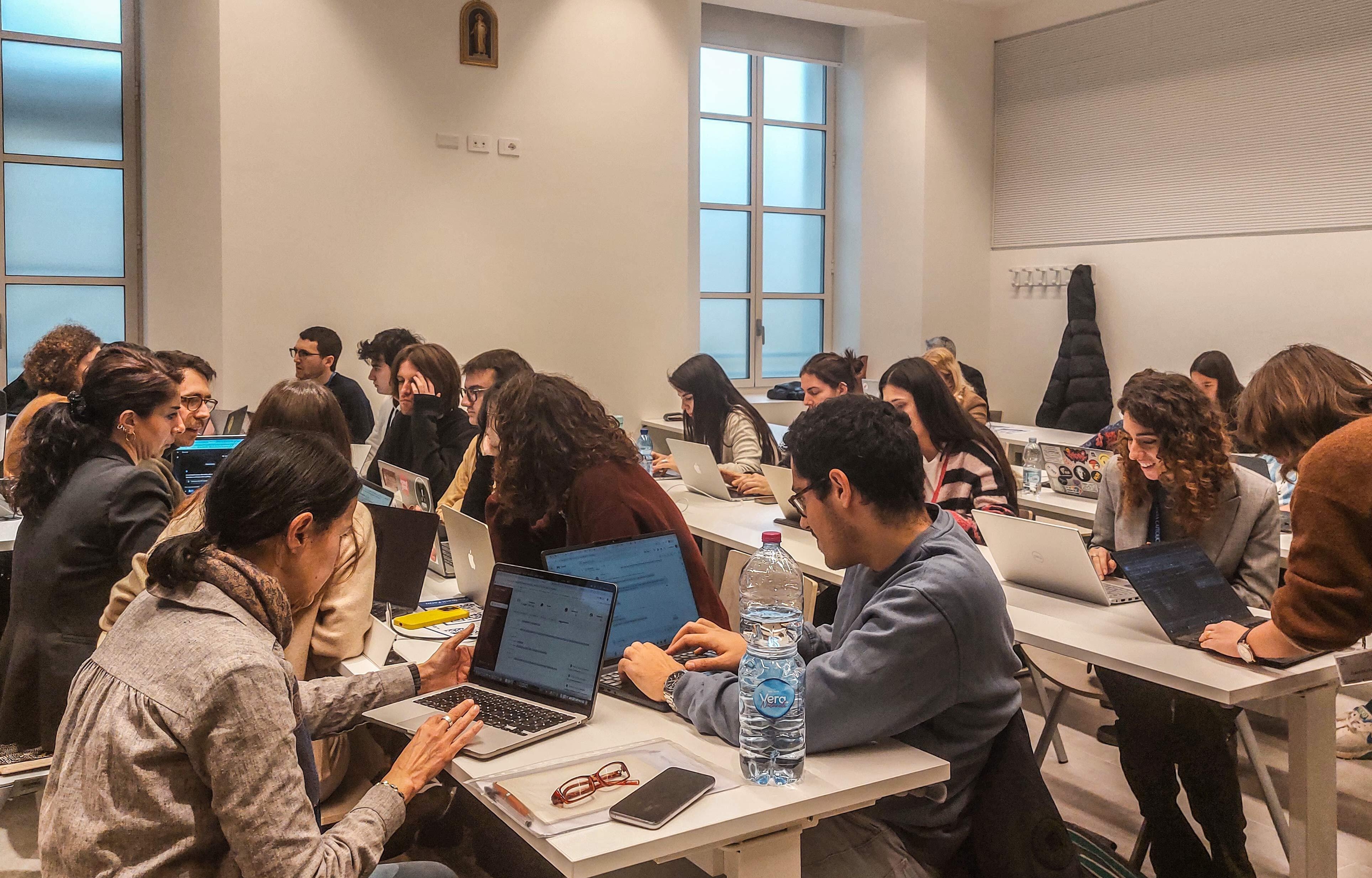
Students and journalists at the investigathon.
The investigathon’s format encouraged openness and experimentation, helping teams to work more quickly and think more ambitiously about cross-border investigations. Collaboration proved effective even when participants were working beyond their own national contexts.
“Group work was really inspiring and efficient — people were very engaged, even if they knew that they may not be able to cover their own country. The participation of students enriched the sessions; they were very hands-on and proactive.”
a participant from Malta
The event was also designed to encourage transgenerational exchanges, allowing early-career journalists to work alongside experienced investigators. Reflecting on this dynamic, freelance investigative reporter Laura Silvia Battaglia al-Jalal, who also serves as editor-in-chief of publications at the Università Cattolica del Sacro Cuore School of Journalism, said:
“Organizing and hosting an investigathon with experienced professionals, like OCCRP colleagues, is a perfect learning opportunity: first, to immediately familiarize trainee journalists with data journalism; and second, to develop a transgenerational perspective on investigative hypotheses, also drawing on the perspective of Gen Z.”
Laura Silvia Battaglia al-Jalal, editor-in-chief of publications at the Università Cattolica del Sacro Cuore School of Journalism
Students described the experience as both demanding and formative. Several noted that working alongside experienced reporters gave them a clearer understanding of the time, patience, and collective reasoning required for investigative journalism, from extracting information from large datasets to debating investigative hypotheses and shaping stories and formats.
What’s next? From Next-IJ Investigathon to Investigation
Many of the investigations launched during the investigathon are continuing beyond Milan. Updates on their progress will be shared on the Next-IJ website in the coming months, as these story ideas develop into published investigations. Reflecting on the event, OCCRP’s Editor-in-Chief Miranda Patrucic said:
“It was inspiring to see so many journalists from across Europe and beyond engaging deeply with topics of crime and corruption, exploring data and connecting with each other. This level of cross-border collaboration is the engine of investigative reporting. All the participants worked impressively to generate genuinely exciting leads. We look forward to the next steps to develop the best ideas into stories published by OCCRP and media around Europe.”
OCCRP Editor-in-Chief Miranda Patrucic
The second Next-IJ Investigathon is scheduled for later this year and will be open to selected participants from Next-IJ’s online investigative journalism trainings. Three more of the trainings are being offered this spring, on March 20, April 22, and May 16. Applications can be made here.
The investigathon was hosted by Università Cattolica del Sacro Cuore, with Next-IJ led by OCCRP, Transcrime, and the Global Forum for Media Development (GFMD). This piece was adapted from an article by Liza Bezushko from GFMD.

.jpg/dc0350ded40ba882af921cb6ffbc0b06/banner-understanding-data-(edit2).jpg)

.jpg/ae35364cf514dd68388e40baaf4063b5/banner-understanding-data-(edit2).jpg)