Reported by
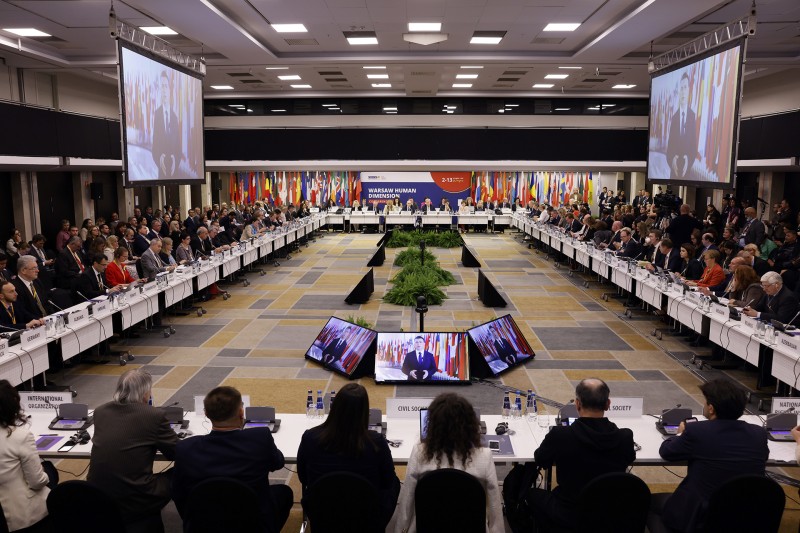
In early October 2023, a Russian historian based in Latvia was presenting a report on xenophobia at a European human rights conference in Warsaw.
The public description of the talk was broad and did not put any special emphasis on Russia. But the researcher’s private correspondence reveals a different agenda.
The goal was to “position the Russian Federation favorably on issues of human rights in general and minority rights in particular,” he wrote in a 2022 grant application requesting funding for the underlying research.
Presenting his findings at international forums — such as the 2023 event in Warsaw hosted by the Organization for Security and Co-operation in Europe (OSCE) — would be “an important step in strengthening the position and authority of the Russian Federation in the international arena,” the applicant, Valery Engel, added.
This leaked grant application and other documents obtained by journalists show that Engel’s report and presence at the OSCE event in Warsaw were directly financed by an arm of the Russian state: the sanctioned legal aid organization known as Pravfond.
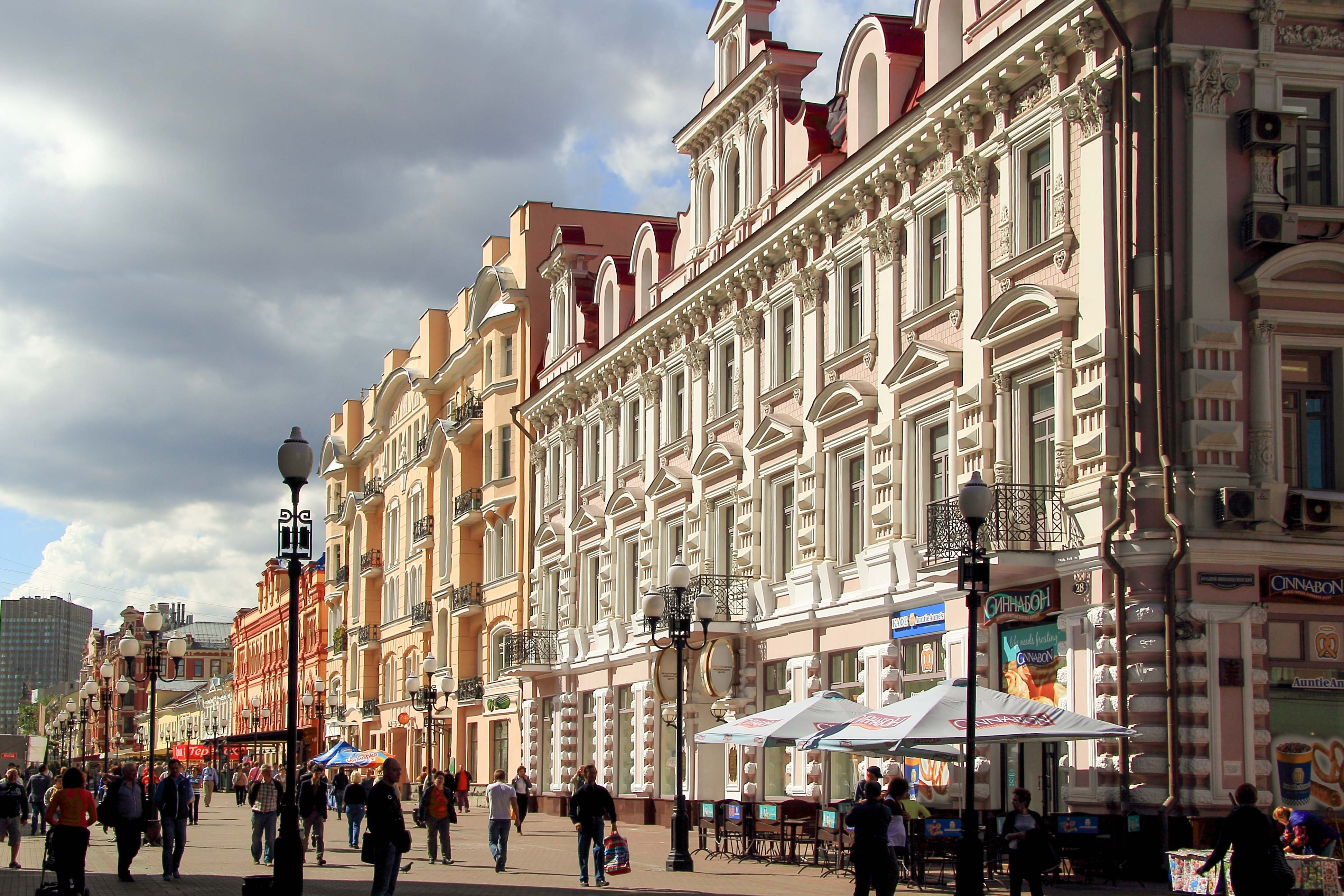
Pravfond's headquarters is just off of central Moscow's famous Arbat Street.
Pravfond’s official mission is to provide legal support to “compatriots” around the world. But in reality, this has extended to funding propaganda in an effort to advance the Kremlin’s interests abroad, a trove of leaked emails obtained by Danish public broadcaster DR and shared with OCCRP and partners last year revealed.
Pravfond and its executive director were sanctioned in June 2023 by the European Union, which accused the foundation of using “unfounded accusations of Nazism, Russophobia, and massive persecution of Russian-speaking people… to create instability and division in many neighbouring countries of Russia.”
Records leaked from inside Pravfond show that despite Engel’s residency in the EU, he made at least two applications for funding after the sanctions were imposed. This adds him to a list of other grantees in at least 11 EU countries who OCCRP found continued receiving Pravfond money after the sanctions.
Any acceptance of funding from a sanctioned organization would be “prohibited in most cases,” Latvia’s Financial Intelligence Unit, which oversees the country’s boycotts against Russia, told reporters.
This is because “such dealings would usually mean making resources (such as services) available to the EU-sanctioned entity or circumventing an asset freeze,” a spokesperson said.
Since 2013, Engel and the Latvia-based non-profit he runs have received funding from Pravfond on at least 10 occasions, including to fund the report he presented in Warsaw, the documents show. The two grant applications he made after Pravfond was sanctioned include a September 2023 request to finance the presentation of the report at the OSCE event, and a March 2024 application for 41,000 euros to fund a study on “Russophobia.” It is not clear if the second application resulted in a grant.
When reached for comment, Engel confirmed his participation in the OSCE conference but denied having applied to Pravfond for grants since Russia’s full-scale invasion of Ukraine in 2022.
“I've never written such applications, never received funding from this foundation, and never prepared any studies with such titles,” he said when asked about the two applications filed after Pravfond had been sanctioned in 2023, and suggested that the documents had been faked.
About the Documents
This is not the first time that Pravfond paid for grantees to attend events hosted by the OSCE, an organization that Moscow has repeatedly criticized in recent years, describing it as being weaponized by the West in its "hybrid war” against Russia. The leaked documents show that Engel is just one of at least ten individuals who have sought funding from Pravfond to attend OSCE conferences over the past decade.
An OSCE spokesperson, Katya Andrusz, said that the organization’s human rights conferences are “open to a broad range of stakeholders” in accordance with the “principles of openness and inclusivity,” and that the body does not vet participant’s sources of funding.
“Participation in such events does not imply endorsement by the OSCE…of the views expressed by any speaker, nor of their institutional affiliations or funding sources,” Andrusz said.
Latvia’s State Security Service told reporters that Engel has “been under the scrutiny” of the agency for his ties to Russia.
“Engel has, through his activities, long and systematically participated in the implementation of Russia’s non-military influence measures and in the justification of Russia’s aggressive foreign policy,” a spokesperson said.
The security agency said that following a request it made in February 2026, Engel had been added to a list of foreign nationals banned from entering Latvia.
Pravfond did not respond to requests to comment.
‘A Subtle Tilt’
Engel publishes regular reports on minority rights through his Riga-registered non-profit the European Center of Democracy Development, an organization which describes itself as being dedicated to the study of xenophobia and radicalism in Europe. The work is funded by “donations from individuals and institutions,” the website notes, citing a project funded by the European Commission as an example.
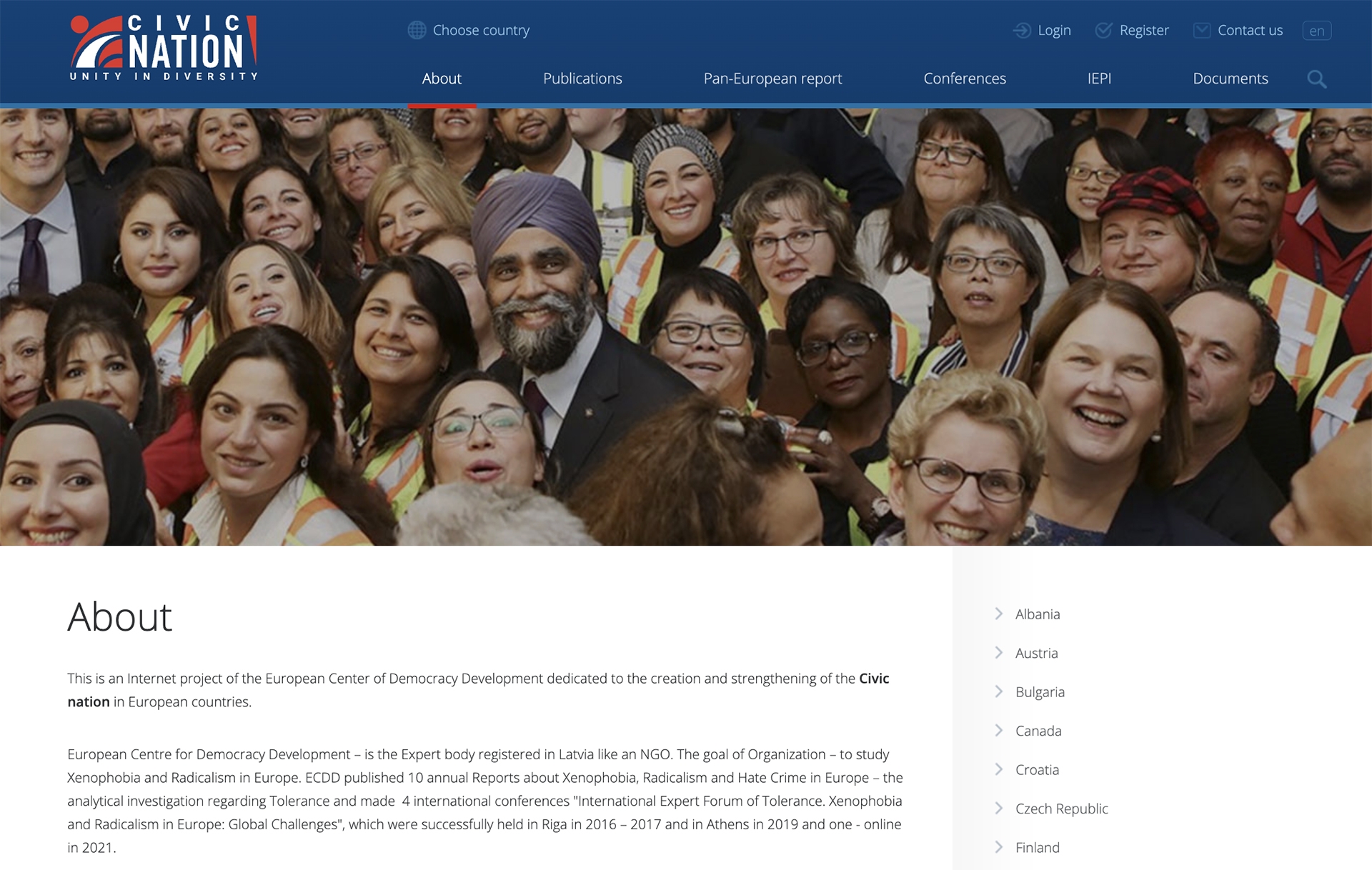
A screenshot from the website of Engel's Latvia-based non-profit, the European Center of Democracy Development.
The non-profit’s annual reports, which include generic information about its finances, do not cite any foreign funding over the past 12 years until 2024. Most of the listed funding falls under the vague category of “other income." Two individual donors are also named, including Engel himself, who donated 10 euros to his association in 2015.
The leaked records show, however, that Engel has won Pravfond funding multiple times over the last 13 years, and that he also enjoyed the support and recognition of Russia’s Ministry of Foreign Affairs even after the full-scale invasion of Ukraine.
A month before the 2023 OSCE event, Engel emailed Pravfond a signed request for 1,230 euros to organize a presentation of his report on the sidelines of the conference, plus funding for airfare from Riga to Warsaw and back, hotel accommodation, and a 50-euro per diem.
The same day, September 1, 2023, Russia’s Ministry of Foreign Affairs sent an official, signed letter of support for Engel’s application, describing him as a successful researcher and speaker at international venues, and an organizer of “high-profile events on the sidelines of international humanitarian forums.”
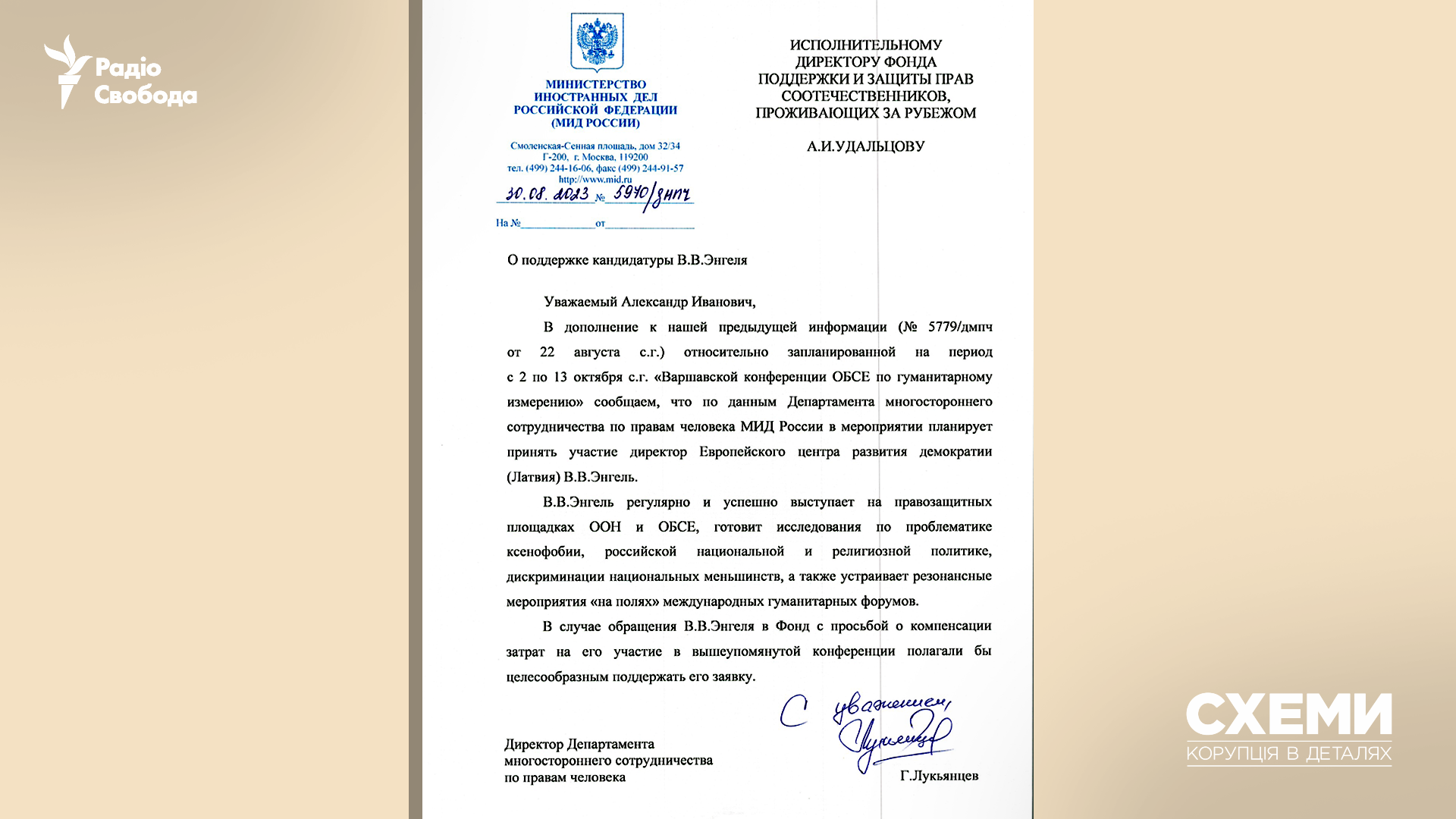
A letter from Russia’s Ministry of Foreign Affairs expressing support for Engel’s application for Pravfond to finance his presentation at the 2023 OSCE conference.
A leaked Pravfond spreadsheet of funding requests dated October 6 — the day after Engel’s presentation in Warsaw — confirms he was granted the money for attendance.
According to leaked cellphone billing records, Engel was in close contact with Pravfond in the week and a half before the event, when five calls between them took place. During the conference there was one call and a series of text messages, the content of which is not known. (Engel denied these calls took place.)
The report that Engel presented at the OSCE conference had also been bankrolled by Pravfond before the organization was sanctioned, the leaked documents show.
In a November 2022 application, Engel requested 22,400 euros to finance a study on xenophobia against Russians and to “counter disinformation.” It described Russia’s full-scale invasion of Ukraine as a “special military operation” — the Kremlin’s preferred euphemism — and said Russian speakers in “unfriendly countries” had since suffered “ethnocratic discrimination and the infringement of their rights.”
The resulting 171-page report, which Engel emailed to Pravfond upon its publication, covers the state of xenophobia and the violation of rights in 13 different countries belonging to the OSCE, including Russia and Ukraine. The language differs noticeably from the overtly pro-Kremlin bent of the grant application, with some references to the Russian aggression against Ukraine as a “war” and “invasion.”
However, “there seems to be a subtle tilt or a certain frame that's being adopted here,” Seva Gunitsky, an associate professor of political science at the University of Toronto, said when shown the document.
He noted how certain sections on Russia were broadly uncritical, such as a summary of the government’s anti-extremism strategy that fails to mention how ensuing legislation has been wielded against independent voices.
“It's designed to be citable in neutral forums, I think, but it definitely has an orientation that aligns more with a Russian narrative,” said Gunitsky.
When reached for comment, Engel pushed back against this reading of the report. The paper “harshly criticizes Russia, as well as other countries monitored,” he said. “Moreover, it draws virtually no conclusions. It presents facts, supported by sources.”
Two Languages, Two Names
In the March 2024 application, Engel asked Pravfond for an additional 41,000 euros to fund a new report that would “draw the attention of the Russian and international public to the problem of violations of the rights of the Russian-speaking minority in EU countries and Ukraine.”
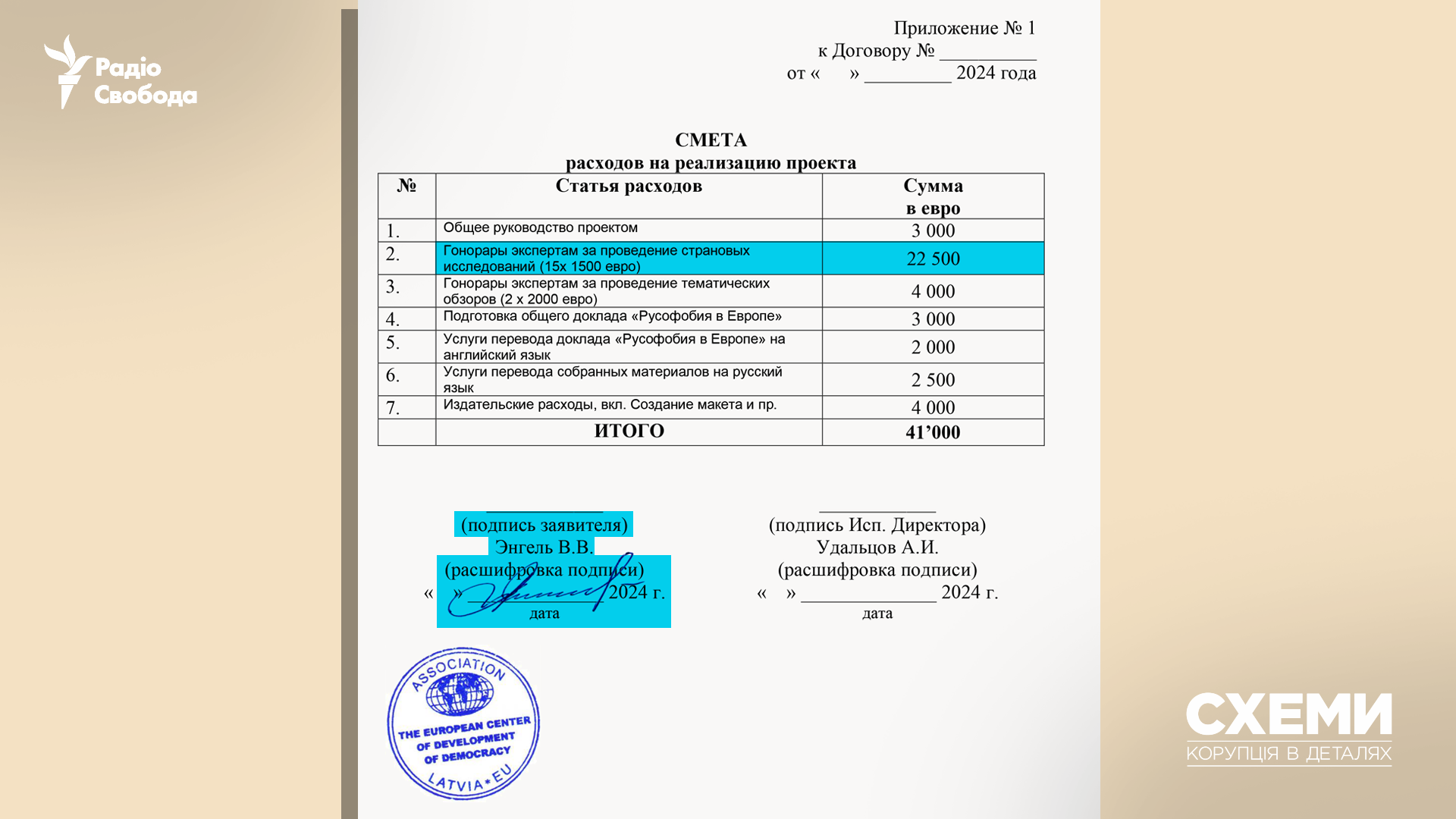
A page from Engel's 2024 application to produce a report on Russophobia.
The project would be published in both Russian and English. However, while the Russian-language version was to be titled simply “Russophobia in Europe,” the proposed English-language title was more veiled: “The State and Minority Rights Violations in the Post-War Period (Fatal Mistakes of the Authorities in Light of the Formation of an Inclusive Society in Europe)".
This was due to “the overall situation in Europe and the involvement of foreign experts from foreign universities and research centers in the preparation of the report,” the grant application explained. In international forums, “the topic of Russophobia will be presented in the general context of violations of the rights of national, religious and linguistic minorities in European countries,” it added.
Engel denied having submitted this grant and there’s no evidence in the leaked materials that the application was approved. Reporters could not find any similar report authored by Engel in the public domain.
Among the experts who were listed as contributors to the project was Engel’s long-time collaborator Ruslan Bortnik, a Ukrainian political analyst who is director of the Ukrainian Institute of Politics.
Bortnik, who has previously promoted some pro-Kremlin narratives on social media, was also named as a co-author of Engel’s 2023 report on xenophobia and other similar earlier publications.
When reached for comment, he denied involvement in any of Engel’s reports, and said he had never received any money from Pravfond, either directly or indirectly via projects in which he was named as a participant.
“I am a world-renowned expert. My name … can be included in any list,” he said. “[Receiving Russian state money] would be complete madness and a crime if that were the case… I have never in my life received Russian funding.”