Reported by
The Belgian government is pressing the European Union to close a glaring sanctions loophole after OCCRP and partners revealed that raw materials from an Irish refinery are feeding into a supply chain that ultimately provides aluminum to EU sanctioned Russian weapons manufacturers.
Maxime Prévot, Belgium’s foreign minister, described the findings as “extremely disturbing.” Through a spokesperson, Prévot announced to OCCRP’s partner "De Tijd" that Belgium would lobby the European bloc to expand its sanctions regime to ensure that E.U.-produced raw materials cannot be repurposed for the Russian war effort.
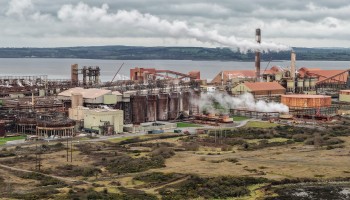
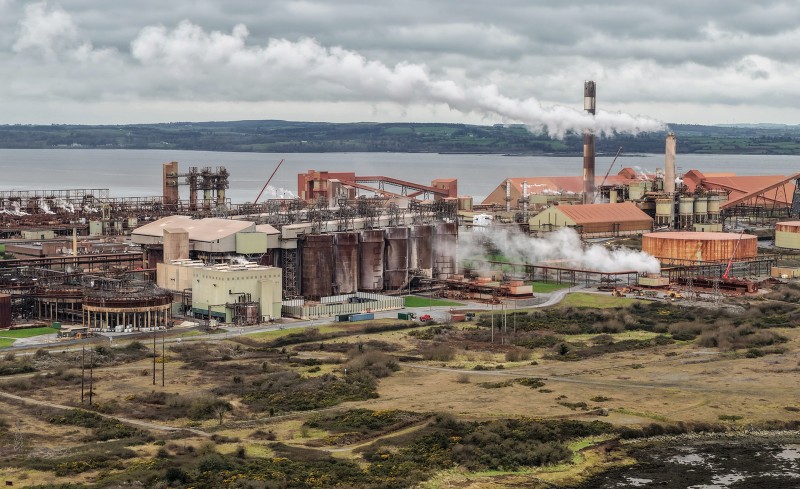
The diplomatic push follows a report by OCCRP detailing the supply chain of Aughinish Alumina, Europe’s largest alumina refinery. The investigation found that since 2023, the Irish facility has sent more than half of its alumina exports to Russian smelters owned by its parent company, the Russian aluminum giant Rusal.
Because EU sanctions currently ban the import of Russian aluminum but do not restrict the export of alumina to Russia, the shipments remain entirely legal.
According to the investigation, the Russian smelters subsequently sold more than $650 million worth of aluminum to a Moscow-based trader. That trader, in turn, supplied more than 40 Russian arms companies that are currently under EU sanctions. The volume of the trade is vast: in 2024 alone, the Aughinish refinery sent approximately half of its total alumina production — worth roughly $400 million — to just two smelters in Siberia.
In Dublin, the revelations prompted immediate political fallout. A government spokesperson said to OCCRP’s partner Irish Times authorities were “aware of reports relating to Aughinish Alumina,” were taking them “very seriously,” and were actively examining the issues raised.
In a parliamentary debate on March 24, Prime Minister Micheál Martin expressed concern over the findings. While noting that the investigation alleged a supply chain routed “through intermediaries” rather than a direct link, he assured lawmakers that the matter would be reviewed.
Martin also cautioned that the refinery holds significant economic importance, serving as a major employer in Ireland and a critical node in broader European supply chains. Nevertheless, he told parliament that the reported diversion of materials into Russian armaments “is a concern.”
Opposition lawmakers in Ireland responded with sharper condemnation. Ivana Bacik, the leader of the Labour Party, said she was “shocked,” calling it “horrific” if Irish-made alumina was being utilized to manufacture weapons that are killing Ukrainian children. Ged Nash, the party’s finance spokesman, characterized the government as “rather incurious” and suggested Dublin must revisit the scope of sanctions at the European level.
Paul Murphy, a lawmaker with the People Before Profit party, accused the government of shielding the interests of an oligarch, while Jennifer Whitmore of the Social Democrats said the shipments demand immediate, intensive scrutiny.
The controversy has reverberated beyond Ireland, highlighting what critics describe as severe structural flaws in the European Union's economic blockade of Moscow.
During a recent session of Ireland’s foreign affairs committee, Oleksandr Merezhko, a Ukrainian lawmaker, argued that it is unacceptable for Western companies to help Moscow circumvent restrictions. Russia, he said, “should be totally isolated, economically, politically.” Anton Gerashchenko, a former Ukrainian deputy interior minister, echoed the sentiment, expressing hope that the investigation would prompt official action.
The Ukrainian Embassy to Ireland says the investigation raises “serious and legitimate concerns.” This case, the Embassy spokesperson says, illustrates the growing challenge of preventing dual-use and other materials from entering Russian military supply chains.
In Brussels, Thijs Reuten, a Dutch member of the European Parliament, cited the case as glaring proof that EU sanctions require urgent tightening and stricter enforcement. Reuten emphasized that companies bear a fundamental responsibility to vet their trading partners, even when a specific trade flow technically circumvents the letter of the sanctions law.
Calling it “incomprehensible” that an EU-based company could export virtually its entire production of a sensitive metal to Russia without obstruction, Reuten warned that the resulting weapons “wreak death and destruction in Ukraine.”
“The game of hide-and-seek by companies and member states must end,” Reuten said, adding that such regulatory blind spots not only cost Ukrainian lives but fundamentally undermine Europe’s own security.
The EU’s sanctions envoy, David O’Sullivan, says that sanctions have decreased EU-Russia trade significantly. He says the information provided “if accurate, is worrying” and promises that the EU Commission will continue to act in order to undermine Russia’s ability to wage its war.
Experts in international relations and anti-corruption advocates echoed the call for reform. John O’Brennan, a professor of Irish politics, said the findings exposed “significant gaps in EU sanctions” and urged the bloc to fully sanction the alumina sector. Alexander Pomazuev, of Russia’s Anti-Corruption Foundation, described the current regulatory framework allowing the exports as a “glaring loophole.”