Reported by
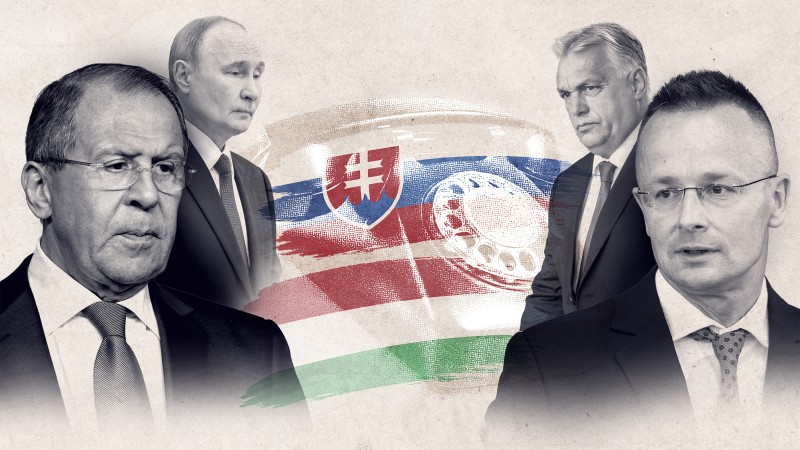
An hour after Hungarian Foreign Minister Péter Szijjártó returned to Budapest from St. Petersburg on August 30, 2024, he received a phone call from his Russian counterpart, Sergei Lavrov.
Lavrov told Szijjártó he had been quoted all over the Russian media following his visit.
“Did I say something wrong?” Szijjártó asked.
“No, no, no.” Lavrov reassured him. “They were just saying that you are pragmatically fighting for the interests of your country.”
In fact, Lavrov was calling to make a request: The Russian oligarch Alisher Usmanov was looking to have his sister, Gulbahor Ismailova, removed from EU sanctions lists, and Szijjártó had promised to help.
“I’m calling on the request of Alisher and he just asked me to remind you that you were doing something about his sister,” Lavrov said.
“Yeah, absolutely,” Szijjártó answered. “The thing is the following: Together with the Slovaks we are submitting a proposal to the European Union to delist her. We will submit it next week, and as the new review period is going to be started, it's gonna be put on the agenda and we will do our best in order to get her off.”
Lavrov expressed his appreciation for Szijjártó’s “support and … fight for equality in all fields.”
From there conversation proceeded to the two men’s shared disdain of the European Union and its officials. Before hanging up, the Hungarian praised the new Gazprom headquarters he’d visited in Russia. “I am always at your disposal,” he added.
Seven months later, Ismailova was removed from the EU sanctions list.
This call between the two foreign ministers was one of several that took place between 2023 and 2025. Audio recordings of Szijjártó’s conversations with Lavrov, as well as other Russian officials, were obtained by reporters from VSquare, FRONTSTORY, Delfi Estonia, The Insider, and the Investigative Center of Ján Kuciak (ICJK). Reporters confirmed the content independently with intelligence sources in multiple countries and consulted on the authenticity of the audio with external experts.
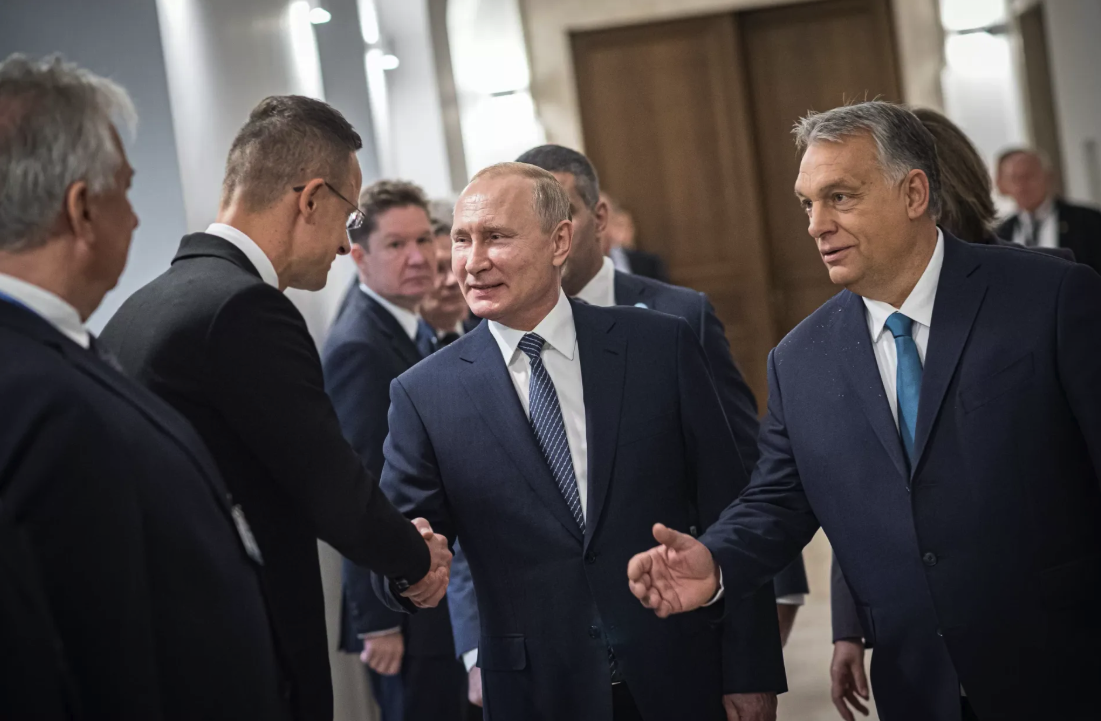
Hungarian Foreign Minister Péter Szijjártó with Russian President Vladimir Putin and Hungarian Prime Minister Viktor Orbán.
The calls highlight the exceeding comity between Szijjártó, who represents an EU and NATO member, and Lavrov, who represents a nation that has invaded a European country and sponsored acts of arson and sabotage against NATO’s eastern flank.
The two men’s conversations traffic in sensitive information about the internal deliberations of both Budapest and Brussels, which are doubtless of interest to the Kremlin. They also provide clearcut evidence of Russia’s role in prodding Hungary and Slovakia to soften EU sanctions against Russian individuals and entities.
In his exchanges with Lavrov, Szijjártó comes across as deferential, at times bordering on obsequious. “If you remove names and show these conversations to any case officer, he will swear that this is a transcript of an intelligence officer working his asset,” said a senior European intelligence officer after reviewing the transcripts.
Neither Lavrov nor Szijjártó replied to requests for comment. Usmanov’s German lawyer, Joachim Nikolaus Steinhöfel, declined to answer questions about the discussion between Lavrov and Szijjártó. He described EU sanctions against Usmanov and his relatives as “unjustified,” stressed his success as a businessman and philanthropist, and emphasized that Usmanov had won “over twenty court cases” against “media outlets, public figures, and politicians who disseminated various false statements about him … many of [which] echoed the very reasonings used for the EU sanctions.”
Szijjártó’s communications go far beyond Usmanov and his relatives. In a call with another Russian official, Deputy Energy Minister Pavel Sorokin, in the summer of 2025, Szijjártó not only says he has already diluted the EU’s 18th sanctions package, then under negotiation — he asks for additional talking points that would make his efforts appear to be in the interest of Hungary rather than Russia.
“I have already removed 72 [entities] from the list, but there were 128. I'm trying to continue, but I have to say that this is in the interest of Hungary,” Szijjártó says.
“If they [Sorokin’s staff] can help me identify the direct and negative effects on Hungary, I would be very grateful,” he adds, “because if I can show something like that, you would give me a completely different opportunity.”
Szijjártó’s willingness to act in Russia’s interests at the EU level helps explain why Moscow is investing significant effort in keeping Viktor Orbán and his pro-Kremlin Fidesz party in power in Hungary.
Independent polling suggests Orbán is trailing badly ahead of the April 12 parliamentary election, with the center-right Tisza party, led by challenger Péter Magyar, holding a strong lead.
As Orbán’s campaign struggles, Russia is reportedly stepping in to assist. As VSquare reported earlier this month, the Kremlin has assigned Sergey Kiriyenko — a deputy chief of staff to Putin and a key architect of Russia’s political influence operations — to covertly support Orbán’s campaign. Kiriyenko previously played an integral role in shaping election interference activities in Moldova.
At the same time, Orbán’s campaign has increasingly echoed Kremlin narratives, staging provocations against Ukraine and accusing opposition figures and critics of acting as Ukrainian proxies or spies while dismissing allegations of Orbán’s own ties to Russia.
The calls show that Szijjártó routinely kept Lavrov informed of supposedly confidential discussions by European diplomats.
For instance, in the same August 30, 2024 call with Lavrov, Szijjártó revealed details of a EU Foreign Affairs Council meeting that he had participated in the day before.
“That was crazy, you know, when [Lithuanian foreign minister Gabrielius] Landsbergis said that we contribute 12 percent of each rockets and missiles,” Szijjártó told Lavrov, referring to the minister’s argument that Hungarian and Slovak gas and oil payments were helping finance Russia’s war on Ukraine.
“I said, my friend, you are not right, because the Europeans contribute much more … it's not only the Slovaks and us who are buying gas and oil from Russia directly but all of you who are buying the same from them through … India, Kazakhstan.”
When reached for comment, Landsbergis confirmed that this conversation had taken place.
“It seems that all this time Putin had, and still has, a mole in all European and NATO official meetings,” he said. “If the integrity of these meetings is to be maintained, it would be appropriate to ban Hungary from all of them.”
“Every generation has a Kim Philby,” Landsbergis said, referring to the notorious KGB spy in the British Secret Intelligence Service. “Apparently Péter Szijjártó is playing the role with enthusiasm.”

Lavrov bestows Szijjártó with the Order of Friendship, a Russian honor awarded by Vladimir Putin, on December 30, 2021.
Hungary’s Leverage
While the EU has sanctioned some 2,700 Russian citizens and entities due to their role in enabling Russia’s war on Ukraine, the bloc must vote every six months on whether to extend those sanctions.
These decisions are made by consensus, meaning all 27 member states must agree.
RFE/RL reported in March 2025 that Hungary and Slovakia threatened to block the extension of EU sanctions that month unless certain names were removed. It wasn’t just Ismailova: Russian businessman Viatcheslav Moshe Kantor and the country’s sports minister, Mikhail Degtyaryov, were also unsanctioned during that round.
Speaking on condition of anonymity in order to be able to reveal inside details, a European diplomat closely involved in the negotiations said that Hungary and Slovakia usually begin with a lengthy list of Russian names they want delisted.
“They don’t use legal arguments,” the diplomat explained. “They just say they don’t want those people on the sanctions list for political reasons.”
As negotiations progress, Budapest and Bratislava usually whittle their list down to a handful of people, as was the case with Ismailova, Kantor, and Degtyaryov.
While it had long been suspected that Hungary and Slovakia leak the details of these negotiations to Moscow, the diplomat described newly obtained hard evidence as valuable: “Hungary is clearly fulfilling political orders from Russia,” they said when reporters showed them the transcripts.

The Europa building is the seat of the European Council and Council of the European Union, located in Brussels’ European Quarter.
‘No clear Hungarian interest’
Economic relief for individuals isn’t the only case in which Hungary secretly acted on the Kremlin’s behalf in Brussels.
In conversations with another high-ranking Russian official, Deputy Energy Minister Pavel Sorokin, Szijjártó said that he was doing his best to “repeal” a crucial EU sanctions package targeting Russia’s shadow fleet of oil tankers — the means by which Moscow evades Western energy sanctions.
In one conversation with Sorokin, Szijjártó offered to remove Russian banks proposed for designation by the EU. He even asked the Russian to provide him with arguments as to why doing so would be in Hungary’s interest.
In another call, Szijjártó complained that the EU refused to share with him documents related to the proposed sanctioning of 2Rivers, a Dubai-based company trading in Russian oil.
“They say that there is no clear Hungarian interest that they can identify, and therefore Hungary cannot legally ask them to be removed from the list,” Szijjártó said after Sorokin asked why Budapest had been cut out of the loop.
According to the EU, 2Rivers, formerly known as Coral Energy, has been a key player in selling Russian oil via its own shadow fleet of tankers and concealing the origin of crude from Russian state energy giant Rosneft, now under U.S. sanctions. 2Rivers then sells the crude above the internationally capped oil price and feeds Russia’s war machine with vital revenue. In December 2024, the UK sanctioned 2Rivers and its oil trading network.
It is unclear what interest Hungary — a landlocked country that receives oil through pipelines — could have in trying to preserve Russia’s shadow fleet operations. But the benefit to Russia is obvious.

German authorities suspect the Eventin, an oil tanker found drifting off the coast in January, of being part of a Russian “shadow fleet” used to skirt EU sanctions.
After reporting that he was unsuccessful with 2Rivers, Szijjártó shared details with Sorokin about then-ongoing negotiations on the EU’s 18th sanctions package.
He explained that the vote was not yet on the agenda thanks to a postponement arranged by Hungary and Slovakia until the EU agreed to “make an exception” for those countries to “allow us to continue buying Russian gas and oil.”
The 18th sanctions package was proposed by the European Commission on June 10, 2025. Two weeks later, Szijjártó announced publicly that Hungary and Slovakia were blocking it “in response to European Union plans to phase out Russian energy imports.”
It was in a call with Sorokin a week later that Szijjártó asked for talking points about “negative effects on Hungary” to help him dilute the package.
Kinga Redłowska, a leading sanctions expert and the Head of CFS Europe at the London-based think tank RUSI, said Hungary’s approach serves a dual purpose.
“Domestically, it allows Viktor Orbán to reinforce an anti-Ukrainian narrative,” she said. “At the EU level, it provides leverage to extract concessions in unrelated areas, such as EU funding or rule-of-law disputes.”
But while this strategy may help Orbán’s government, enabling an aggressive neighbor to capture and hold more sovereign European land runs counter to Hungary’s national interest, she said: “Weakening sanctions risks bolstering Russia’s war economy, undermining the broader security interests of all EU member states, including Hungary itself.”
The conversations between Szijjártó and Sorokin also touched on Russian banks that were in the EU’s crosshairs.
“[S]hare the names of those banks with me, I can check if they are on the list or not, I’ll check the legal grounds and then I’ll do my best,” Szijjártó told Sorokin. “I know they want to put Sankt Petersburg Bank on the list, which I managed to remove; they also wanted to put another bank related to the Paks [nuclear power plant] project on the list, and I managed to remove it.”
After weeks of delays by Hungary and Slovakia, the European Union finally adopted the 18th sanctions package on July 18, 2025. 2Rivers was included on the list, prompting it to begin dissolving. The package also dealt a significant blow to Russia’s shadow fleet and its efforts to circumvent oil sanctions.
However, it remains unclear how much greater the impact might have been without Szijjártó’s efforts. By that time, his close relationship with Russia had already been made public.
In April 2025, the Polish weekly Polityka reported that Szijjártó was suspected of sharing written notes from EU ministerial meetings with Russia. Earlier this year, the Washington Post reported that Szijjártó has been regularly sharing information over the phone with Lavrov during breaks in EU talks. “Every single EU meeting for years has basically had Moscow behind the table,” a European security official told the Post.
Politico reported earlier this month that “the EU is limiting the flow of confidential material to Hungary and leaders are meeting in smaller groups.”
Hungary’s government dismissed such reports as “pro-Ukrainian propaganda,” while Szijjártó, while acknowledigng his frequent communication with Lavrov, called stories about his actions “fake news.”
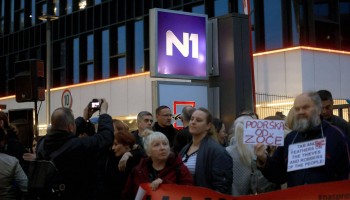
This strategy appears to be backfiring. Szijjártó was recently booed by protesters, who shouted “traitor” and “Russian spy” at a campaign event.
Hungary’s interference in EU sanctions policy began within months of Russia’s full-scale invasion, hardening over the ensuing four years into a systematic lobbying effort for Kremlin-linked figures that was joined by Slovakia.
In June 2022, Hungary held up the entire sixth EU sanctions package — which included the landmark partial Russian oil embargo — until Patriarch Kirill, a former KGB agent and the head of the Russian Orthodox Church, was stripped from the list. Prime Minister Viktor Orbán personally intervened on the grounds of “religious freedom.”
In February 2025, Hungary extracted another Kirill exemption during negotiations on the 16th package, as well as saving the Russian Olympic Committee and two Russian football clubs.
In February 2026, Hungary vetoed the entire 20th sanctions package outright — the first time Budapest had gone that far — blocking new restrictive measures that had been intended to mark the fourth anniversary of the invasion, citing a dispute over oil flows through the Druzhba pipeline.
In March 2026, Slovakia threatened to veto the six-month renewal of the entire existing individual sanctions list unless Usmanov and another Russian oligarch, Mikhail Fridman, were immediately removed, before executing what EU diplomats called one of the strangest U-turns they had witnessed, backing down without securing either removal; Hungary likewise dropped its list of seven targets.