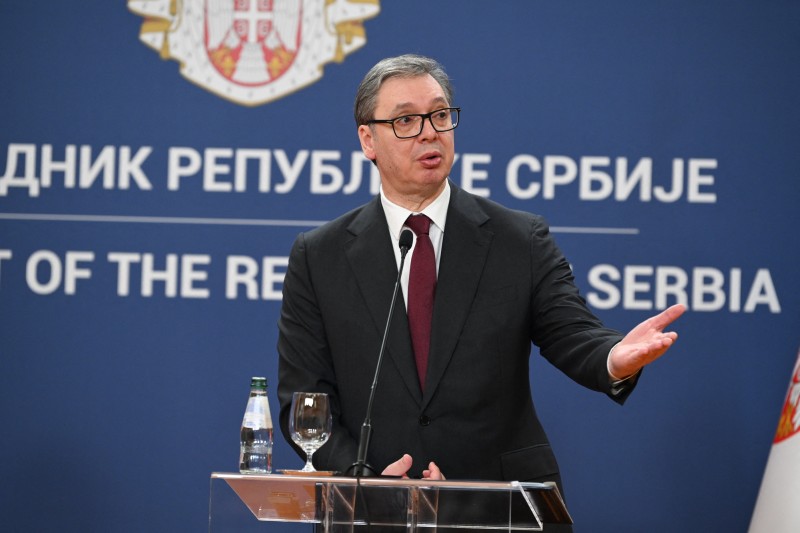
Addressing the nation on Sunday evening, Serbian President Aleksandar Vučić hailed the ruling Serbian Progressive Party’s (SNS) performance in 10 small municipal elections as if he had secured a massive national mandate. But outside the president’s press conference, independent watchdogs and media outlets painted a grimly different picture, describing an election day marred by heavy fraud and gang violence.
“It is 10 to zero. Thank you, Serbia,” Vučić declared, claiming that a “huge evil” had been narrowly avoided. Projecting an image of magnanimity, he added: “I hope that we will experience future elections as a democratic game, as a holiday, and not as a war.”
He went on to accuse the political opposition of “pulling guns and harassing people,” positioning his party as the nation's defender of stability.
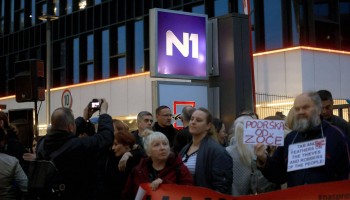
However, reports from the ground completely shattered the ruling party’s narrative of a peaceful democratic exercise. According to the independent news outlet N1, the local elections quickly descended into “scenes of street violence,” featuring gangs armed with sticks, physical brawls, and “bloody heads” in the municipalities of Bor, Bajina Bašta, and Kula.
The Center for Research, Transparency and Accountability (CRTA), an independent election watchdog, rated the election day anywhere from “bad to worst.” In a scathing preliminary assessment, the organization noted that the sheer intensity of the physical violence overshadowed a massive apparatus of systemic fraud, which included parallel voter registries, compromised ballot secrecy, and the organized migration of voters across municipal lines.
This violent ground game appears to be the physical manifestation of the massive dark money operations recently exposed in preliminary campaign finance reports, which showed the ruling party funneling tens of millions of dinars into these small towns. CRTA’s findings on Sunday revealed how those off-the-books resources were deployed on the ground. Observers recognized public servants imported from other Serbian towns acting among the “thugs and operatives for dirty work” who were terrorizing the polling stations.
International observers voiced sharp condemnation. “This is not just alarming — it is unacceptable,” the European Democratic Party (EDP) said in a statement, pointing to illegally inflated electoral rolls, detained journalists, and passive police forces.
Sandro Gozi, the EDP Secretary General, noted that Sunday’s events were not the picture of a normal democratic election, but rather “a system under pressure, using pressure in return.”
Yet, amid the mounting reports of beaten citizens and severe electoral irregularities, the ruling party deployed a bizarre new tactic: a trio of American “election monitors” who spent the day recording glowing reviews for social media.
Speaking to a local Kula TV Instagram channel right outside a polling station, American operative Jake Hoffman confidently reported that his team had “so far not seen any issues” and that “everything was good.”
He then handed the camera to his colleague, Michelle Sassouni, who enthusiastically described the voting process as a “well-oiled machine” where “everybody knew exactly what their job was.” A third American, Peter Finnochio, chimed in to declare: “It’s great seeing democracy in action here in Serbia.”
The irony was stark: while the Americans were filming their cheerful dispatches, independent media and CRTA explicitly identified Kula as one of the epicenters of the day’s most severe violence, where police cordons ultimately had to be deployed to separate ruling party supporters from students and the opposition.
The facade of international legitimacy crumbles entirely upon examining the monitors themselves. Hoffman and Sassouni are not credentialed democracy experts; they are a husband-and-wife duo from Florida who co-host a conservative political podcast called “Moderately Outraged.” Hoffman, who runs a digital marketing agency and recently ran a failed campaign for the Florida State House, serves as a National Committeeman for the Young Republicans.
Rather than objectively observing the election, watchdogs argue they functioned as imported content creators, providing the ruling party with a sanitized digital alibi while actual voters faced intimidation.
The deployment of these monitors in Serbia mirrors a strategy previously documented by OCCRP and the European Platform for Democratic Elections (EPDE) during local elections in Georgia last October. In that instance, the European Platform for Democratic Elections (EPDE) reported that Georgia brought in a network of 29 foreign “fake observers”—including Hoffman—just as independent watchdogs were being suppressed by the state. That network, affiliated with the Hungary-based Center for Fundamental Rights, publicly praised Georgia’s heavily criticized polls.
In Serbia, local watchdogs view this as a direct continuation of that exact tactic. Raša Nedeljkov, program director at CRTA, noted that these foreign operatives act as “supervisors” for ruling party polling chiefs, calling their appearance “a step further in destroying the integrity of the elections.”
For local democratic advocates, the damage has already been done.
“The election day bluntly confirmed what was already seen during the campaign,” CRTA concluded in its final report, pointing to the extreme criminalization of state institutions and the weaponization of public resources. “In short, this can hardly be called an election.”