Reported by
Russia has recruited more than 24,000 foreign fighters from 44 countries since its full-scale invasion of Ukraine in February 2022, according to data provided to reporters by Ukrainian authorities.
Ukraine has captured recruits from Colombia to Cameroon, and Italy to China, according to the previously unreported data.
The figures were compiled by Ukraine’s Coordination Headquarters for the Treatment of Prisoners of War, and they cover the period from the invasion until late 2025. The data, which the agency says comes partially from sources within the Russian military, was shared with OCCRP’s media partner, Himal Southasian.
The largest number of recruits came from Central Asia, according to the data. Uzbekistan, Tajikistan, Kazakhstan, Kyrgyzstan and Turkmenistan together sent 11,157 recruits. At least 1,399 of them have been killed, the agency said.
"Russian efforts are focused on recruiting in the poorest countries of the world among the most vulnerable segments of the population,” said a spokesperson for the Coordination Headquarters.
“These (recruitment) networks operate on three principles: bribery, deception, and coercion,” he told Himal Southasian.
Russia's foreign and defense ministries did not respond to emailed requests for comment.
South Africa and India have made efforts to prevent recruitment, and to repatriate citizens fighting for Russia, while Kenya has charged one man with human trafficking. The Russian embassy in Nairobi denied any government involvement in recruitment, but noted that foreigners are allowed to voluntarily enlist in the military.
Sri Lankan authorities launched an investigation in 2024 into a network allegedly sending fighters to Russia, and reportedly arrested two retired military officers. The outcome of that investigation is unclear, and police did not respond to a request for comment before publication.
OCCRP reported in 2024 on Yemenis who said they left their own war-torn country, because they were promised non-combat jobs — and Russian citizenship — but were forced to fight.
British Defence Secretary John Healey has said Russia’s increasing reliance on foreign recruitment is due to high levels of casualties suffered on the battlefield, Bloomberg reported.
Between February 2022 and December 2025, Russian casualties — including killed, wounded, and missing — totalled about 1.2 million, according to a report by the Center for Strategic & International Studies (CSIS).
The Washington-D.C.-based think tank warned, however, that “assessing casualties and fatalities in wartime is difficult and imprecise, and various sides have incentives to inflate or shrink the numbers for political purposes.”
Ukraine has suffered about half the number of casualties as Russia, according to the CSIS report.
Ukraine's Coordination Headquarters spokesperson said Russia has stopped recruiting from Sri Lanka, Nepal, India, and Pakistan, which together had sent at least 1,794 fighters.
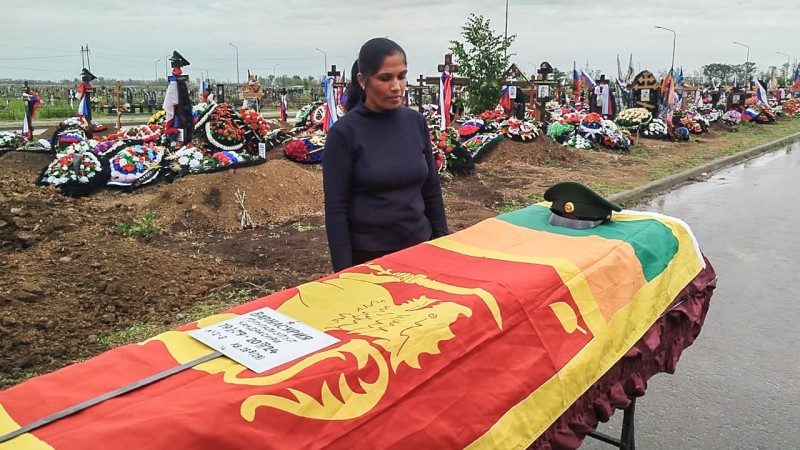
Of the 751 Sri Lankans recruited into the Russian military, at least 275 were killed in action, he added.
One of the missing Sri Lankans is Ulpakada Pathira Arachchilage Mahesh Suranjith Karunanayake, 45. He had served one year in the Russian military and was due to return home, according to his wife Nayomi Maheshika Dissanayake, 41.
She told Himal that she had last heard from her husband more than seven months ago, and he was last seen boarding a Moscow-bound bus from Bryanka, an occupied city in eastern Ukraine.

Sri Lankan Ulpakada Pathira Arachchilage Mahesh Suranjith Karunanayake disappeared while fighting for Russia in Ukraine.
Before disappearing, he found that 3.7 million Russian rubles (about $48,000) had been withdrawn from his account by his commander, and he filed a complaint, Dissanayake said.
The Ukraine Coordination Headquarters spokesperson claimed that Russian officers sometimes steal the signing bonuses received by recruits, which range from 1 to 4 million rubles (about $13,000 to $52,000).
He added that fighters are recruited online via chatbots and advertisements on social media, as well as in person through locals who are paid to find potential candidates.
In the case of Karunanayake, a Sri Lankan recruitment agent told him “he would not be sent to the frontline,” according to his wife, Dissanayake.
“Then he gave money to a local agent. That agent is in hiding now,” she said.