Reported by
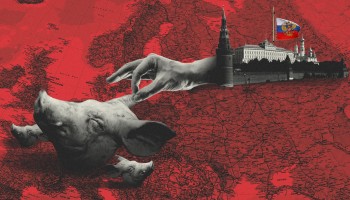
Russian authorities have seized control of a major agricultural producer, saying its billionaire founder violated anti-corruption rules while serving as a senator, and accusing him in a separate criminal case of embezzlement — allegations he rejects.
A Moscow court ordered billionaire Vadim Moshkovich, his family members, and former Rusagro chief executive Maxim Basov to transfer a controlling stake in the company to the state, Russia’s state news agency, Interfax reported.
Prosecutors framed the seizure as an anti-corruption action linked to Moshkovich’s time in Russia’s Federation Council, while a separate criminal case accuses him of embezzling around $400 million.
Both men deny any wrongdoing, according to Interfax. Basov’s lawyer said he would appeal the ruling, which he characterized as “unfair, unfounded and illegal.”
Rusagro is one of Russia’s largest agricultural producers, with operations in sugar, pork, oil-and-fats, and farming. The seizure places a major food-sector asset under state control as Russian authorities have expanded the use of courts and prosecutors to take over private companies.
Nikolai Petrov, a consulting fellow in the Russia and Eurasia Programme at Chatham House, told OCCRP that the case fits into a wider wartime redistribution of property, rather than a simple campaign against Kremlin opponents.
Moshkovich was not an obvious anti-Kremlin figure. He served in Russia’s Upper House of Parliament from 2006 to 2014, and attended a Kremlin meeting with President Vladimir Putin on the day Russia launched its full-scale invasion of Ukraine in February 2022. He was later sanctioned by the European Union, which said he had expressed support for the war.
Moshkovich challenged the sanctions at the EU General Court, arguing that he was not part of Putin’s inner circle. The case was dismissed in December 2023, and he appealed that ruling. The court has not yet posted a final ruling on the dismissal.
Petrov said the Russian state’s approach to property has changed significantly since the full-scale invasion. The Kremlin is no longer targeting only disloyal figures, but overseeing a broader redistribution. These days, he said, major assets can be vulnerable even when their owners have not openly opposed Putin.
Russian prosecutors initiated 17 confiscation cases in 2022, another 40 in 2023, and 37 in 2024, according to an article in the Russian Analytical Digest, which is published by several research institutions. Prosecutors launched nearly 70 cases in 2025.
The total value of assets targeted for seizure from early 2022 through late 2025 exceeded 4.99 trillion Russian rubles, or about $58 billion, according to the journal.
The article said the seizures have been justified through a range of legal arguments, including alleged corruption, illegal privatization, foreign ownership, strategic-sector restrictions, and claims that assets were acquired or managed in ways that harmed the state.
Russia has used similar mechanisms before. In the 2000s, tax and criminal cases helped dismantle Yukos, then Russia’s largest private oil company, after the arrest of its chief executive Mikhail Khodorkovsky. The company was driven into bankruptcy through multibillion-dollar tax claims, and its core assets were later absorbed by state-controlled Rosneft.
After Russia’s annexation of Crimea in 2014, authorities also moved against major private assets. That year, a court ordered the transfer of 81.7 percent of the oil company Bashneft from Vladimir Yevtushenkov’s Sistema to the state after prosecutors challenged the company’s privatization.
In 2023 and 2024, Russia moved against Rolf, one of the country’s largest car dealers: Putin first placed it under state management, and a court later nationalized the company on anti-corruption grounds.
Now, the Rusagro case involves a sanctioned businessman with past ties to the Russian political system, and a company operating in a strategic sector. Analysts say it shows how wartime Russia is redefining property rights, making large private assets increasingly conditional on political protection and usefulness to the state.
While the Kremlin once used nationalisation to target political opponents, “there are no disloyal or non-systemic actors left in Russia — neither in politics nor in business,” Petrov said.
That leaves even loyalists vulnerable to more powerful actors who covet their resources, he added, using a Russian idiom: “Everyone still wants to eat.”