Reported by
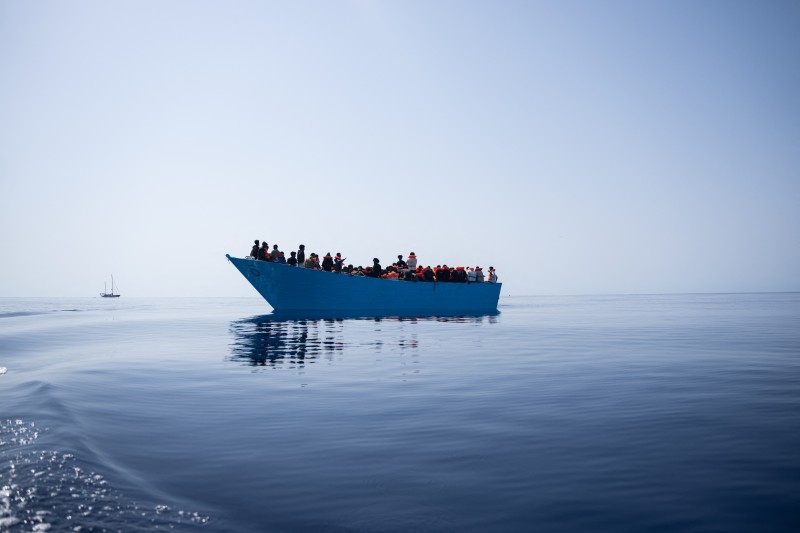
The German humanitarian organization Sea-Watch said that an armed vessel affiliated with the Libyan Coast Guard opened fire on one of its rescue ships shortly after the crew pulled 90 people from an overcrowded wooden boat in the Mediterranean.
In a statement on Tuesday, the group said the Libyan patrol boat fired on the civilian ship, the Sea-Watch 5, in international waters about 55 nautical miles north of Tripoli, the Libyan capital.
“The attack began at around 11 a.m. on Monday morning," Sea-Watch said. "First, a single shot was fired, followed by a burst of approximately ten to fifteen further shots — without any warning.”
Militia members aboard the Libyan vessel then used radio communications to order the Sea-Watch 5 to sail to Libya, the group added, threatening to board the ship when the rescue crew refused.
“Since 2016, we have documented more than 75 cases of extreme violence committed by Libyan militias in the Mediterranean," said Giulia Messmer, a spokesperson for Sea-Watch. "Protection from Italy? None. Consequences for this escalation of violence? None either.”
Sea-Watch noted that its crews had previously come under fire from Libyan units in September 2025, prompting the organization to file criminal complaints in Rome and Hamburg, Germany, last month. Other aid groups have reported similar hostility; in August 2025, SOS Méditerranée said the Libyan Coast Guard fired on its vessel, the Ocean Viking, in international waters as it carried 87 migrants.
Human rights organizations have long criticized the European Union for funding and equipping the Libyan Coast Guard to intercept migrants in order to curb irregular migration to Europe. The financial and logistical backing continues despite widespread allegations that Libyan forces subject returned migrants to forced labor, torture, and unlawful detention.
“The European Union has helped create a violent monster in the form of the so-called Libyan coastguard that it is now either unwilling or unable to control,” Messmer said.
In a related development, the International Criminal Court (ICC) is set to begin hearings into crimes committed against migrants and refugees in Libya. Scheduled for May 19–21, 2026, the proceedings will determine whether to confirm charges against Khaled Mohamed al-Hishri, a senior figure in the militia formerly known as the Special Deterrence Forces (RADA). The militia is aligned with the Tripoli-based Libyan Presidential Council, which assumed power in 2021 through a UN-backed process.
Al-Hishri is accused of committing, ordering, and overseeing crimes against humanity and war crimes against both Libyan nationals and migrants detained at Tripoli’s Mitiga Prison between May 2014 and June 2020.
The hearings represent the first case in the ICC’s 15-year investigation into Libya to reach this stage, according to the International Federation for Human Rights (FIDH), which described the move as a “long-awaited step toward justice, truth, reparation, and deterrence.”
Libya, a major transit point for migrants attempting to reach Europe, has become an increasingly hostile environment as people making the trek face widespread abuses and inhumane conditions at the hands of security forces and militias.
While the country remains a primary transit hub, migrants face a wide array of perils ranging from systemic exploitation and physical violence to death. Security forces and militias have been widely accused of perpetrating abuses in migrant detention facilities across the country. A February 2025 report detailed the horrific experiences within these detention centers, where human trafficking victims recounted being captured in Tunisia and sold to Libyan armed groups. Many were held in these camps until their families could pay ransoms, which in some cases exceeded $700.
Through mid-2025, a series of mass graves containing hundreds of migrant bodies were discovered at various locations across the country. One site where authorities discovered 10 charred bodies was the former headquarters for the Stability Support Apparatus (SSA), a security force that operated under the Presidential Council until May 2025. An additional 67 bodies were found in hospital refrigerators, while another burial site was uncovered at the Tripoli Zoo, an area previously under SSA control.
According to an International Organization for Migration (IOM) report published last month, nearly 8,000 people lost their lives or disappeared on migration routes in 2025. The Central Mediterranean route from Libya and Tunisia to southern Europe remains "the deadliest migration route to Europe based on existing evidence, with casualties reported even before migrants reach embarkation points," the organization said.