Reported by
Former Philippine President Rodrigo Duterte has lost a crucial legal battle at the International Criminal Court, with appellate judges ruling on Wednesday that the tribunal has jurisdiction to try him for alleged crimes against humanity connected to his deadly anti-narcotics campaign.
The ICC’s appeals chamber rejected all four grounds of Duterte’s appeal by a majority vote. The decision eliminates the final procedural roadblock before the court’s pre-trial chamber determines whether there is sufficient evidence for the case to proceed to trial — a ruling expected by April 28, following a confirmation of charges hearing held earlier this year.
“Having rejected the entire appeal, the appeals chamber considers that the defense request for the immediate and unconditional release of Duterte is moot,” Luz Del Carmen Ibañez Carranza, the presiding judge, said on Wednesday.
The jurisdictional dispute stems from the Philippines’ withdrawal from the ICC. Duterte, who served as president from 2016 to 2022, unilaterally withdrew the country from the Rome Statute in March 2018, shortly after the court opened a preliminary investigation into his drug war. Although the withdrawal became official a year later, the court maintained that it retained legal authority over potential crimes committed while the Philippines was still a member state.
Wednesday’s ruling marks Duterte’s third failed attempt to halt the investigation. The court previously rejected an appeal from the Philippine government in July 2023, and the pre-trial chamber upheld its jurisdiction in October 2025. This latest appellate decision is final, exhausting Duterte's options to challenge the court's authority.
The former leader was arrested in the Philippines and transferred to The Hague in March 2025. In September of that year, the ICC Office of the Prosecutor charged him with three counts of widespread murder, alleging he was an indirect co-perpetrator of extrajudicial killings.
The charges span his tenure as both mayor of Davao City and president of the Philippines. They include the alleged murders of 19 victims in Davao between 2013 and 2016; the killings of “high-value targets” nationwide between July 2016 and 2017; and the deaths of 45 victims during village, or barangay, clearance operations through September 2018.
Duterte has long maintained that he does not recognize the court’s authority, insisting he is only willing to face a domestic tribunal.
His chief legal counsel, Nicholas Kaufman, framed the appellate ruling as a product of institutional pressure. “The stakes are just too high for the court just to throw the case out,” Kaufman said, asserting that the tribunal is currently in a “state of crisis” and heavily reliant on Duterte's high-profile prosecution.
Kaufman noted the defense team is fully preparing for trial, pending the pre-trial chamber's upcoming decision. “We maintain everything that we argued at confirmation, and we believe that the evidentiary weaknesses that we identified at confirmation will lead ultimately to his acquittal,” he said.
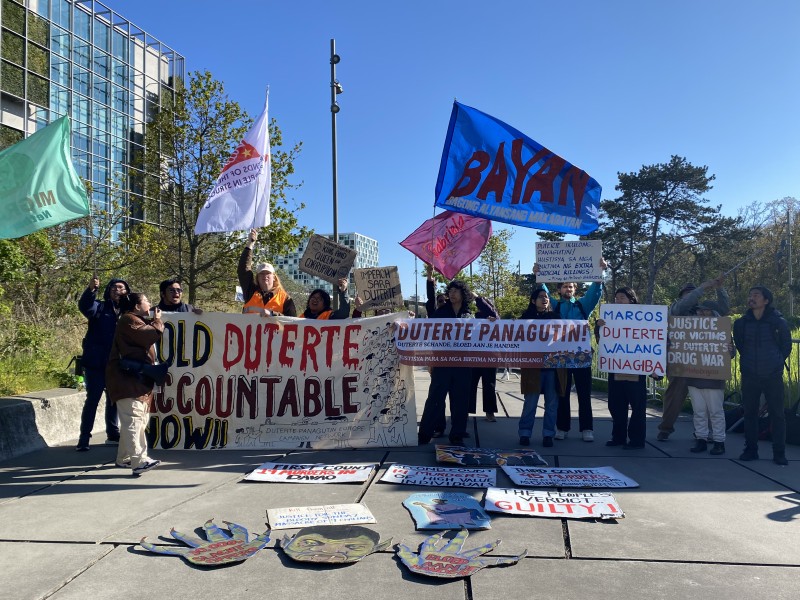
Outside the court in The Hague, the ruling highlighted the deep, lingering polarization over Duterte’s political legacy.
Human rights advocates and Filipino progressive groups celebrated the decision. “Under the Duterte administration, killings without due process, terrorizing the poor, and the state’s use of armed forces to silence government critics were normalized,” said Aldo Gonzalez of Migrante Netherlands.
Icai Enriquez, a convenor for the Duterte Panagutin (Hold Duterte Accountable) Network Europe, said the ruling validated the court's role as a vital backstop. “The purpose of international law is to make sure that countries like the Philippines... would be able to have an opportunity to still fight for justice at a higher court such as the ICC,” she said.
Across the gathering area, loyalists of the former president heckled the activists, chanting Duterte’s name and accusing his critics of being paid operatives. While some supporters grew emotional as the rejection of the appeal became clear, many vowed to continue demanding his release.
“I know sooner or later, the truth will come out. I will fight for him until he is released,” said Janet Suliman, a longtime resident of the Netherlands.
The legal drama in Europe is also amplifying political fractures back in Manila. Following a bitter public fallout between current President Ferdinand Marcos Jr. and Vice President Sara Duterte — the former president’s daughter — Duterte loyalists have accused the Marcos administration of facilitating the ICC arrest for political gain. Marcos had previously vowed he would not cooperate with the international tribunal.
“I am angry with the Bongbong administration,” said Alvin Sarzate, a pro-Duterte content creator gathered outside the court, using Marcos's nickname. He lamented that the country’s reliance on an international body made its domestic justice system appear weak. “We are becoming a laughingstock in the international community.”