Reported by
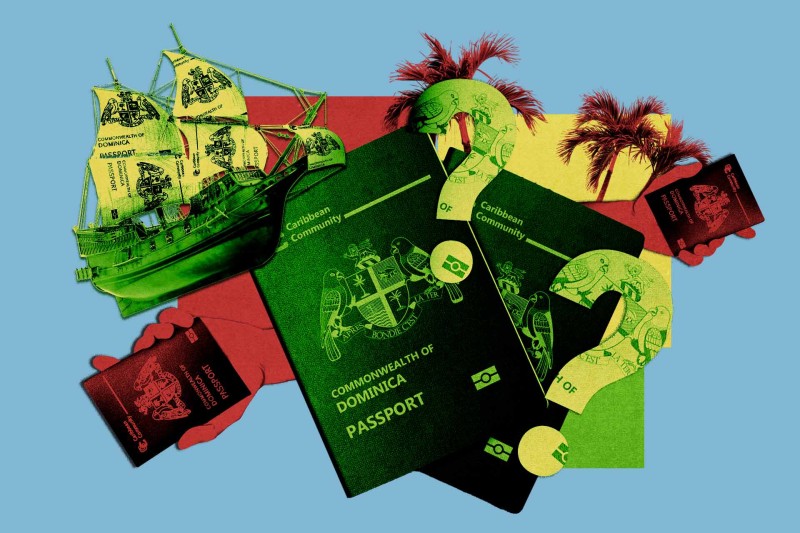
The Caribbean nation of Dominica has revoked the citizenship of the son of a recently assassinated Iranian official, accusing him of concealing his father’s political ties to obtain a so-called “golden passport.”
The move comes in the wake of an investigation by OCCRP, which revealed that Abolfazl Shamkhani and his brother, the sanctioned oil tycoon Hossein Shamkhani, used Dominican aliases to hold a luxury real estate portfolio in Dubai valued at approximately $29 million.
In a letter dated March 27, 2026, and obtained by the OCCRP, Dominica’s state minister in the Ministry of Labour, Daren Pinard, informed Abolfazl Shamkhani that his citizenship — which had been granted under the alias “Sami Hayek” — was being revoked “with immediate effect.”
Pinard stated that Shamkhani had secured his citizenship in 2020 through the “concealment of a material fact.” Specifically, he had failed to disclose that his father, Ali Shamkhani, was a top political advisor to Iran’s late Supreme Leader, Ayatollah Ali Khamenei.
Both Ali Shamkhani and Ayatollah Khamenei were killed, along with several other senior Iranian officials, in U.S.-Israeli airstrikes on Feb. 28, according to Iran’s semi-official ILNA news agency.
The revocation letter also cited an unspecified “act which is incompatible with loyalty to Dominica” as justification for the decision. Shamkhani has been given 25 days to request a formal inquiry into the order.
The island nation's decision mirrors a similar move made in August 2025, when Dominican authorities revoked the citizenship of Abolfazl’s brother, Hossein Shamkhani, according to a separate letter also signed by Pinard.
Hossein Shamkhani has been the target of an escalating Western crackdown. The United States and the European Union sanctioned him in July 2025, accusing him of orchestrating a multibillion-dollar illicit oil smuggling network that benefited both Iran and Russia. The United Kingdom followed suit in August, stating that he supported the Iranian regime’s “hostile activity.”
A sanctions notice from the U.S. Treasury Department alleged that Hossein Shamkhani leveraged “corruption through his father’s political influence… to build and operate a massive fleet of tankers and containerships.”
According to the Treasury’s Office of Foreign Assets Control (OFAC), the Shamkhani family systematically funneled this “ill-gotten wealth” into global real estate and foreign passports “to travel undetected and hide their connections to Iran.” OFAC noted that Hossein Shamkhani held a Dominican passport under the name “Hugo Hayek.”
The OCCRP’s investigation found that the brothers used their Dominican aliases to hold at least four high-end properties in Dubai. Two neighboring villas were originally purchased under their real Iranian names before being quietly transferred to their “Hayek” identities at an unknown date.
Corporate records further connect the brothers to the broader sanctions evasion network. The “Hayek” brothers were listed as founding shareholders of a Turkish firm that was later sanctioned by the United States as part of its sweeping action against Hossein Shamkhani’s shipping empire.
While Abolfazl Shamkhani has not been criminally charged or personally sanctioned, his financial activities have drawn the attention of U.S. law enforcement. In two civil forfeiture actions filed in federal court in Washington, U.S. prosecutors alleged that he manages several firms tethered to his brother’s network.
The Justice Department is currently targeting $15.3 million in funds seized in early 2026, after alleged “front companies” linked to Hossein attempted to wire the money through the U.S. financial system.
It remains unclear whether either brother plans to legally challenge Dominica’s revocations, and neither responded to requests for comment in time for publication. However, in a previous statement to Bloomberg, Hossein Shamkhani denied owning oil companies and maintained that he operates only in jurisdictions “not under sanctions.”
Amid the escalating conflict in Iran, Dominica is tightening its lucrative Citizenship by Investment (CBI) program to prevent further exploitation.
According to a March 23 letter issued by CBI unit director Gregory McDougall, Dominican authorities have officially closed the scheme to new Iranian applicants. Under the revised rules, Iranians are now only eligible for a Dominican passport if they have lived outside of Iran for at least ten years and hold no significant assets or business interests within the country.