International civil society organizations published an open letter Thursday to the EU Council calling for an expansion of banned exports to Kyrgyzstan, alleging the current trade route empowers the Russian war machine.
In the appeal, seen by OCCRP, the State Capture Accountability Project (SCAP) and Freedom for Eurasia (FFE) argued that the bloc's “previous strategy of ramping up sanctions in incremental steps has proven ineffective.”
The organizations urged the EU Council to swiftly tighten sanctions by imposing a total export ban on “all key high-priority items for which there is no historically proven domestic market” within the Central Asian nation.
The appeal follows the EU’s April 23 decision to ban the export of computer numerical control machines and radio equipment to Kyrgyzstan, amid allegations that these goods are funneled to Russia for the manufacture of drones and missiles.
According to SCAP, an analysis of trade data revealed an abnormal “spike” in high-priority EU exports to Kyrgyzstan in 2025. The watchdog noted that items such as turbo-jet turbines, electronic integrated circuits, and lasers “continue to flow into the Russian military-industrial complex via Kyrgyzstan.”
“As long as the Kyrgyzstan route is open to these items, Russia will continue to terrorize Ukrainian civilians and occupy Ukrainian land,” the letter stated.
OCCRP reached out to the office of EU Sanctions Envoy David O’Sullivan for comment, but did not receive a response by the time of publication.
In a statement issued Monday, the Kyrgyz Ministry of Foreign Affairs expressed bewilderment at the EU’s measures, claiming the decision “leaves the position of the Kyrgyz side unaccounted.” Officials emphasized that Kyrgyzstan maintains regular negotiations with European partners and provides all requested documentation.
“Of particular concern is that such unilateral decisions not only undermine the atmosphere of trust that has been built within the framework of bilateral cooperation, but also clearly contradict the repeatedly stated intentions of the European Union to develop comprehensive cooperation with the Kyrgyz Republic,” the ministry said.
While the EU embargo represents the first instance of country-level sanctions, it follows a series of Western actions against Kyrgyz entities. In July 2023, the U.S. sanctioned four private Kyrgyz firms for re-exporting electronic components and dual-use goods to Russian defense industry companies.
Last year, the UK and the U.S. designated four Kyrgyz banks and the crypto-exchange Grinex. In October 2025, the EU further increased economic pressure by sanctioning Tolubai Bank and Eurasian Savings Bank over providing payment services and supplying crypto assets to Russia.
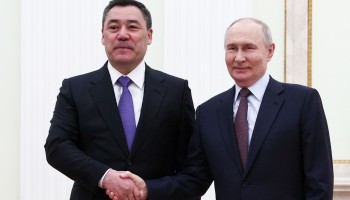
Kyrgyz President Sadyr Japarov has previously dismissed the allegations. In an August 2025 interview, Japarov accused local NGOs of providing false information to the West, which then imposes sanctions without any facts or evidence.
“We are developing the country's economy on our own. And steps that are not in keeping with the spirit of partnership can be seen as interference in the state's internal affairs”, the president said.