Reported by
A sprawling Balkan media empire known for its independent journalism is being quietly prepared for sale to an investment fund with deep ties to the political orbit of former Prime Minister Viktor Orbán of Hungary, according to a leaked draft contract.
The planned 30 million euro ($32.5 million) sale of United Group’s media assets to a Luxembourg-based fund has raised fresh alarms about the creeping influence of illiberal governments over the press in Eastern Europe. The media properties slated for sale include the N1 and Nova television networks, which have historically served as rare bastions of critical reporting in Serbia, Bosnia and Herzegovina, Croatia, Slovenia, and Montenegro.
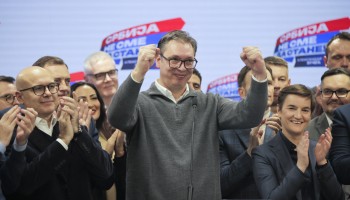
The contract obtained by OCCRP and shared with the local investigative outlet Raskrikavanje, follows a string of controversial editorial shake-ups and a leaked audio recording that suggested direct meddling in the network's leadership by Serbia's increasingly authoritarian president, Aleksandar Vučić.
While the final contract has not yet been signed, the draft designates a Luxembourg fund called European Future Media Investments (EFMI) as the official buyer. However, details buried in the document—including notification addresses and key contacts—point directly to Alpac Capital, a Portuguese investment firm. The contract lists Pedro Vargas David, Alpac Capital’s director, as a primary representative.
Vargas David is well-known in European media circles. In 2022, Alpac Capital acquired a majority stake in Euronews, the pan-European broadcasting network. A subsequent investigation by independent European media, including France’s Le Monde and Hungary’s Direkt36, revealed that the Euronews acquisition was heavily financed by Hungarian state capital and companies closely allied with Orbán’s powerful propaganda apparatus.
According to leaked internal documents from that earlier deal, one of the primary goals of the Euronews investment was to "mitigate left-wing bias" in the press. Financing for the purchase was traced back to Gyula Balásy, a Hungarian businessman whose empire has secured lucrative state contracts for years, and whose companies are now the subject of an investigation launched by Hungarian police just days before a recent change in government leadership.
Legal representation for EFMI in the current United Group buyout is being handled by Moore Legal Kovács, a Hungarian law firm, further cementing the deal's Budapest ties.
A Hollow Promise of Independence?
According to the draft contract, United Group is required to undergo a massive corporate reorganization before the 30 million euro sale is finalized. The network’s sprawling assets—including N1 television stations across the Balkans, the Serbian weekly Radar, and a 51 percent stake in Montenegro's Vijesti—will be consolidated under a single corporate umbrella, Adria News.
The contract contains several clauses explicitly promising "editorial independence." The buyers have pledged to respect European rules on media pluralism, shield the newsrooms from commercial and political influence, and establish an independent advisory body of international media professionals.
But for many journalists in the region, those promises ring hollow following months of severe internal turmoil and alleged political capitulation.
Last August, a leaked audio recording published by OCCRP exposed a conversation between United Group’s newly appointed CEO, Stan Miller, and Vladimir Lučić, the director of Serbia's state-owned telecom operator, Telekom Srbija. The two men were caught discussing the ouster of Aleksandra Subotić, the long-time director of United Media.
The audio made it clear that the initiative to fire Subotić came directly from President Vučić.
"I understand that the President called you and is very upset, and I can understand that, but I have to find a way to do it quickly and efficiently," Miller was heard telling Lučić. "When I promise something, I do it. I am a person of my word."
Miller explained his strategy on the recording: "I cannot fire Aleksandra today, as we discussed, okay? I have to make that company very small in Serbia, if you know what I mean. To separate it. It takes time for that, and that is what we agreed upon."
The plan swiftly materialized. In late February, Subotić was fired, coinciding with the launch of a new corporate entity, Adria News Network (ANN). By early April, the purge reached the newsroom floor, with Igor Božić, the head of the N1 newsroom, removed from his post. Brent Sadler, a former CNN anchor, was subsequently installed as Chief Executive News Editor to oversee editorial standards across the network.
The impending sale to Alpac Capital marks a bitter conclusion for the journalists who built the network. In early November of last year, sensing a shift in corporate winds, editors and directors of United Group’s media outlets submitted a formal request to the owners—including the private equity firm BC Partners—proposing a management buyout. They wanted to purchase the media networks themselves to protect their editorial independence.
A month later, their offer was flatly rejected.
According to Božić, the owners informed the journalists that they "do not wish to sell the media to a third party for now," and claimed they were working with regulators to make the outlets "even more independent."
Months later, the leaked 30 million euro contract tells a distinctly different story. Representatives for BC Partners, Stan Miller, and Alpac Capital did not respond to requests for comment.