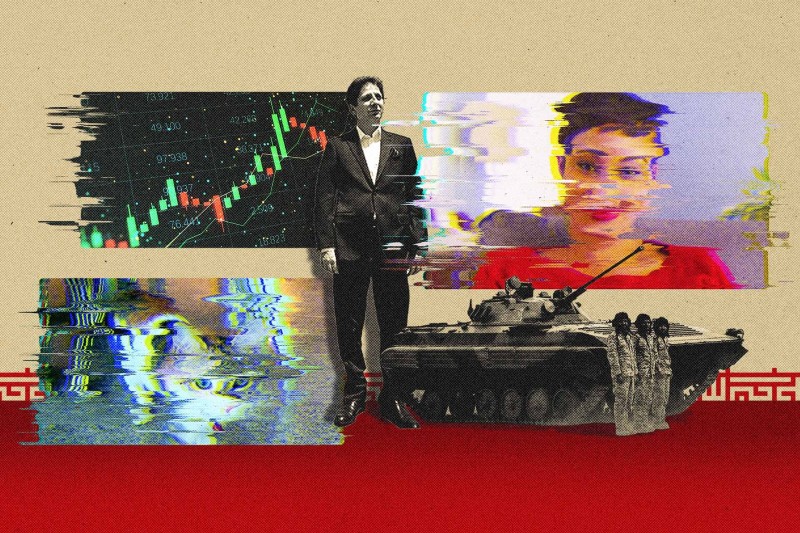
On paper, Elizabeth Newman is a financial titan behind two U.K.-based cryptocurrency exchanges that claim to process more than a billion dollars’ worth of digital assets every day.
To believe U.K. corporate records and a promotional video, the short-haired Dominican in her 40s maintains a global footprint, listing correspondence addresses ranging from a beachfront Caribbean property to London’s charming Covent Garden and a 68-story skyscraper in Dubai.
But in reality, this person doesn’t seem to exist at all.
An OCCRP investigation has discovered that the woman presented to the world as the director of these two major crypto firms is actually a stock-footage model. While the U.K.'s business registry accepted her as a “person with significant control" over the companies, reporters found no evidence of a physical person corresponding to the Elizabeth Newman described in filings.
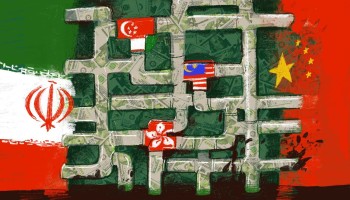
Newman’s companies were listed as "dormant" in official corporate filings. But U.S. authorities allege they were active engines for Babak Zanjani, a notorious Iranian financier sanctioned last month for providing financial backing for major projects that support the Islamic Revolutionary Guard Corps (IRGC) and the Iranian regime more broadly.
By allowing Newman to front these entities, the U.K. provided a veneer of Western legitimacy to a crypto network alleged to have helped bypass global financial blockades.
Iran had sentenced Zanjani to death for embezzlement of state oil funds in 2016, but he has bounced back into favor with the country’s hardline Islamist authorities; his sentence was commuted in 2024 and he was formally released last year.

Babak Zanjani at the Revolutionary Court of Tehran, Iran on November 1, 2015.
The U.S. Treasury claims he was freed to launder money for the very regime that had imprisoned him. It describes his two exchanges, Zedcex and Zedxion, both registered as U.K. companies, as part of an operation helping the IRGC bypass sanctions, moving billions of dollars’ worth of funds through a global financial hub with total anonymity.
The exchanges are among the latest in a sophisticated toolkit Tehran uses to make and receive payments. TRM Labs, a blockchain analytics company, said in a January report that cryptocurrencies appear to play an increasingly prominent role in the financing of the IRGC, a military organization that doubles as a multi-billion-dollar business empire and enforces the agenda of Iran’s theocratic regime.
In January the IRGC played a leading role in violently quashing nationwide protests in which thousands were killed, rights groups reported.
TRM Labs reported that the Zedcex and Zedxion crypto exchanges also handled millions of dollars in transfers from the IRGC to a man the U.S. accuses of financing a Yemeni armed group responsible for attacking commercial shipping in the Red Sea.

The burned East Tehran General Directorate of Tax Affairs headquarters in the aftermath of protests in Tehran, Iran, on January 21, 2026.
Zedcex and Zedxion have processed approximately $1 billion in funds linked to the IRGC, according to TRM Labs’ analysis of crypto wallets attributable to the exchanges’ operations.
In the weeks following the mass protests, Western governments have scrambled to choke off funding for the IRGC and other Iranian state bodies.
“Treasury will continue to target Iranian networks and corrupt elites that enrich themselves at the expense of the Iranian people,” said U.S. Treasury Secretary Scott Bessent in a January 30 statement where his department applied sanctions on Zanjani and the two U.K. crypto exchanges.
“This includes the regime's attempts to exploit digital assets to evade sanctions and finance cybercriminal operations.”
In response, Zanjani said on the social media site X that the U.S. accusations were “merely a pretext for seizing 660 million Tether [U.S. dollar-pegged stablecoin crypto assets], and extortion.” He has not directly confirmed or denied having a connection to the firms.
Zanjani did not respond to questions about his role in the crypto exchanges. OCCRP sent questions addressed to Elizabeth Newman to both Zedcex and Zedxion, but received no response.
The Stock-Footage CEO
Both exchanges have said on their websites they are directed by a woman named “Elizabeth Newman,” but despite a months-long search, OCCRP was unable to find any real-life individual matching the “Elizabeth Newman” persona.
An official Zedxion and Zedcex marketing video from March 2022 featured an image of a woman called "Elizabeth" — identified as the platforms' “executive director.”
That woman, in fact, was a stock-footage model from a video titled “Pretty black woman talking to camera” available on Shutterstock.
The same video named the firm’s supposed finance administrator as “Smith” and team leader as “Muhammad,” but their images were also stock footage.

The purported CEO of the Zedcex cryptocurrency exchange, Elizabeth Newman, is portrayed in a promotional video using stock footage of a "pretty black woman talking to the camera," reporters found. Other supposed employees are also portrayed using stock footage.
Journalists also scoured global corporate registries and social media platforms, and made inquiries to individuals and companies associated with the “Elizabeth Newman” persona. All went unanswered. The Dominican Republic’s general directorate for migration did not respond to a request to confirm that a woman named Elizabeth Newman was a citizen of the country.
The U.K.’s corporate registry has long operated along the lines of an honesty box, with no legal mandate to verify the information submitted to it.
Under the Economic Crime and Corporate Transparency Act 2023, the U.K. is gradually moving from passive record-keeping to active gatekeeping.
The measures aim to curb the widespread misuse of U.K. companies for financial crime — specifically the use of “fake or stolen identities.”
The act requires all registered company directors and “persons with significant control” of a company to verify their identity with Britain’s corporate registry, Companies House.
Existing directors like Newman were granted a grace period of up to a year to comply, with the two crypto exchanges’ deadline falling on May 19 this year.
British anti-money-laundering expert Graham Barrow told OCCRP that until these measures were introduced, submitting the name of a fictitious executive to Companies House was “actually the easiest thing in the world to do."
But the U.K.’s moves to tighten its corporate register came too late to have any bearing on the financial networks supporting those responsible for the recent bloodshed on the streets of Iran.
Since its registration in August 2022, one of the crypto exchanges, Zedcex, has processed over $94 billion in total transactions, according to the U.S. Treasury — a fortune moved through a company that, according to U.K. company records, has reported doing no business at all.
Bloody Crackdown, Maritime Attacks
Iran’s most recent protests were initially triggered by complaints over economic hardship — record inflation and a currency collapse, according to U.N. human rights experts.
They quickly metastasized into one of the largest and deadliest anti-government demonstrations since the Islamic Republic’s founding in 1979, and a fight for the regime's survival, in which over 20,000 people may have been killed, according to the Center for Human Rights in Iran.
Days of countrywide protests reached a peak on January 8 and 9 when, under the cloak of a near total internet blackout, security forces including the IRGC carried out massacres on the demonstrators, raising the death toll into the thousands, according to Amnesty International.
On January 19, British lawmaker Alex Sobel raised concerns in parliament about the potential role of U.K.-based Zedxion and Zedcex in financing the repression.
“We know that the IRGC has used two registered cryptocurrency exchanges to move approximately $1 billion since 2023, evading international sanctions,” Sobel said.
Two weeks later, the U.K. sanctioned Zanjani, describing him as “an Iranian businessman who runs a network of companies which generates funds and enables the criminal activities of the IRGC, including its suppression of protesters.” However, unlike the U.S., it didn’t sanction the two crypto exchanges.
TRM Labs also claimed the network had financed a Yemeni militia labelled by the U.S. as a Specially Designated Global Terrorist group. It said it had identified transfers of over $10 million to Yemeni national Sa’id Ahmad Muhammad al‑Jamal, whom the U.S. Treasury has described as a senior Houthi financial official backed by the IRGC. Al‑Jamal could not be reached for comment.
The Houthis are an Islamist political and military organization that controls the north of Yemen, including its capital Sana’a and most of the country’s population, according to a U.K. parliamentary research briefing.
The group has deployed missiles, unmanned aerial vehicles, and naval mines to attack commercial shipping interests in the Red Sea, threatening global freedom of navigation and the integrity of international commerce, according to the U.S. Treasury.
From Death Row to Crypto
According to Iran’s judiciary, Zanjani remained on death row until April 2024, when his sentence was commuted. However, prison records seen by OCCRP suggest that he may have been allowed to leave prison as early as 2019 — two years before his alleged crypto network was set up.
Zedxion Exchange Ltd was incorporated in the U.K. in May 2021. It was founded by a Dutch national named Mehmet Hasancebi, according to Companies House. But five months later the company’s directorship switched to a United Arab Emirates passport-holder named Babak Morteza, whose identifying details match those of Zanjani. (The U.S. Treasury lists Zanjani’s full name as Babak Morteza Zanjani.)
Then, on August 10 the following year, Newman took over as director, according to U.K. company records. Shortly after that, she became the company’s person of significant control.
Just days later, Zedcex Exchange Ltd. was incorporated at the same mass registration address, 71-75 Shelton Street in London’s Covent Garden. Newman was also named its director and person of significant control.
Both crypto exchanges have filed paperwork to Companies House every year since then, claiming to be dormant.
“Taken together, the overlapping directors, shared address, mirrored filings, and coordinated timing indicate that the two entities were designed to function as a single exchange operation,” TRM Labs reported.
Both companies have also claimed on their websites that their founder and CEO was a woman named “Elizabeth Newman,” whom they identified as a graduate of the University of Ege — a school in Turkey that is Zanjani’s alma mater.
But there are signs that Zanjani could have been behind them the whole time, even while still formally subject to a death sentence.
For example, his name is listed in the metadata as the author of a revised Zedxion white paper written in September 2023. The document outlines the company's technical roadmap while doubling as a marketing tool.
And in October last year, he uploaded a YouTube video of himself sitting in an office in front of a large TV showing the Zedcex trading platform. A screenshot from the same video was posted on his Facebook account a week later.

A still from a YouTube video Zanjani shared, showing himself sitting in an office in front of a television showing the Zedcex trading platform.
The Cat With The Purple Bell
Although “Elizabeth Newman” does not appear to exist, there is a woman in Zanjani’s life who appears to have helped play a direct role in operating both exchanges.
Solmaz Bani, a former model who has also gone by the names “Niyoosha Bani” and “Sara Bani,” has left a social media footprint indicating that she has been Zanjani’s romantic partner for several years, including photographs and comments between the two expressing mutual affection.
"The best feeling is being Loved back by the person you love. Happy to Love and Being Loved by you. My B.Z.," she posted in 2022 on a Facebook account she uses. “Happy Birthday Booboo,” she wrote two years later.

Solmaz Bani, who also goes by the name "Niu Niu,” has left a social media footprint indicating that she has been Zanjani’s romantic partner for several years,.
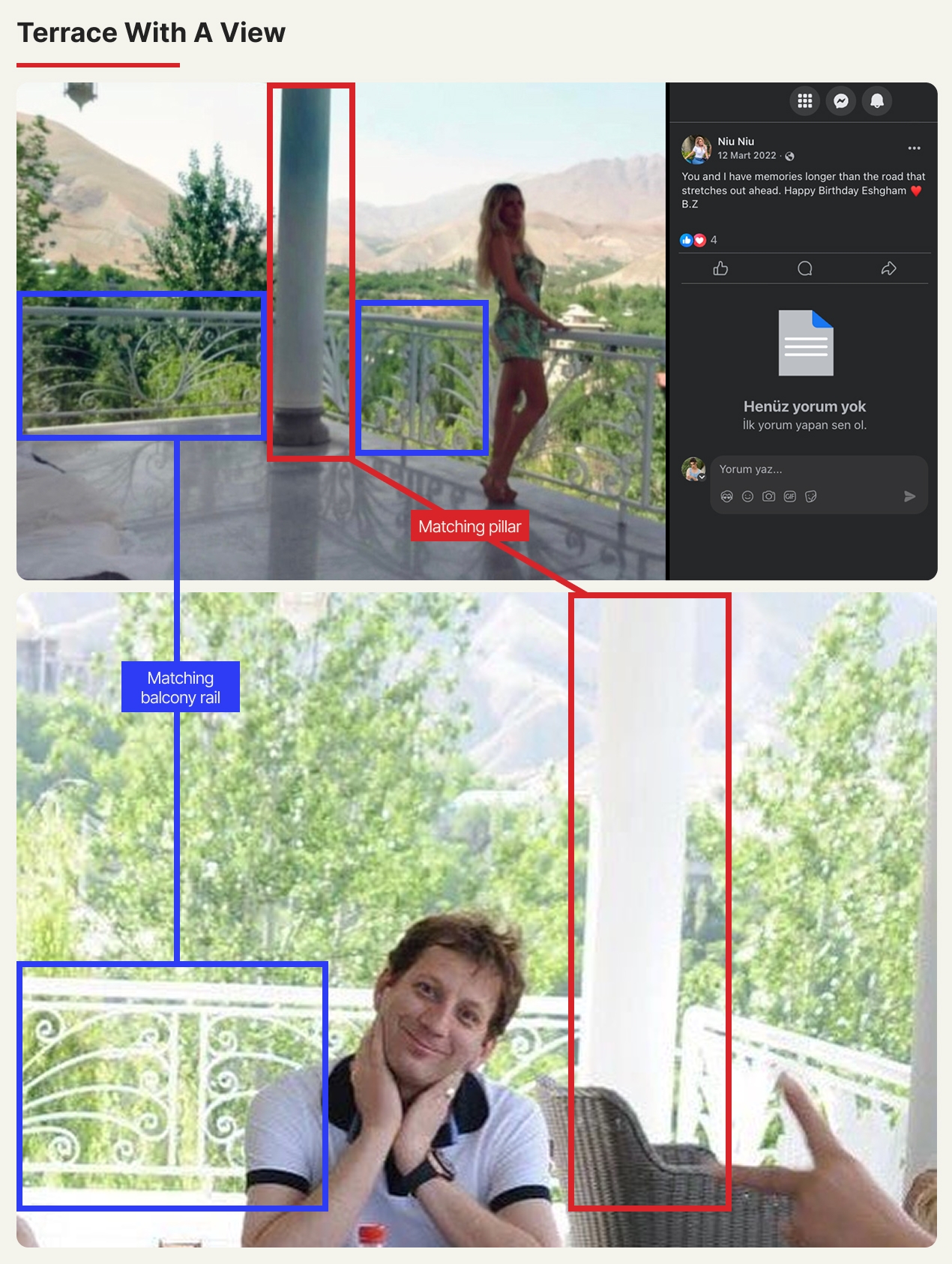
Images posted to social media place Solmaz Bani in the same locations as Babek Zanjani.
OCCRP found that Bani has also been involved in both Zedxion and Zedcex.
Internet registry data lists Bani as the registrant of web domains used for distributing Zedxion's online newsletter, and general email registration details and login reminders for Zedcex.
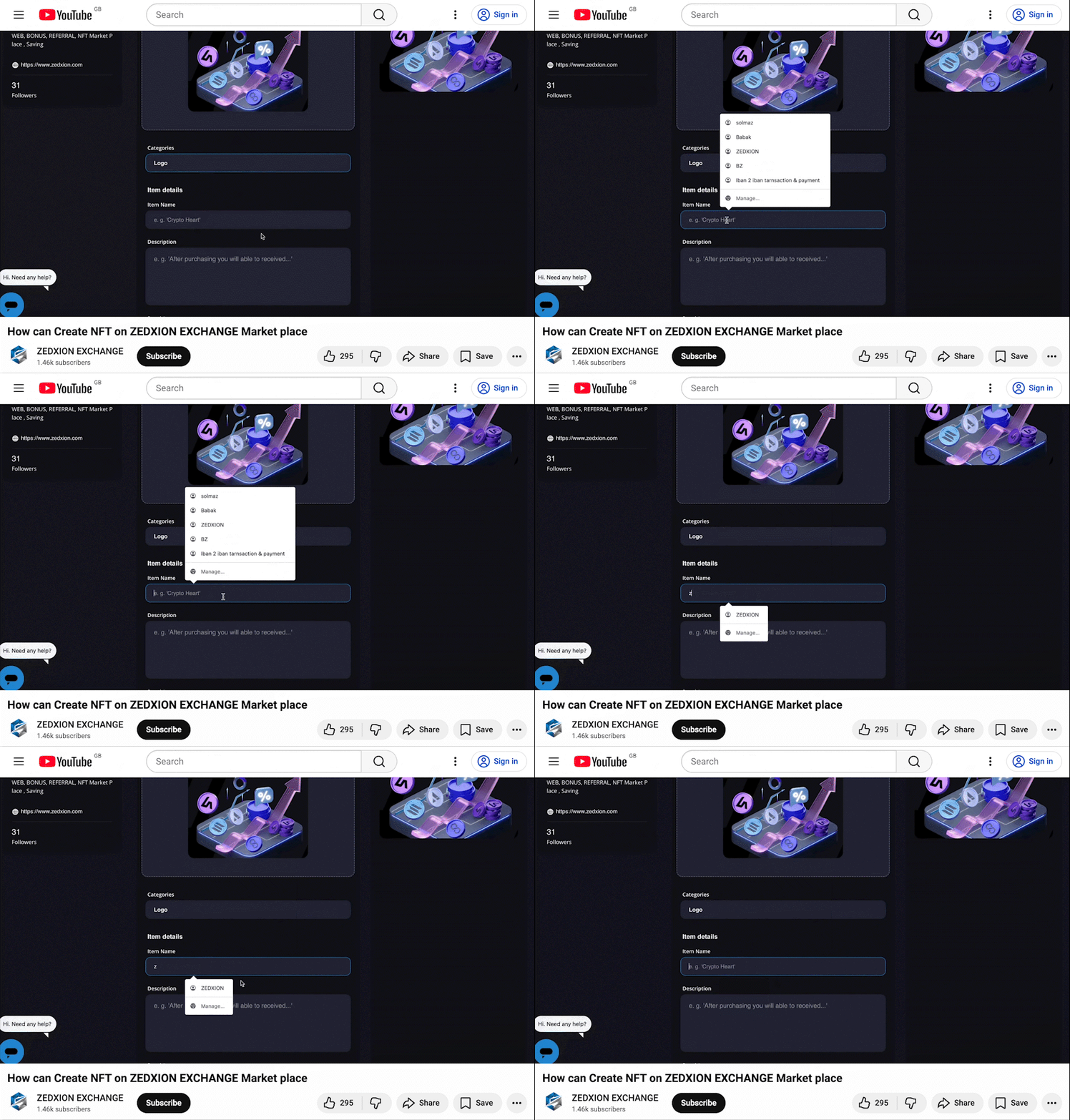
Furthermore, the name “Solmaz” was briefly displayed in auto-fill details on a tutorial video uploaded to Zedxion Exchange’s official YouTube channel, together with “Babak.”
In May 2024, Zedxion’s official Telegram channel publicly shared a photo of a mostly white cat with distinctive grey and brown markings, and a bright purple bell on its collar. An animal with identical features — and an identical purple bell — appeared in a photo on the Facebook page of Solmaz Bani’s alter ego “Niu Niu” in February 2025. (The account was deleted in December.)
The cat in the photograph sits under a table and chairs with distinctive legs. In another image posted on an Instagram fan page for Zanjani, the Iranian businessman sits near what appear to be the same table and chairs, playing with a dog.

Images posted on social media show Babak Zanjani playing with a dog underneath a distinctive table and chairs. The same furniture appears in an image of a cat wearing a purple bell on its collar posted by "Niu Niu," who appears to be his girlfriend. An image of the same cat was shared to the Telegram channel of the Zedxion exchange.
The BZ Empire
Bani has also played key roles in several companies that are part of the Dubai-based BZ Group, all of which bear Zanjani’s initials and are linked to him. (Some are owned by his family members, while he has publicly promoted others.)
Even if “Elizabeth Newman” fails to verify her identity by the deadline of May 19 and the companies behind Zedxion and Zedcex are no longer able to operate out of the U.K., hundreds of millions of dollars are alleged to have already flowed through the digital ether on behalf of the IRGC.
In Tehran, that accomplishment will likely have bolstered the reputation of a man who has in the past described himself as an “economic basij,” a Persian term used to refer to a paramilitary volunteer militia within the IRGC.