Reported by
When the top international official overseeing the fragile peace agreement in Bosnia and Herzegovina announced his resignation this week, analysts went into overdrive.
Among other factors, many noted the public clashes between Christian Schmidt and Bosnian Serb separatist leader Milorad Dodik, who had never acknowledged his appointment and called him a “tourist” in the country.
Schmidt, a German diplomat who served as head of the Office of the High Representative for five years, offered little explanation for his resignation. On Tuesday he told the United Nations Security Council it was a “personal decision.”
Bosnia watchers can have little insight into Schmidt’s thinking. What is known, however, is that he was a target in an aggressive lobbying campaign in the U.S. paid for by Republika Srpska, the Serb-dominated region of Bosnia that Dodik led until last year. The campaign aimed at wider goals, but Schmidt’s removal and the closure of his office was cited specifically.
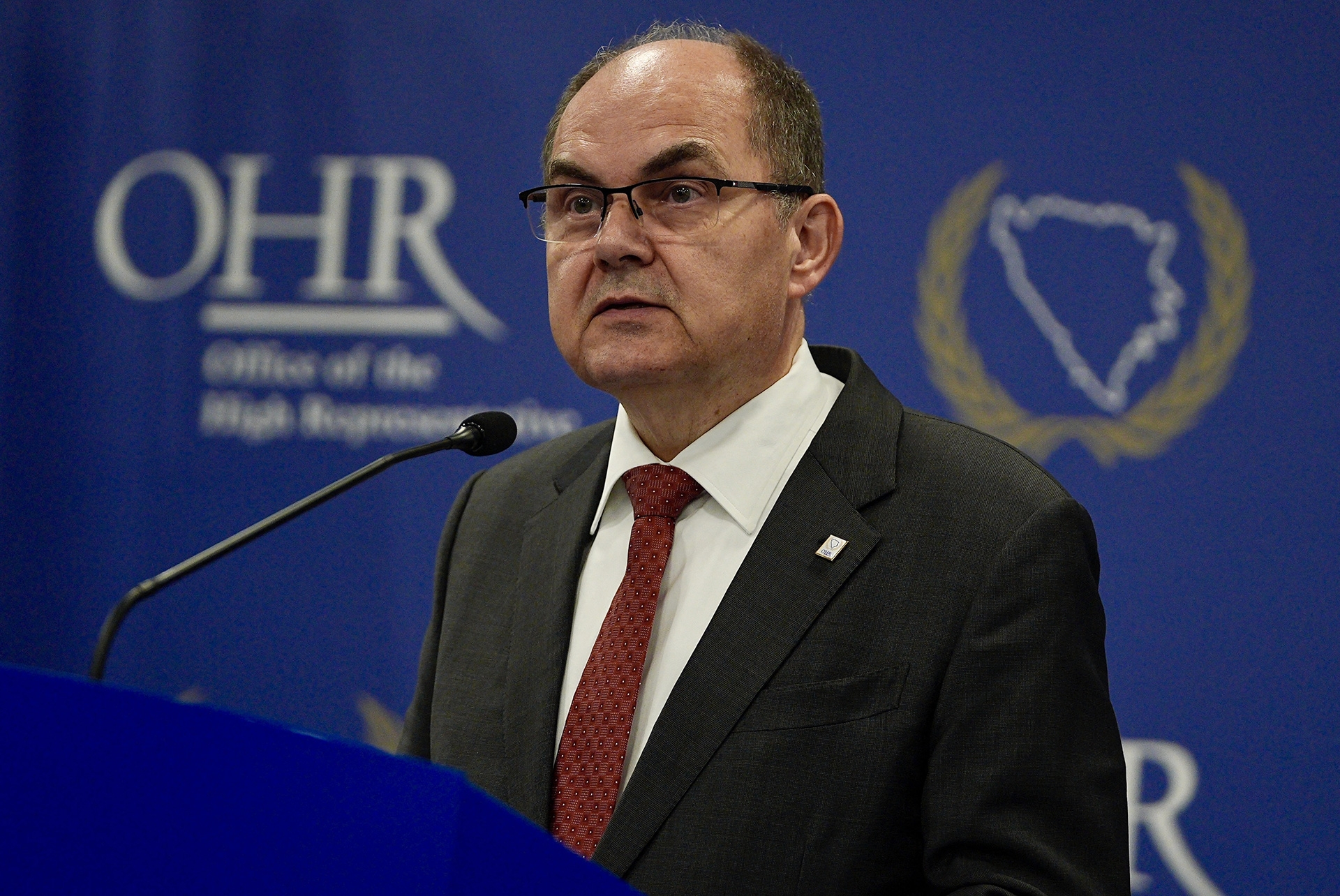
High Representative for Bosnia and Herzegovina Christian Schmidt addresses a press conference in Sarajevo on April 24, 2025.
An analysis by OCCRP of U.S. Foreign Agents Registration Act (FARA) filings found that Republika Srpska paid at least $8.9 million to 11 Washington lobbying firms throughout 2025 and 2026 to improve the image of the territory, and build support for secession.
Dodik was president of Republika Srpska until he was removed from the office last year for pushing separatist legislation inside the region, which threatened Bosnia’s constitutional order. Schmidt had used the powers of his office to annul Dodik’s separatist legislation.
Dodik still heads the ruling party in Republika Srpska, and remains its most influential politician.
A contract filed with FARA in March 2025 between Republika Srpska and the Montreal-based firm Dickens and Madson Canada Inc. states objectives that include lifting sanctions placed on Dodik by previous U.S. administrations — and getting rid of Schmidt.
The first goal was achieved last October, when the administration of U.S. President Donald Trump dropped the sanctions.
“We shall also secure the support of the United States government to remove Christian Schmidt as High Representative in Bosnia Herzegovina and condemn the biased decisions of this representative,” the Dickens and Madson contract said.
It’s hard to know if lobbying had anything to do with Schmidt’s decision to leave. The Office of the High Representative said it had no more to add about Schmidt’s “personal decision” to step down.
But with Schmidt out of the way, Dodik faces one less obstacle in his dream of splitting up Bosnia, which is spelled out in the Dickens and Madson contract.
“The independence of the Republic of Srpska from Bosnia Herzegovina is our ultimate goal,” it states.
Neither Dodik nor the government of Republika Srpska responded to requests for comment.
A spokesperson for the U.S. State Department said Washington continues to support "the territorial integrity of Bosnia and Herzegovina."
The spokesperson added that sanctions on Dodik and others were removed last October, because they "were originally imposed in response to specific actions over previous years, which Republika Srpska authorities took concrete steps to unwind, deescalating the crisis we faced at the time."
Under Dodik's leadership, Republika Srpska National Assembly had passed a series of controversial laws at decoupling the territory from Bosnia and Herzegovina. These unconstitutional separatist laws were officially annulled in September 2025, and the sanctions were lifted shortly after.
The U.S. Treasury Department had also stated that sanctions had been imposed due to Dodik's alleged corruption. However, the State Department spokesperson did not comment on the corruption allegations.
Winds of Change
Back in 2022, when the administration of President Joe Biden slapped a second round of sanctions on Dodik — following sanctions imposed under his predecessor, Barack Obama — the U.S. government was concerned that he could unwind the Dayton Accords.
Brokered by the U.S. in 1995, the accords ended the four-year war that killed an estimated 100,000 people and displaced another 2.2 million — many fleeing ethnic cleansing. The agreement split the country into two semi-autonomous regions cut largely along ethnic lines, with Republika Srpska on one side and a Bosniak-Croat federation on the other.
The fear was that Dodik’s separatist moves could plunge the country back into armed conflict.
“Milorad Dodik’s destabilizing corrupt activities and attempts to dismantle the Dayton Peace Accords, motivated by his own self-interest, threaten the stability of Bosnia and Herzegovina and the entire region,” Brian E. Nelson, the U.S. Under Secretary of the Treasury for Terrorism and Financial Intelligence, said at the time.
But the political winds have shifted, and Dodik has found friends in the Trump government.
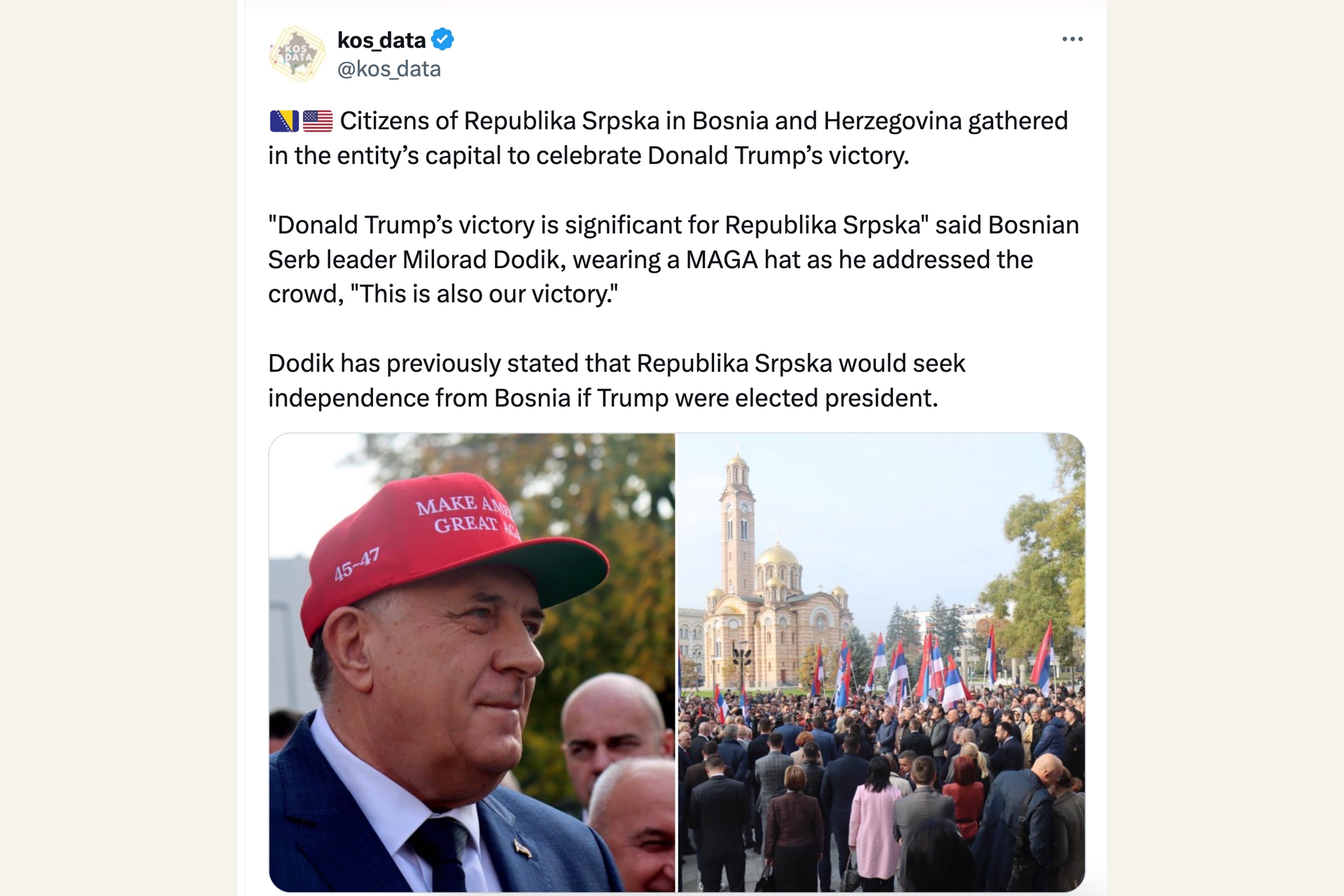
A screenshot of an X post from Kosovo and Balkans Daily News depicting Milorad Dodik wearing a MAGA hat.
Kurt Bassouner, co-founder and senior associate of the Berlin-based Democratization Policy Council think tank, told OCCRP that Dodik and his allies viewed Trump’s return to the presidency in 2025 “as a real opportunity.”
“They had been hoping as soon as he was running again that he would get re-elected, because they thought that this would, at a very minimum, reduce the resistance to their agendas,” Bassouner said.
Under Dodik’s leadership, the government of Republika Srpska poured millions into contracts with lobbyists. Among those named in FARA documents are Trump’s former national security adviser Michael T. Flynn, and former Illinois governor Rod Blagojevich, whom Trump pardoned after he was sentenced for corruption.
But the latest lobbyist to sign a contract with Republika Srpska is even more eye-catching: Jonathan Moore, a former U.S. ambassador who headed the OSCE mission in Bosnia from 2014 to 2017.
At the time, Moore became well-known for speaking out against corruption and defending the Dayton Accords. Now he’s lobbying for a government that wants to break Bosnia apart.
According to the contract filed in February under FARA, Republika Srpska will pay Moore $30,000 per month to, among other tasks, facilitate the messaging of its key political leaders.
“Any work performed would be consistent with the Dayton Peace Accords,” Moore told OCCRP in a short response to questions.
The owner of Dickens and Madson, Ari Ben-Menashe, made no such promises.
“The Dayton peace agreement did not take into account various issues concerning the Serbs in Republika Srpska,” he told OCCRP. “They feel they were taken advantage of due to the circumstances of the day.”
He argued that the actions of Shmidt — whose office was created to oversee the Dayton Accords — “risk reigniting the conflict in the region.”
Rather than trying to keep Bosnia together, he said independence for Republika Srpska would “bring positive results for both sides of the equation.”
Dodik is only one in a long roster of controversial clients Dickens & Madson has represented, including Zimbabwe’s Robert Mugabe, as well as Myanmar’s military junta.
Ben-Menashe also inked a deal with Lieutenant General Mohamed Hamdan Dagaio who signed on behalf of the military council that took over Sudan after a 2019 coup. Dagaio had been part of the Janjaweed militia, which has been accused of genocide in Darfur.
Ben-Menashe said his company represents those who are “voiceless because they have a bad reputation.”
“Bad reputation is one thing,” he added. “But sometimes, bad reputation doesn't mean they're bad people.”
Interests Aligned
While foreign lobbying is legal and regulated in the U.S., transparency watchdogs warn that the practice allows autocratic figures to launder their reputations.
Ivana Korajlić, executive director of Transparency International in Bosnia and Herzegovina, also questions whether hiring expensive foreign lobbyists is the best use of taxpayer money in a country struggling with high unemployment and poverty rates.
Republika Srpska itself depends on continuous debt refinancing to stay afloat, according to S&P Global, a financial analytics firm which says the entity’s economic outlook “remains negative.”
"This is not lobbying for the interests of Republika Srpska at all, but rather for the interests of individuals within the Republika Srpska government, and the fulfillment of their personal ambitions," Korajlić said.
Dodik’s interests appear to have aligned with those of the Trump administration, judging from some of the recent high profile visits to Republika Srpska.
In April, the president’s eldest son, Donald Trump Jr., spoke at a business conference in Republika Srpska’s capital of Banja Luka. That followed a visit to Banja Luka last year by former New York mayor Rudolph W. Giuliani, who has also served as Trump’s personal lawyer.
Giuliani came at the invitation of Dodik, and appeared at a political rally for the Bosnian Serb leader with a red cap that said “Make Srpska Great Again.”
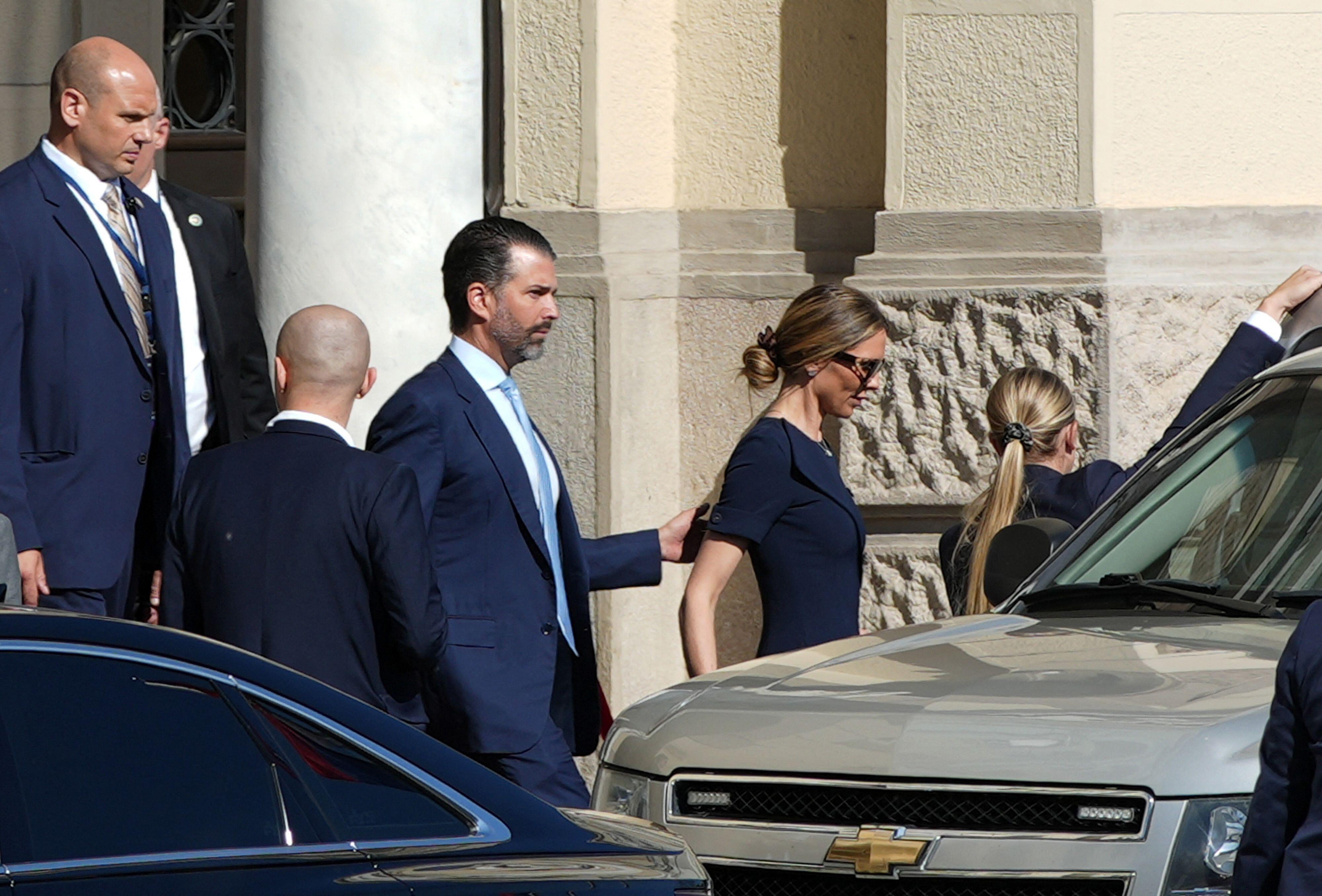
Donald Trump Jr., eldest son of the U.S. president, and his fiancée Bettina Anderson in Banja Luka, Bosnia and Herzegovina, on April 7, 2026.
Later this month, an economic and security conference in Banja Luka is scheduled to feature Flynn, Trump’s former national security adviser, as a speaker alongside Dodik.
Meanwhile, Schmidt’s decision to step down is another victory for Dodik. In a social media post the day Schmidt made his announcement, Dodik took the opportunity for another jab at the high representative to Bosnia and Herzegovina (BiH).
“Christian Schmidt is leaving BiH in the same way he came to it — without legitimacy,” Dodik wrote.
NOTE: This story has been updated with comment from a U.S. State Department spokesperson.