Reported by
With his shaved head, thick neck, and heavy jaw, Andrei has the look of a man built to intimidate.
His professional background matches that impression. Andrei’s resume describes him as a former commander in an elite Russian airborne unit who served in “combat operations” in Chechnya, worked as a personal bodyguard, and later held senior corporate security roles.
More recently, however, he had an altogether different mission: ensuring that tankers carrying sanctioned Russian oil reached their foreign destinations.
His job, he says, was to “to watch, to report in a timely manner — and, let’s say, to not allow the vessel to deviate from its course.”
Strained by its grinding war on Ukraine, Moscow desperately needs this so-called “shadow fleet” of aging and opaquely-owned vessels to keep delivering its oil to clients around the world. In March, an investigation by OCCRP, Delfi Estonia, Helsingin Sanomat, and iStories laid out in detail how Russian crew members with security backgrounds, like Andrei, were covertly being placed onboard alongside largely foreign crews.
Now, OCCRP has joined a consortium of European media outlets led by Follow the Money and Dossier Center to identify dozens more of the men, map the routes they took, and speak to several of them first-hand.
Though often listed as “technicians” or “supernumeraries” on crew lists, their backgrounds are already an indication that they were not normal sailors. A combination of leaked data and open-source research shows that many are veterans of the Russian military, private military companies, or former state security personnel.
By posing as recruiters seeking security guards for upcoming shadow fleet voyages, reporters managed to speak with Andrei (a pseudonym) and three other men to learn more about their experiences on board. The men said that chief among their tasks was keeping an eye on the foreign captains and crews manning the ships, particularly in situations where there was a danger of being boarded.
Over the past year, European authorities have intercepted tankers belonging to Russia’s shadow fleet on a handful of occasions, often for flying a false flag or for being suspected of damaging undersea cables.
In these situations, Andrei explained in a video call with a “recruiter,” some captains have “behaved correctly” while others “gave in.” His mission, he said, was to “ensure that such incorrect actions did not take place.”
Andrei said his duties also included keeping his superiors, whom he did not identify, apprised of his vessel’s location, speed, and direction in twice-daily reports. And “naturally,” he said, he was to make an “immediate report” in the event of any emergency.
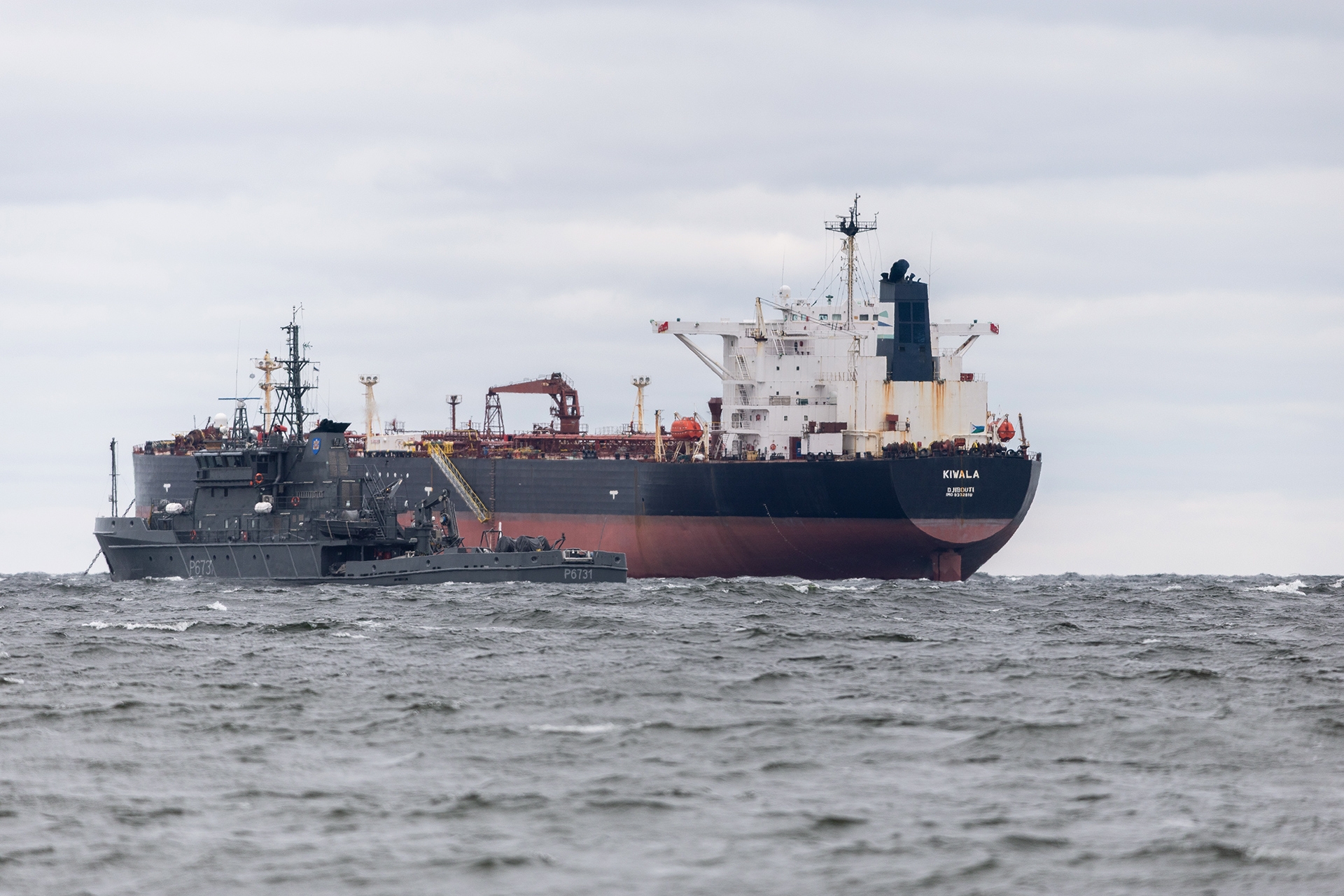
The interception of the oil tanker Kiwala by the Estonian Navy in the Gulf of Finland (Baltic Sea) on April 11, 2025 as it sailed toward the Russian port of Ust-Luga.
Another watchman, Mikhail, said that he had graduated from a leading officer training center for Russia’s Airborne Forces and spent eight years in Syria heading a personal security detail for a private military contractor. Though registered onboard a sanctioned vessel as a “technician,” his job, he said, involved “monitoring the crew, the captain, and the first mate.”
“I was finding out who was snitching, who they were working for, what information was coming from the ship to shore,” Mikhail said. “To the Indian authorities, or maybe even to NATO countries.”
The men also revealed more quotidian details about their time at sea, complaining about spicy food cooked by an Indian crew and bedbug infestations.
“When I board the ship, I'm happy with everything. The cabin is clean,” Mikhail said. “And then a week later, I find that I've started waking up covered in bites, and there are blood stains on the sheets.”
“This job, it turns into hell,” he said. “A real hell.”
A European intelligence officer, who spoke on the condition of anonymity, said the findings tally with his assessment of the watchmen’s primary task: “to keep the captain in check.”
Their role, he said, is “to ensure captains don't lose their nerve and enter the territorial waters of Western nations. If they don't enter, Western countries can't do anything.”
Michelle Bockman, a London-based maritime intelligence analyst specializing in sanctioned oil flows, noted that ships sometimes carry armed guards in areas where piracy is a threat. But the “constant” deployment of men who have worked for state-linked security companies, such as the former mercenary outfit Wagner Group, is “a really concerning blurring of military and commercial,” she said.
The Russian navy and President Vladimir Putin’s spokesman, Dmitry Peskov, did not respond to requests for comment. Given the opportunity to provide on-the-record comments to a reporter speaking openly, Andrei described any reference to his work on the shadow fleet as a “lie” and Mikhail said he had never been onboard an oil tanker.

The tanker Eventin, reported to be part of Russia’s so-called shadow fleet, seen off Sassnitz in Mecklenburg–Western Pomerania, Germany, on January 12, 2025.
From Russia to India
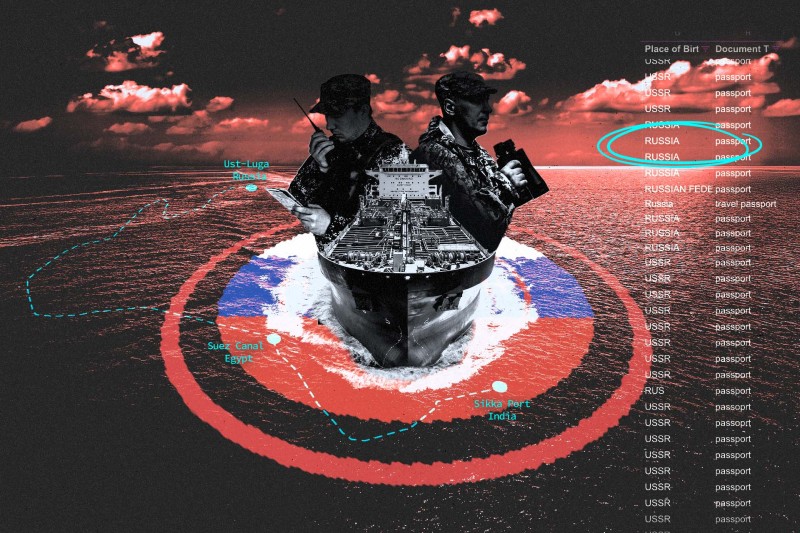
To begin this investigation, reporters from Dossier Center obtained crew lists from 757 “shadow fleet” tankers who made voyages between January 2023 and April 2026. The vessels had either been sanctioned by the United States or European Union, or flagged by Ukrainian authorities.
Among the tens of thousands of crew members listed, reporters managed to identify 83 men who appeared to fit the pattern of watchmen: They are Russians who have joined largely foreign crews, and most were listed as “supernumeraries,” “technicians,” or, in some cases, “security guards.” Unlike other sailors on the crew lists, many did not have any relevant seafaring diplomas or other qualifications next to their names.
The number of journeys these men took rose sharply in the summer of 2025, a few months after the Estonian navy detained one Russian shadow fleet tanker and nearly boarded another. The men’s presence then dropped off starting this January, a development analysts are still puzzling over.

They were most frequently deployed on one of Russia’s most commercially important oil routes: Most of their ships set sail from Russia’s Baltic Sea ports before traveling via the Mediterranean to deliver their oil to India, largely to the adjacent ports of Sikka and Vadinar in the state of Gujarat.

By looking at online recruitment platforms, dating and social media profiles, and information leaked from official Russian databases, reporters from Dossier Center learned more about the men’s professional backgrounds.
Many came from the world of private security, a significant number had military backgrounds, and roughly a quarter of the 83 were veterans of private military companies.
The latter includes Redut, a Western-sanctioned outfit that reportedly works under the Defense Ministry, and the better-known Wagner Group, which fought in conflicts around the world on Moscow’s behalf for nearly a decade.
Many of the men have served in Syria, where the Wagner Group helped Moscow prop up the Assad regime. Among them is Yuri Rzhevsky, a 52-year-old who worked last November on the Selva, a sanctioned tanker sailing under the flag of Oman. According to leaked Wagner Group files obtained by Dossier Center, Rzhevsky served in Syria as a squad leader and combat engineer under the callsign ‘Poruchik,’ a Czarist-era military rank.
Rzhevsky’s profile on VKontakte, a Russian social network, presents another side of the watchman. While some photos show him posing with modern weapons, others show him participating in historical reenactments of Russia's post-revolutionary civil war — and in one post, he displays a certificate attesting to 300 hours of yoga teacher training.
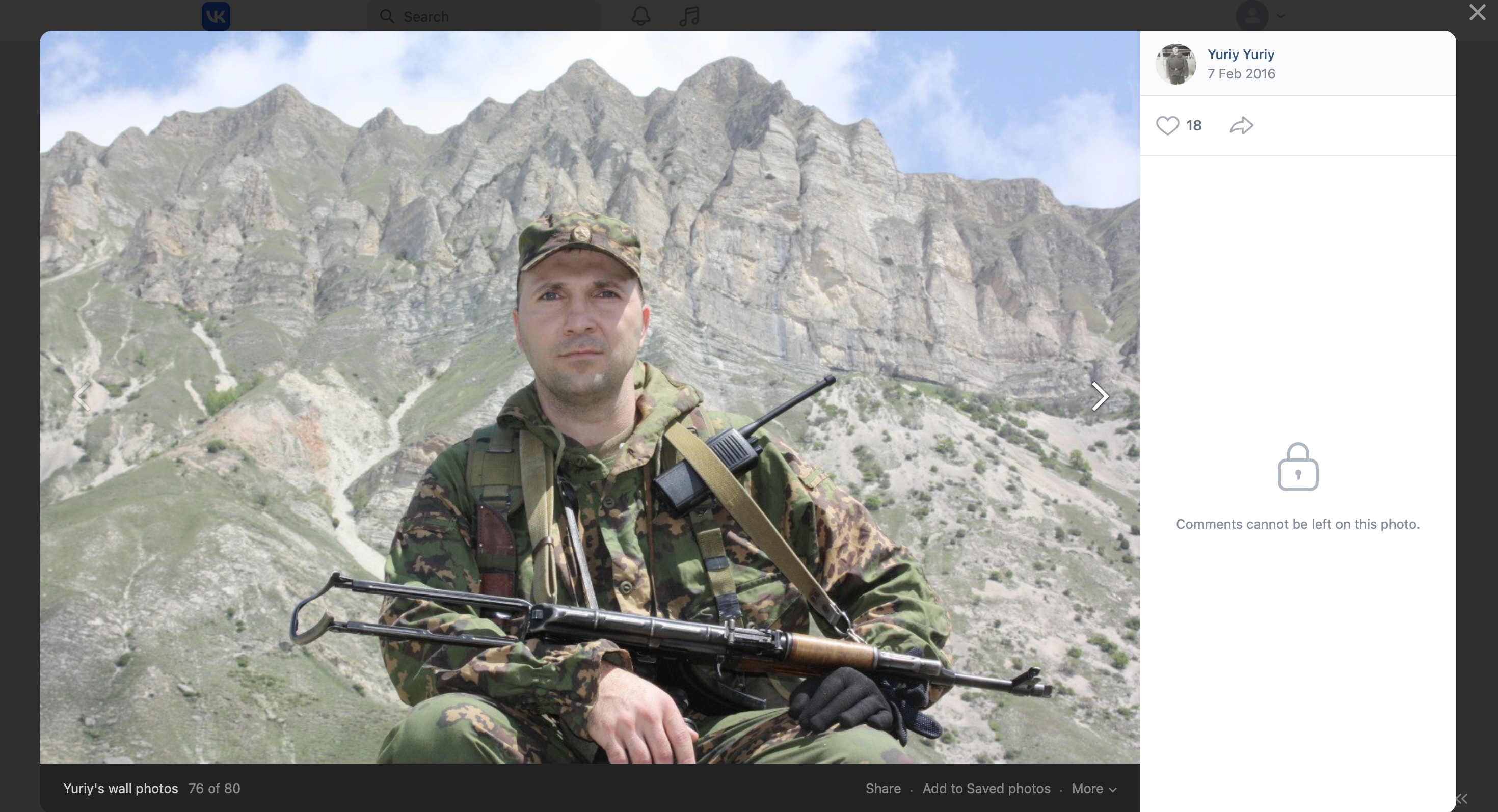
Yuri Rzhevsky posted a photo on social media platform VKontakte of himself with a gun.
Other men honed their security skills in police forces or other state agencies.
For instance, leaked records show that Evgenii Skorovarov, 45, served in a special rapid response unit of Russia’s customs service. When contacted by an undercover reporter posing as a recruit, Skorovarov denied working in maritime security. Still, his date of birth matches his entry on the crew list — and his profile picture on the Russian messaging platform Telegram appears to show him standing aboard a large ship.
Rzhevsky and Skorovarov did not respond to requests for comment sent openly by reporters.
Standard Duties and Culture Clashes
Intelligence sources have previously told OCCRP that the Russian men are deployed to deter authorities from boarding, inspecting, or potentially seizing the ships that form an economic lifeline for Moscow.
In the interviews with undercover reporters, several watchmen confirmed that this is one of their most important tasks.
“The usual standard duties,” one explained, include “monitoring the vessel's crew to ensure compliance with all protocols for countering the detention or seizure of the vessel.”
Part of the role was also to ensure the largely foreign crews manning the oil tankers acted in Russia’s best interests, the men said.
Mikhail recalled high tensions and “endless, endless requests” — though it was not clear from whom — near European countries or when passing through the English Channel on the way to India. “You have to keep an eye on all this, because some assistant captain might blurt out something inappropriate,” he said.
He also related an encounter near Denmark when his ship was boarded by two French-speaking pilots, whose role is to help captains navigate in local conditions.
“The first thing [one of them] did, he rushed at me with a question: ‘Who are you? Who are you? Why are you on the bridge?’” Mikhail recalled, referring to the ship’s command center. “I told them, I’m a radio engineer, I’m here because I’m supposed to be.”
Mikhail said he ended up leaving the bridge and standing on the deck, watching the pilots through the window for hours.
“I stood there practically the whole night,” he said. “Because I thought … there might be some kind of provocation ... I thought, even some boarding parties might come. So I wanted to be ready and to have the chance at least to communicate that we’ve been attacked.”
Reporters also spoke to several ordinary sailors who worked on shadow fleet vessels to learn about the role of the Russian men onboard.
“Lei,” who worked on a shadow fleet tanker for nine months and asked not to be identified out of fear of losing his livelihood, told a reporter from SourceMaterial, a U.K.-based investigative platform, that he first saw the Russians in mid-2025.
They proudly discussed their military backgrounds with the rest of the crew, Lei recalled, showing photos of themselves on past deployments, posing with weapons and armored vehicles. “One was the Russian officer,” Lei added. “He was in very good rank.”
Lei eventually came to believe the watchmen were not onboard simply to monitor the crew, but to act as a link between the vessel and Russia’s military. “If some forces come behind us,” he said, “they should inform their Russian Navy, so they can help our battle.”
Another seaman whose ship carried Russian guards said that when they boarded at Egypt’s Port Said, the chief officer on the vessel simply told the crew “they were coming from the owner's side.”
While it remains unclear who the watchmen report to, an analyst with the Finnish Security and Intelligence Service (SUPO) told OCCRP in March that they likely acted as “liaisons” for the Russian military. According to Ukraine’s Foreign Intelligence Service, they are typically hired for the job by Russian security companies, such as the Moran Security Group that Andrei lists on his resume as his most recent employer. The company did not respond to a request for comment.

One of Russia’s watchmen, Viktor Aleksandrov, is a former Wagner Group mercenary whose social media profile features a photo of himself, uploaded in May 2021, posing in camouflage gear in Homs, Syria.
Lei, the sailor, also shared other details from his time at sea. He said many of the crew came to resent the Russians, who were felt to eat too much food but contribute little to the operation of the vessel.
At times they were convivial, showing crew members photos of their families and girlfriends. Still, Lei said he felt they did not “deserve” to be on board. “We all don't like them, because they only stay there like they are coming on the holidays, enjoying a picnic.”
The watchmen had their own complaints. During a conversation with an undercover reporter, Mikhail said he repeatedly asked the ship’s Indian cook to prepare meals “the European way” because “it was impossible to eat” the spicy food they served.
Even basic internet access became a point of frustration, Mikhail said, with data allowances sometimes limiting them to just enough internet for their handful of daily reports back to shore.
Despite their combat-related backgrounds, two of the watchmen who spoke to reporters insisted they were unarmed while onboard. But they did recount facing some “emergencies” at sea, including drone attacks from Ukraine, which has targeted several vessels over the past year.
“We caught one of these attacks”, said Andrei, “attacks by scoundrels.”
The details of his story match the attack on the Qendil, an Oman-flagged vessel that had delivered an oil shipment to Port Sikka in India and was crossing the Mediterranean on its way back to Russia when it was struck in December 2025.
Grainy targeting footage released by the Security Service of Ukraine appears to show explosives peppering the ship’s deck, each one erupting into a bright white fireball on impact.
Andrei described the crippled ship’s subsequent journey as an “ordeal.”
“We went for repairs,” he said. “And while we were waiting for this repair, near the Turkish shore, our anchor was torn off — we got slammed against the shore. We were thrown aground there for one-and-a-half, two weeks. Those were the consequences of the attack, you could say … We shouldn’t have ended up there, but we did.”

Ukrainian news media reporting on the attack on the vessel Qendil in December 2025.
The Qendil was not the first shadow fleet tanker to come under attack, but Ukraine’s audacious long-range strike, which took place some 2,000 kilometers from its borders, marked the expansion of its drone campaign from the Black Sea into the Mediterranean.
Immediately after the strike, the number of watchmen appearing in reporters’ data plummeted. Experts are still unsure why.
One Western intelligence source said that the cost of placing the guards may have become too high in light of plummeting oil revenues.
An officer from another country echoed this idea: “It's cheaper not to deploy them because everyone [in the West] is talking about them being on board anyway.”
With additional reporting by Misha Gagarin.